Index
Brand growth in the age of AI search doesn’t come from vague, category-wide awareness anymore. It comes down to how often, and on what evidence, a brand gets called up inside the specific time, place, emotion, and constraint a consumer is actually dealing with. This guide organizes that process (finding these buying situations, or CEPs; turning them into real brand assets; and managing them as a repeatable, measurable system) into 13 strategy articles.
The guide follows four stages: finding and owning a CEP → building a measurable system → reinforcing the evidence AI can trust → shifting from campaigns to an ongoing operating system. Jump straight to whatever topic interests you from the roadmap below, or read the whole thing in order.
What Is GEO?
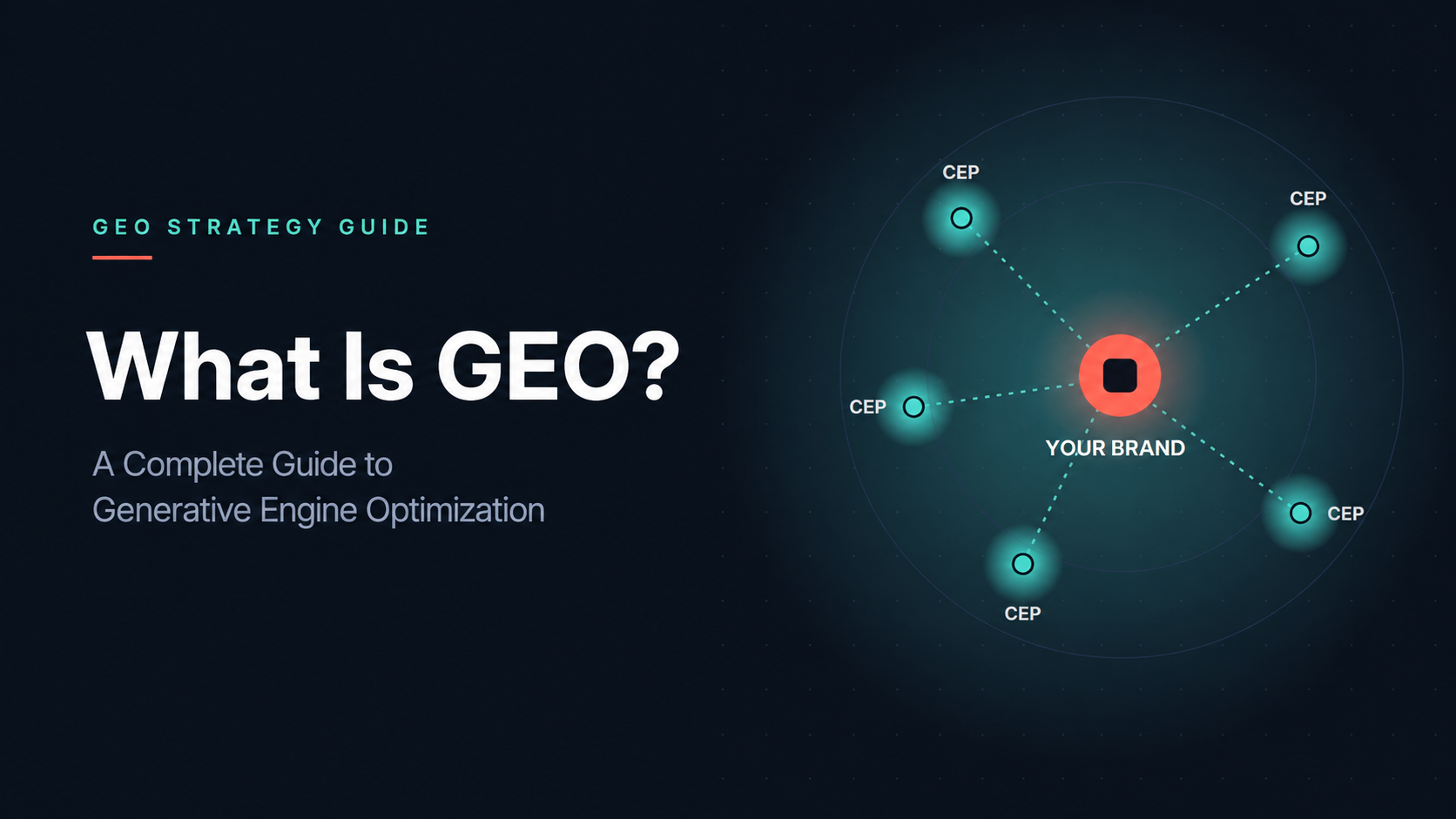
GEO (Generative Engine Optimization) is the set of strategies that get a brand mentioned and recommended as a trustworthy candidate when generative AI (ChatGPT, Perplexity, Google AI Overviews) answers a user’s question.
In the traditional search environment, consumers scanned a list of search results themselves, compared several pages, and made a choice. Generative AI compresses that process. It interprets the user’s question, narrows down candidates, and presents an answer up front. Instead of the consumer doing the comparing and exploring, AI now does most of that work on their behalf.
In this shift, a brand’s job isn’t simply getting more exposure. It’s building the evidence, ahead of time, that lets AI call up your brand as the answer when it interprets a specific consumer situation. That’s the core problem GEO addresses. And every concept in this guide (CEP, mental availability, entity gap, Brand Ops) is a tool for solving it.
How SEO, AEO, and GEO Differ
All three deal with “getting found,” but they differ in how discovery happens and what gets measured.
| SEO (Search Engine Optimization) | AEO (Answer Engine Optimization) | GEO (Generative Engine Optimization) | |
|---|---|---|---|
| Goal | Rank high on the search results page (SERP) | Get selected as the direct answer in voice search or instant-answer snippets | Get mentioned and recommended as a trustworthy candidate inside a generative AI answer |
| Optimizes | Keywords, backlinks, page structure, load speed | Clear question-and-answer structure, schema markup | Consistent entity signal across multiple sources, trust evidence, content citability |
| User behavior | Scans a results list, clicks and compares | Types a question, expects a direct answer | Describes a situation to AI, receives a recommendation |
| Metrics | Search ranking, click-through rate (CTR), traffic | Snippet ownership rate, voice-answer selection rate | Brand mention rate in AI answers, content citation, accuracy of the stated reasoning |
| Core work | Keyword research, on-page optimization, link building | Structured data, FAQ-format content | Aligning signal across owned and earned media, running management prompts |
These three aren’t mutually exclusive. The page structure and content SEO builds becomes GEO’s foundation, and the clear question-and-answer structure AEO focuses on matters just as much for GEO. What’s different is that GEO cares less about one page’s ranking, and more about whether brand signal scattered across many sources all points the same direction. Parts 2 and 3 of this guide cover how to measure and reinforce that signal.
Why GEO, Why Now
Consumer search behavior itself has changed. People used to search short keywords like “sunscreen recommendations.” Now they describe their situation and conditions in full sentences, like “recommend a gentle sunscreen for acne-prone skin that won’t feel heavy before makeup.” This shift connects directly to the move from search queries to prompts covered in Part 12.
In an environment where AI narrows the field and presents an answer up front, brands also get fewer chances to persuade a consumer directly. In the past, a brand could make its case repeatedly: through an ad, a search result, a landing page, a review. Inside an AI-compressed answer, there’s a lot less room for that. Which means the connection between a brand and a specific consumer situation has to already exist before the question even gets asked.
That means how brands operate has to change too: moving from campaign-centered operating, which pushes out a message for a set period and then stops, to an operating system that continuously watches consumer questions and AI answers, and reinforces signal on an ongoing basis. Part 4 of this guide covers that operating system under the concept of Brand Ops.
The Full Roadmap
| Stage | Core question | Related strategies |
|---|---|---|
| Part 1. Discovery & Ownership | In what situation should our brand come to mind? | Strategies 1–3 |
| Part 2. Measurement | Is our brand actually getting called up in that situation? | Strategies 4–7, 13 |
| Part 3. Reinforcing Evidence | Is there enough evidence AI can trust and cite? | Strategies 8–9 |
| Part 4. Operations | How do we turn all of this into a repeatable system? | Strategies 10–12 |
Part 1: Finding and Owning a CEP
[Strategy 01] What everyday moment (CEP) should our brand focus on?
Look at what surrounds a search term like “late-night snack,” and people aren’t just searching that: they’re searching more specific conditions alongside it, like “healthy late-night snacks” (roughly double the search volume of the plain term in the US) or “quick and easy late-night snacks.” It’s easy for a marketer to feel satisfied just spotting that insight, but the real problem starts after. For a brand to actually come to mind in that moment, get found in search, and get called up inside an AI answer, discovery alone isn’t enough. Finding a CEP coordinate and turning that coordinate into your brand’s actual position are two completely different things.
A CEP isn’t just a list of search terms. It’s the situation where a consumer needs a category within a specific time, place, emotion, and constraint: the semantic coordinate a brand needs to own. Discovering a coordinate and turning that coordinate into a brand asset are different problems, and only repeated connection, stacked up over time, makes that coordinate actually yours.
→ Read: Finding a CEP Isn’t Enough, You Have to Own It
[Strategy 02] Why do certain brands come to mind, and not others, at the moment of choice?
When people make a buying decision, they don’t recall every brand they know and compare them one by one. Instead, the moment a specific situation opens up, one or two brands tied to that situation come to mind on their own. There’s a brand that comes to mind for a light bite late at night, and a separate one for a quick snack on the commute home. The same person recalls different brands depending on the situation. That’s why a brand can have strong category-wide awareness and still fail to come to mind in a specific buying moment, while another brand with modest overall awareness comes to mind almost instantly in one particular situation.
Brand awareness, mental availability, and brand salience are three different concepts. A strong brand isn’t simply a well-known one: it’s a brand that comes to mind easily across many CEPs, and comes to mind first in the ones that matter most.
→ Read: Why Only a Few Brands Come to Mind at the Moment of Choice
[Strategy 03] What is a distinctive brand asset?
When a brand tries to enter several closely related scenes at once (“healthy late-night snack,” “quick late-night snack,” “low-calorie late-night snack”) and shows up looking different every time, people stop experiencing it as one coherent brand. Without cues like color, logo, mascot, tone of voice, or packaging that make people recognize a brand instantly, without even reading the name, expanding into more CEPs actually scatters recognition instead of building it.
The more a brand expands across CEPs, the more it risks not being recognized as one brand if it shows up differently each time. Distinctive brand assets like color, logo, tone, and packaging bind experiences scattered across many scenes into a single brand memory. And in the AI era, they need to repeat inside text and data, not just visuals.
→ Read: Distinctive Brand Assets: The Memory Cue Behind CEP Ownership
Part 2: Making GEO Measurable
[Strategy 04] How do you turn a CEP into a repeatable, measurable question?
Deciding on a priority CEP doesn’t automatically start real operations. The next step is turning that CEP into a repeatable, measurable question, a management prompt. Too broad a question fails to reflect the real consumer situation; too narrow, and it’s hard to use as an ongoing metric. So instead of building a keyword list, you need to design natural question sentences a real user would actually ask AI.
Turning a chosen CEP into an operating management prompt takes six steps: collecting candidate questions, identifying detailed context, connecting core buying factors to trust evidence, building the actual prompt set, pre-checking needed signal, and balancing branded and non-branded prompts (roughly 70/30 to start).
→ Read: Turning a Consumer Situation Into a Management Prompt
[Strategy 05] What should brands measure in the AI era?
Brand management in the AI era has to be judged against specific buying situations, not vague, brand-wide awareness. Only two questions really matter: Is the CEP we’ve chosen actually alive in the real market? And does AI call up our brand as a candidate inside that CEP? High search volume alone doesn’t mean a market is real. What matters more is whether that situation is actually functioning as a genuine concern and selection criterion for real users.
CEP demand shows how alive a specific buying situation is in the real market. AI citation signal shows how accurately AI calls up your brand inside that situation. Crossing the two lets you sort CEPs into a core competitive zone, a priority opportunity zone, a niche strength zone, and an untapped zone, and set your operating priorities accordingly.
→ Read: What to Measure: CEP Demand and AI Citation Signal
[Strategy 06] How do you find out why AI recommends your brand?
Once you’ve built management prompts, the next step is checking how AI actually responds. What matters isn’t just whether your brand “showed up or not.” You need to see which CEPs it appears in and which it’s missing from, and if it appears, what reasoning and evidence back the recommendation: that’s what tells you whether to reinforce product pages, reviews, or expert evaluations. Most brands stop at a simple yes/no check, but an AI answer actually carries layers: the answer frame, the brand mention, and the content citation.
An AI answer isn’t a simple recommendation list: it’s built from three layers: the answer frame, the brand mention, and the content citation. Reading brand mention and owned-content citation together is what lets you diagnose whether your brand is recommended with weak external evidence, or whether your content gets cited while the brand-level connection stays weak.
→ Read: How to Read an AI Answer: A Framework for AI Response Analysis
[Strategy 07] What if AI describes your brand differently than you intended?
The goal of AI response analysis isn’t just confirming whether a brand shows up in an answer. Measuring appearance, rank, cited sources, and sentiment tells you the current state, but the measurement alone doesn’t tell you why. A drop in brand mentions doesn’t always mean the same problem. Sometimes AI has filed your brand under the wrong category; sometimes a core attribute isn’t showing up clearly; sometimes there just isn’t enough trust signal.
The entity gap is the difference between how a brand intends to be perceived and how AI actually constructs that brand in its answers. It splits into five types: category gap, attribute gap, relationship gap, CEP gap, and trust gap. Each has a different cause and a different fix, so identifying which type of gap you’re facing, not just noting a low score, is where correction starts.
→ Read: The Entity Gap: Where Intended and AI Perception Diverge
[Strategy 13] How do you read the real situation hiding behind a search query?
The most common mistake in working with search data is treating a query as a customer’s “intent” outright. It’s true that someone searching “sunscreen recommendations” is looking for sunscreen information, but that’s not the whole story. Follow the same query’s real search paths, and it branches toward dermatologist-recommended sunscreen, sunscreen for sensitive skin, and oily-skin sunscreen, each starting from a different concern. Intent isn’t a simple desire compressible into a few words. It’s closer to one scene formed where time, place, constraint, and emotion overlap.
A search query isn’t intent itself. It’s the doorway into intent. The same query “sunscreen recommendations” opens from different scenes: skin irritation, makeup compatibility, time of use. Reconstructing that scene is what makes clear exactly what signal a brand needs to reinforce.
→ Read: How to Read Consumer Context From Search Data
Part 3: Building Evidence AI Can Trust
[Strategy 08] What role should owned media play in the AI search era?
Getting AI to understand your brand as the answer to a specific consumer situation starts with organizing the information a brand directly controls. That starting point is owned media. Traditionally, owned media focused mainly on persuading consumers. But a lot of brands’ product detail pages are still filled with generic phrases like “outstanding performance” and “premium quality,” leaving AI without enough basis to understand why a product actually fits a specific situation.
In an AI search environment, owned media is both a space for persuasion and the reference library AI consults to understand a brand. Product pages and content need to be rebuilt around real answers to “who is this a good fit for, and in what situation, and why,” not advertising copy.
→ Read: An Owned-Media Strategy Built for GEO, Not Just Ads
[Strategy 09] How do you get AI to actually trust your brand’s claims?
If owned media provides the baseline claims, earned media shows whether those claims actually get confirmed outside the brand’s control. A brand can say “great for sensitive skin” or “highly credible” on its own, but AI checks whether that claim shows up the same way in real user reviews and expert evaluations. The biggest difference from owned media is control: reviews are written by consumers, evaluations by experts, so a brand can’t directly manufacture the conclusion.
A brand’s own claims alone aren’t strong evidence for AI. Earned media (user reviews, expert evaluations, news coverage) is where a brand can’t control the conclusion, but it can strengthen the signal by designing the experience conditions that let consumers verify things for themselves.
→ Read: Building Reason-to-Believe Into Your Earned Media Strategy
Part 4: From Campaigns to an Operating System
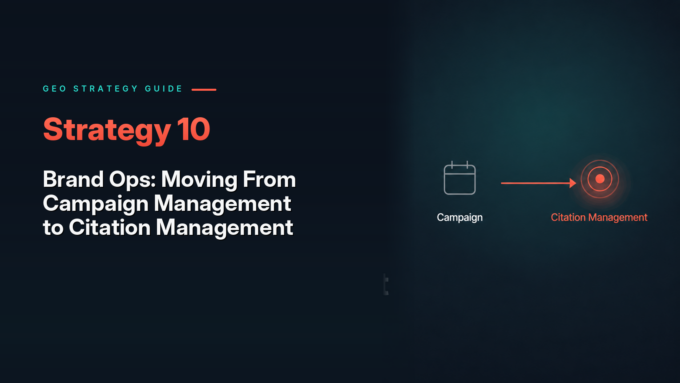
[Strategy 10] Why move past campaigns into citation management?
For a long time, most brand organizations have run on campaigns. Build a campaign around a new product launch, write new messaging when a season arrives, run ads once budget is approved: this way of working is easy to explain internally because the timeline and reporting are clear. But a campaign runs on a company’s calendar, while consumer questions and AI’s answers run continuously, with no fixed period. A campaign report shows what you said. It doesn’t show how AI and consumers actually understand your brand as the answer to a situation.
A campaign runs on a company’s calendar; a consumer’s question and AI’s answer never stop. Brand Ops is an operating method that repeats diagnosis, reinforcement, measurement, and learning around a CEP, and it’s also the work of aligning signal scattered across different departments under a single CEP.
→ Read: Brand Ops: Moving From Campaign Management to Citation Management
[Strategy 11] How does a small team start a GEO strategy?
GEO work is fundamentally hard to contain inside one team. The signal a brand needs to get selected by AI is scattered across messaging, content, product information, reviews, PR, customer support, and commerce data. A team just starting GEO often feels the pull to reorganize immediately. But when a small team with limited authority tries to change how multiple departments work all at once, meetings and coordination costs balloon while the signal barely improves. The real question isn’t “how do we redesign the whole organization?” It’s “where do we start?”
Trying to redesign the whole organization from day one makes execution heavy and results invisible. Picking one CEP that has real market size, connects to your brand, and is repeatably measurable, and starting with a small pilot, is the most realistic place to begin.
→ Read: GEO for Small Teams: Start With One CEP
[Strategy 12] Why doesn’t a Top of Mind strategy fit the AI search era anymore?
For a long time, the search query was the most important clue to consumer intent. A short query like “protein bar recommendations” or “family hotels in Orlando” always left something out. Why someone was looking for that product, what situation they’d use it in, what they wanted to avoid: most of that context got compressed away. But now, a consumer can describe their full situation directly, in a sentence like “a four-night Orlando trip with my four-year-old and my parents, needs a pool, within 30 minutes of the airport, breakfast included.”
Consumers no longer compress their situation into a short query: they describe it directly in a long prompt combining time, place, and conditions. That’s shifting the battleground of brand competition from being the first thing that comes to mind across an entire category (Top of Mind) to being the first thing called up inside a specific situation (Top of CEP).
→ Read: From Search Query to Prompt
Key GEO Terms
Terms that repeat throughout this series. Each one gets covered inside its own strategy article too, but it may help to have them defined up front.
CEP (Category Entry Point): The specific situation, combining time, place, emotion, and constraint, where a consumer comes to need a particular product category. The semantic coordinate a brand needs to own.
Mental Availability: The state of a consumer being able to easily recall a brand and consider it a candidate, inside a specific buying situation.
Brand Salience: The state of a brand coming to mind faster and more strongly than competitors, inside that same situation.
Distinctive Brand Assets: Cues (color, logo, tone of voice, packaging) that let a consumer instantly recognize a brand without even reading its name.
Management Prompt: A representative question a brand regularly asks AI to check how it’s read inside a specific CEP.
CEP Demand: A metric showing how often and how clearly a specific buying situation shows up in real consumers’ lives.
AI Citation Signal: A metric showing how often, and on what evidence, a brand shows up in AI’s answer when a management prompt is asked.
Entity Gap: The difference between how a brand intends to be perceived and how AI actually constructs that brand. Splits into five types: category gap, attribute gap, relationship gap, CEP gap, and trust gap.
Owned Media: Channels a brand directly manages message and content on: official site, product pages, FAQ, and similar.
Earned Media: Outside channels a brand can’t control the conclusion of (reviews, expert evaluations, news coverage) that AI references to verify a brand’s claims.
Brand Ops: An operating system that continuously diagnoses, reinforces, measures, and learns, anchored in consumer buying context and how AI structures its answers, instead of managing a brand through one-off campaigns.
Top of Mind / Top of CEP: The difference between being the first brand that comes to mind across an entire category, and being the first brand that comes to mind inside a specific, concrete buying scene.
FAQ
It’s the specific situation, combining time, place, emotion, and constraint, where a consumer comes to need a particular product category. It isn’t a simple keyword; it’s the growth coordinate a brand needs to own inside human memory and AI’s semantic space.
Brand awareness is a consumer knowing your brand’s name and that it exists. Mental availability is being able to easily recall that brand and consider it as a candidate inside a specific buying situation. Brand salience is coming to mind faster and more strongly than competitors in that same situation. See [Strategy 02] for more detail.
CEP demand is a metric showing how alive a specific buying situation is as a real signal in the market. AI citation signal is a metric showing how clearly AI calls up your brand as evidence-backed when that situation gets turned into a prompt. See [Strategy 05] for more detail.
An entity gap is the difference between how a brand intends to be perceived and how AI actually constructs that perception. It splits into five types: category gap, attribute gap, relationship gap, CEP gap, and trust gap, and the right response differs by type. See [Strategy 07] for more detail.
Early in a program, roughly 70% non-branded and 30% branded prompts is a reasonable starting split. Non-branded prompts show whether your brand makes the candidate set at all; branded prompts show how AI explains your brand once it’s there.
Rather than trying to redesign the whole organization at once, the realistic starting point is picking one CEP: one with real market size, a genuine connection to your brand, and repeatable measurability, and running it as a small pilot.