Index
GEO Strategy Series, Part 13 of 13.
Catch up on Part 1, Part 2 ,Part 3, Part4, Part 5, Part 6, Part 7, Part 8, Part 9, Part 10, Part 11 and Part 12.Key takeaways
- A search query isn’t intent itself. It’s the doorway into intent. The same keyword can hide several distinct underlying scenes.
- Real US search-path data confirms this: “sunscreen recommendations” branches into dermatologist-recommended, sensitive-skin, oily-skin, and acne-prone-skin paths, each a different consumer concern.
- Brands compete inside the scene behind a keyword, not the keyword itself, and reconstructing that scene is what reveals which evidence a brand actually needs to build.
The most common mistake in working with search data is treating a query as intent itself. See the search term “sunscreen recommendations,” and it’s tempting to conclude that people are simply searching because they want a sunscreen recommended to them.
That’s not wrong, exactly. Someone who searches “sunscreen recommendations” is genuinely looking for information to help them choose one. But that’s not the whole story. A real consumer decision is never as simple as a single keyword suggests. The words typed into a search box are short. The life context behind them is far more complicated.
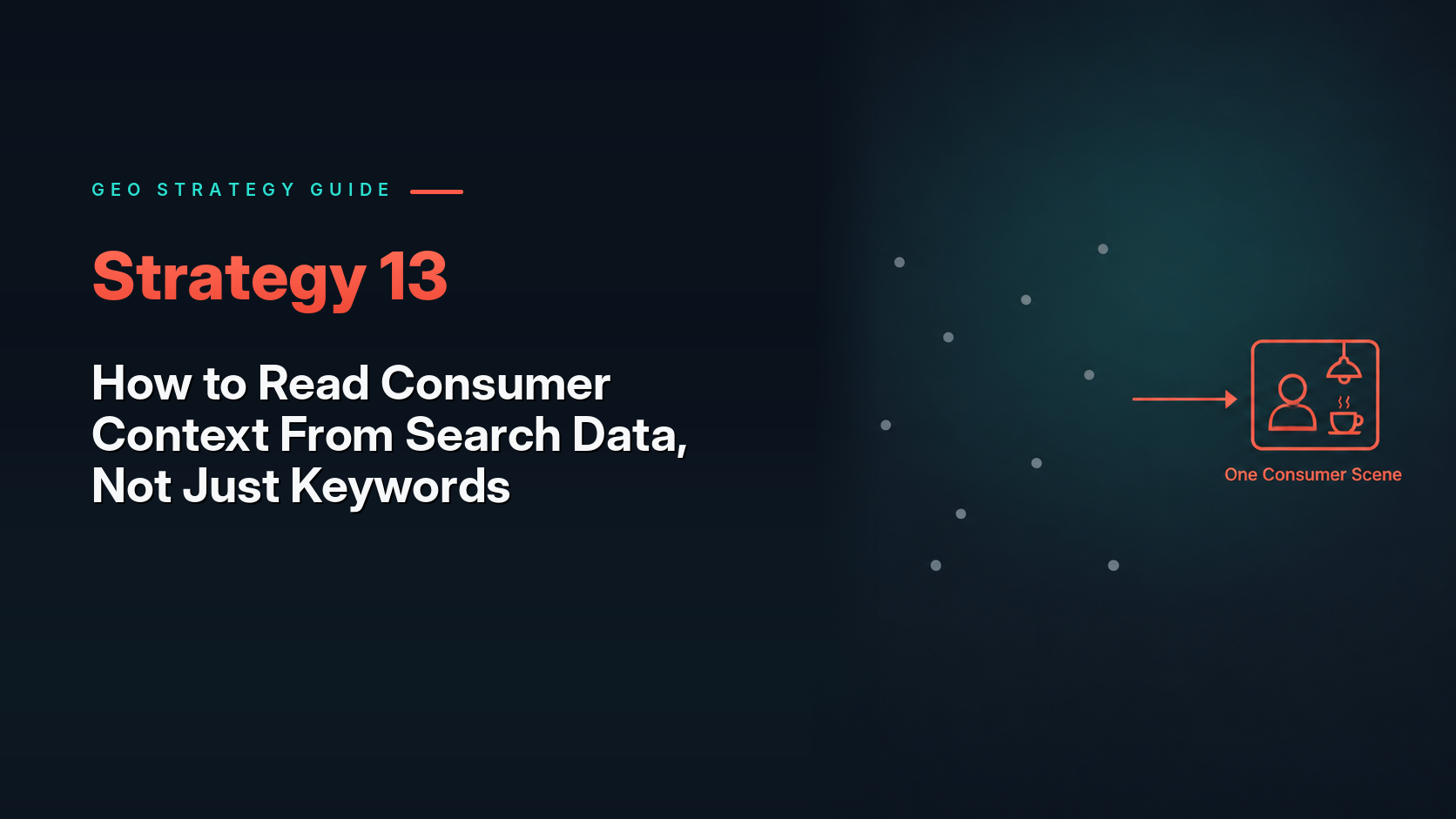
Intent isn’t a simple desire expressible in a few words. It’s closer to one scene formed where time, place, constraint, emotion, situation, and purpose all overlap. Reading search data properly means not just looking at the query itself, but reconstructing the scene hiding behind it.
What Real Search-Path Data Actually Shows
Real search-path data makes this obvious. “Sunscreen recommendations” doesn’t point to one single intent. Looking at real US search behavior, that query branches out in several distinct directions: toward “dermatologist recommended sunscreen,” toward “sunscreen for sensitive skin,” toward “sunscreen for oily skin” and “sunscreen for acne-prone skin,” and toward “best sunscreen for everyday use,” split separately by face and body. (Source: ListeningMind, US search-path data, retrieved August 20, 2026.)
These all look like the same search for sunscreen on the surface, but the actual concern driving each person is different. Someone is worried about skin irritation and wants a dermatologist’s stamp of approval. Someone else is managing oily or acne-prone skin. A third person is drawing a distinction between what they’ll use on their face versus their body. Lump all of these under the single keyword “sunscreen recommendations,” and you lose track of buying scenes that started from entirely different reasons.
The same thing happens in other categories. On the surface, “protein bar recommendations” looks like a simple product-recommendation request. But look at the actual paths people take, and the search splits toward “energy bar recommendations,” “meal-replacement bar recommendations,” “protein snacks,” and toward specific brand reviews or price comparisons.
One person is thinking about post-workout protein. Another is looking for something to get through an afternoon after skipping lunch. A third wants a snack that feels less guilty than a bag of chips. On the surface, everyone’s searching for a protein bar. In practice, the category door is opening from three entirely different scenes: exercise, a missed meal, and snacking.
This difference shows up even more clearly in lifestyle-context queries. “Things to do with kids” looks simple on the surface. But real search paths branch it out into “things to do with elementary schoolers,” “indoor things to do with kids,” “things to do with kids this weekend,” and city- or region-specific variants.
What matters here isn’t just that the query got longer. It’s that conditions like the child’s age, location, indoor versus outdoor, and weekday versus weekend reveal the consumer’s actual situation. Intent, in the end, isn’t the simple desire “I need somewhere to take my kid.” It’s a much more specific scene: “I need an indoor place where my elementary-school-age kid can spend a few hours this weekend.”
Seen this way, a keyword is just the doorway. The real decision happens in the scene just inside it. A consumer types only a few words into a search box, but those words are always a compressed version of a much bigger scene. Inside “mineral sunscreen no white cast” sits a physical state someone is trying to avoid irritation from. Inside “meal-replacement energy bar recommendations” sits a busy schedule and the anxiety of a missed meal. The query is short. The intent behind it never is.
Where Brands Actually Compete
This matters because this is exactly where real competition between brands happens. Brands don’t compete over a category word. They compete inside the scene where that product is actually needed. Even within the same category, who you’re competing against, and what opportunity exists, changes depending on which scene you’re looking through.
Take sunscreen as an example. The brands competing in the scene “sweat-resistant sunscreen for outdoor exercise” can be completely different from the brands competing in “sunscreen that won’t pill under makeup.” In “a gentle sunscreen safe to use every day even on sensitive skin,” irritation testing and ingredient stability become the deciding evidence. In “a sunscreen I can apply in three minutes before heading out the door,” texture, absorption, and white cast become what matters most.
Same sunscreen, different scene, different selection criteria. Different selection criteria, different evidence a brand needs to provide. And that changes the actual competitive landscape a brand is operating in. This is exactly why search data needs to be read as scenes, not keywords.
Reconstruct the Scene, Not Just the Volume
What matters when reading search data isn’t just finding high-volume terms. What matters more is reconstructing the scene compressed inside that term. See “sunscreen recommendations,” and instead of jumping straight to a product comparison chart, ask why this person needed a recommendation in the first place. See “protein bar recommendations,” and instead of jumping straight to a bestseller list, ask what situation is actually driving this person to look for one.
Only then does intent start reading as a scene instead of a word.
Reconstructing the scene matters for another reason too: search queries carry the language of life more clearly than the language of product categories. People don’t start out searching “[our brand name] + [product name].” They search in the language of whatever condition would actually solve their problem. Phrases like “sunscreen for oily skin,” “sunscreen that stays on well with makeup,” “protein bar to replace lunch,” or “indoor things to do with kids” aren’t product-taxonomy language. They’re the language of a consumer’s actual life.
To understand a consumer, a brand needs to think less about how it defines its product, and more about which scene a consumer is standing in when they open the door to that category. Consumers don’t think in the category system a brand built. They search based on the situation they’re in, the problem they need to solve, the discomfort they want to avoid, and the outcome they’re hoping for.
Intent analysis, in the end, isn’t a job of sorting keywords into buckets. It’s the job of reading the scene hidden behind a search term, understanding the conditions under which that scene opens up, and figuring out what position a brand can actually hold inside it.
The keyword is the surface. The scene is the structure. And growth opportunity almost always lives in the structure, not the surface.
What Changes Once You Read Queries as Scenes
Once you start reading search terms as scenes, what a brand needs to do changes too. Instead of simply building content around high-volume keywords, you need to understand what conditions matter to a consumer inside a specific scene, what anxiety they’re trying to resolve, and what language they use to ask about it. Then you need to organize the reasons your brand is the answer in that scene: inside your product information, content, reviews, FAQ, product pages, and outside trust signals.
Take the query “sunscreen that stays on well under makeup.” Treat it as a plain beauty keyword, and your content easily ends up as something generic like “Top 10 Sunscreens That Won’t Move Under Makeup.” But read it as a scene, and it changes. Behind this query is a consumer who needs to apply sunscreen before doing their makeup in the morning. This person isn’t just checking SPF protection: they’re also worried about absorption, oiliness, white cast, pilling, how it works with foundation, and whether it’ll break down over the course of the day. The information a brand needs to provide shifts too: less about a raw SPF number, more about detailed explanations and reviews covering exactly how it feels under makeup, application order, and formula texture.
The same applies to “meal-replacement energy bar recommendations.” Treat it as a plain energy-bar keyword, and you end up comparing protein content, calories, and flavor. Read it as a scene, and you see someone stuck in a busy schedule who’s skipped a meal. What matters to this person is fullness, portability, price, ease of eating, whether it upsets their stomach, and whether it’s not too sweet. A brand needs to answer the actual scene’s question: can this genuinely replace a meal on a busy afternoon? It’s not enough to just state a protein number.
Read this way, a search term reveals a consumer’s actual selection criteria, and shows a brand exactly what signal it needs to reinforce. What to explain, which reviews to gather, what detail information to structure, which FAQs to build: all of it becomes far more concrete.
This perspective matters even more as AI search and generative answers spread. AI doesn’t treat a user’s prompt as a single keyword either. It interprets the time, place, constraint, emotion, budget, and purpose a person states, together, and recommends brands and products that fit those conditions. In the AI era, a brand that understands the scene behind a search term is far more likely to actually get called up.
The question a brand should be asking when working with search data isn’t simply “how much volume does this keyword get.” It’s: What scene does this keyword come from? What is the consumer worried about inside that scene? What conditions have to be met to get chosen in that scene? Does our brand have enough evidence that we meet those conditions?
Answer these, and search data stops being a plain list of keywords. It starts working like a map of brand growth. And that map shows exactly which consumer scenes a brand hasn’t connected to yet: in other words, where the next growth opportunity actually is.
A search query isn’t intent itself. It’s the doorway into intent. Just inside that doorway sits a scene woven from a consumer’s time, place, discomfort, emotion, constraint, and purpose. That scene is what a brand actually needs to be looking at.
Reading search data properly isn’t about collecting more keywords. It’s about reconstructing the consumer’s scene behind those keywords more accurately: and finding what answer your brand can be, inside that scene.
FAQ
A short query is a compressed version of a much more complex real-life situation. The same query can hide several genuinely different underlying concerns: real search-path data shows a term like “sunscreen recommendations” branching toward dermatologist-recommended, sensitive-skin, and oily-skin paths, each starting from a different worry.
Instead of jumping straight to volume or a bestseller list, ask why someone needed that search in the first place: what situation, discomfort, or goal is driving it. Real search paths and sub-keyword variations are the clues that reveal the scene.
AI doesn’t treat a prompt as a single keyword either: it interprets the time, place, constraint, and purpose stated together. A brand that understands the scene behind a search term is far more likely to actually get called up in an AI answer.
Continue the series:
- Find Your Best CEP, Then Link It to Your Brand
- Why Only a Few Brands Come to Mind at the Moment of Choice
- Distinctive Brand Assets: The Memory Cue Behind CEP Ownership
- Turning a Consumer Situation Into a Management Prompt
- What to Measure: CEP Demand and AI Citation Signal
- How to Read an AI Answer: A Framework for AI Response Analysis
- The Entity Gap: Where Intended and AI Perception Diverge
- An Owned-Media Strategy Built for GEO, Not Just Ads
- Building Reason-to-Believe Into Your Earned Media Strategy
- Brand Ops: Moving From Campaign Management to Citation Management
- GEO for Small Teams: Start With One CEP
- From Search Query to Prompt: Why Top of Mind Isn’t Enough
- How to Read Consumer Context From Search Data, Not Just Keywords (this article)