Index
GEO Strategy Series, Part 5 of 13.
Catch up on Part 1, Part 2 ,Part 3 and Part4.
Key takeaways
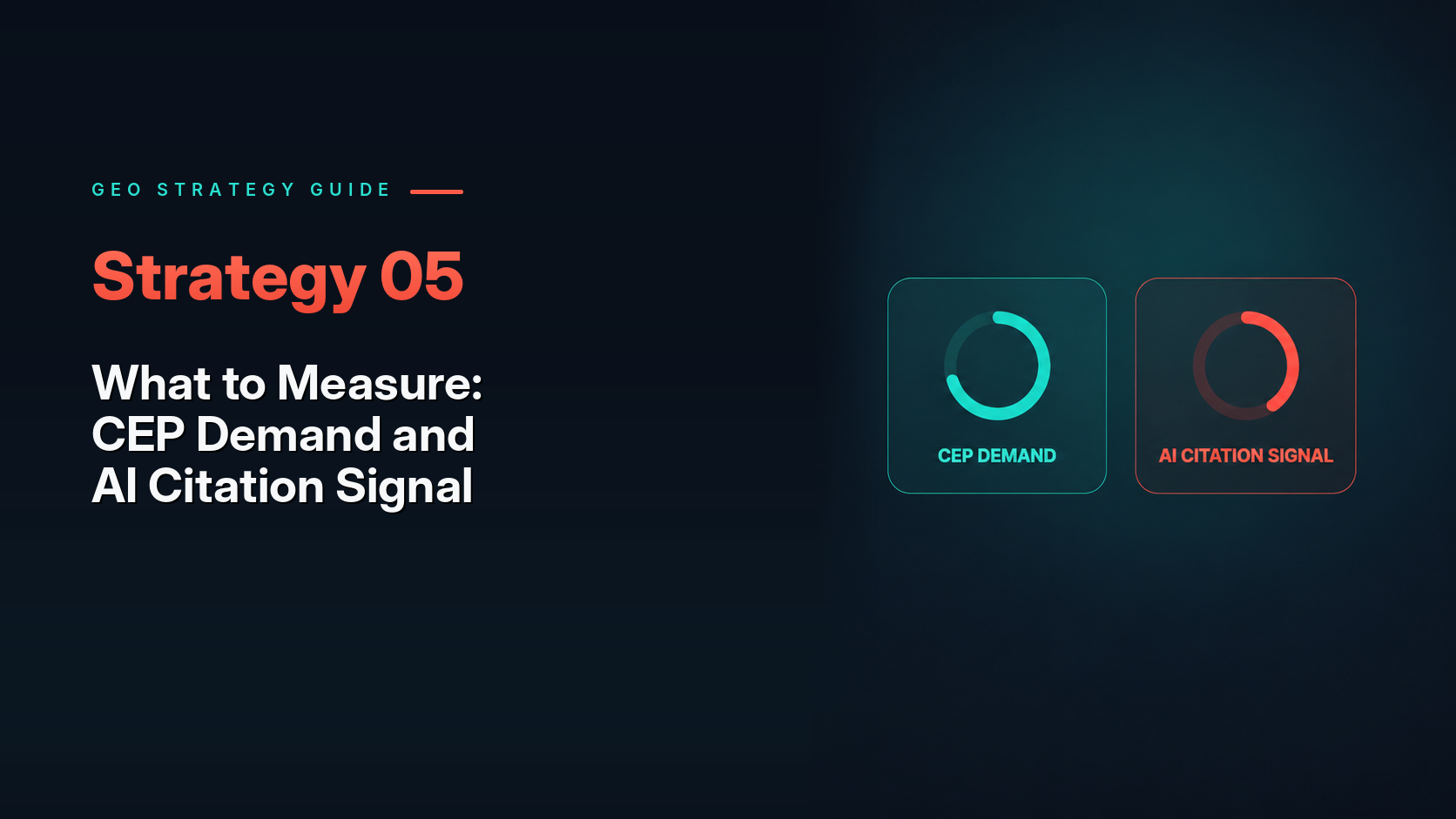
- Two numbers decide where to focus: CEP demand (how alive a buying situation is in the real market) and AI citation signal (how often AI calls up your brand as evidence-backed inside it).
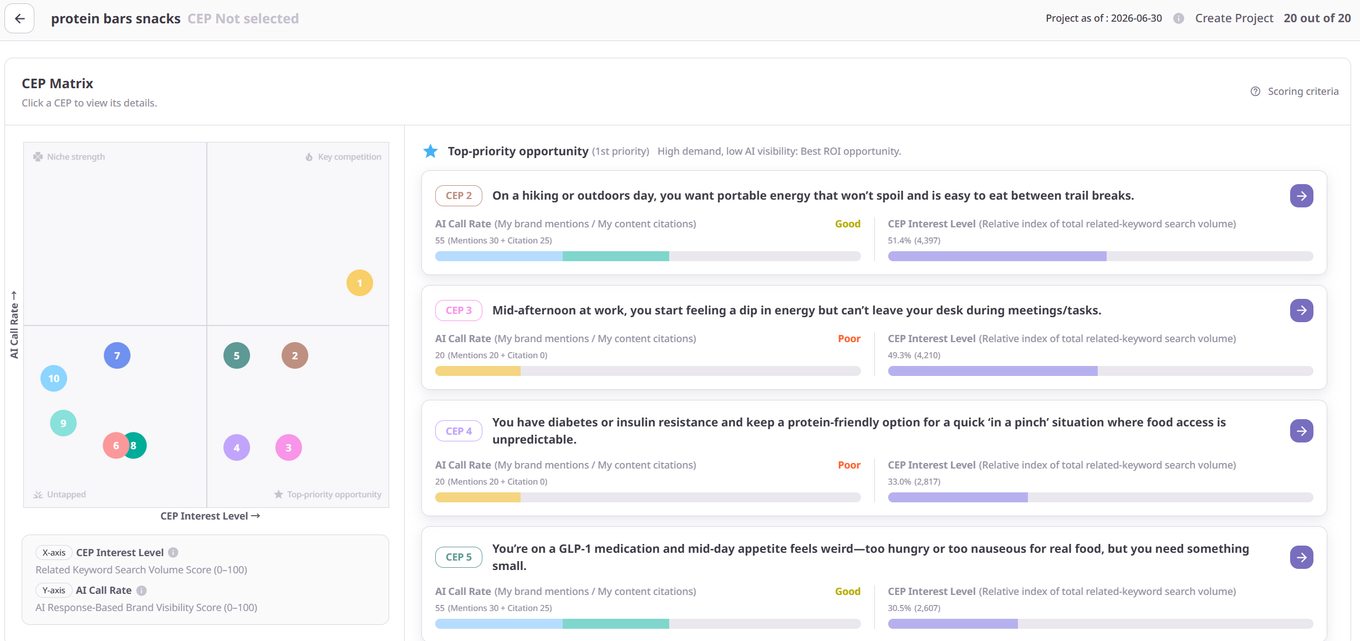
- Crossing the two produces four zones: core competitive, priority opportunity, niche strength, and untapped, each with a different recommended action.
- High search volume alone doesn’t confirm real demand. What matters is whether the situation functions as an actual selection criterion for real users.
Managing a brand in the AI era means looking at specific consumer buying situations, CEPs, instead of vague, brand-wide awareness. Two questions decide where to focus. First: is the CEP we picked actually alive in the real market? Second: does AI call up our brand as a candidate inside that CEP? Answer both, and it becomes clear where a brand should be spending its effort.
The First Number: CEP Demand
CEP demand measures how often, how importantly, and how clearly a specific buying situation or problem shows up in real users’ lives. Look at search volume for related terms, the trend over time, how many different sub-keyword variations exist, community mentions, and repeated phrasing inside reviews. Search volume alone doesn’t tell you whether a market is real. What matters is whether that situation is actually functioning as a genuine concern and selection criterion for real users.
“Sunscreen for sensitive skin” isn’t one keyword, it’s a problem space made up of several connected concerns. If terms like “gentle sunscreen,” “sunscreen for acne-prone skin,” “sunscreen that doesn’t sting your eyes,” “sunscreen for before makeup,” and “mineral sunscreen with no white cast” show up together, that’s a real signal the CEP is alive inside actual consumer behavior. US search data backs this out directly: “mineral sunscreen for sensitive skin” runs about 25,466 searches a month, “sunscreen for sensitive skin” about 22,466, and “fragrance-free sunscreen” about 5,066: this isn’t a niche concern, it’s a large, active category. (Source: ListeningMind, US average monthly search volume, May–July 2026.) Trend matters too, not just current volume, a CEP that looks small today but is growing fast can be an early opportunity.
The Second Number: AI Citation Signal
AI citation signal measures how often, how clearly, and for what reasons your brand appears when a CEP gets turned into a prompt and asked to a major AI service. Don’t just check whether your brand shows up: look at where it ranks in the recommendation, how it’s explained, its position relative to competitors, the sources AI cites, and the actual reason your brand gets mentioned.
Take the prompt “recommend a gentle sunscreen that won’t pill under makeup.” If your brand doesn’t show up at all, citation signal is low. If it shows up but only gets described as “an affordable sunscreen option,” the connection to the CEP you actually intended is weak. If it shows up alongside reasons like “tested on sensitive skin,” “minimal white cast,” “good under makeup,” and “mineral filter,” that’s a sign AI understands your brand fairly accurately inside that specific CEP.
Two Different Starting Points, One Relationship
CEP demand and AI citation signal start from different places. CEP demand reads the temperature of the market: from search data, community, reviews, and how real users talk about the problem. AI citation signal reads presence: how your brand actually gets positioned inside real AI answers. But the two feed each other. Higher consumer interest usually means more related content, reviews, and outside mentions, which strengthens the signal AI can read over time. Higher AI citation signal drives more people to search and review after being pointed to your brand by an AI recommendation, which in turn builds up your brand’s presence inside that CEP.
Four Zones, Four Different Plays
Looking at both numbers together lets you set priorities by CEP.
High demand, high citation: the core competitive zone. The market is already large and competition inside AI answers is already established. Keep checking where your brand ranks and what strengths or weaknesses it’s described with, and keep defending and sharpening your position.
High demand, low citation: the priority opportunity zone. The consumer problem clearly exists, but your brand hasn’t earned a solid place in AI’s answer yet. This is where to concentrate effort: content structure, answerable sentences, clean entity information, product data, reviews, and outside trust signals.
Low demand, high citation: the niche strength zone. The mass market isn’t large yet, but your brand’s coordinate is already fairly sharp in this specific problem. Rather than pouring in budget, maintain the current strength and look for adjacent CEPs to expand into.
Low demand, low citation: the untapped zone. Priority is low for now, but keep an eye on it: if search volume starts climbing quickly or a new pain point starts repeating across communities, it could become a future opportunity worth watching.
From “Are We Known?” to “Where Are We Called?”
Managing a brand in the AI era means moving past the single question of “how well-known is our brand?” The better ongoing questions are: In which situations does our brand actually get called up? Why does AI recommend it there? And where it’s missing, what’s actually lacking? This is what can be called brand ops: not managing a brand as one image or one message, but continuously managing when, why, and on what evidence it gets called into a specific consumer situation.
CEP demand and AI citation signal aren’t just analytics for a dashboard. Together, they’re a priority map for brand operations: which CEPs to attack first, which to defend, and which to simply watch. A brand in the AI era isn’t managed by overall awareness. It’s managed by its ability to get called up by both people and AI, inside specific, real situations.
FAQ
CEP demand measures how alive a specific buying situation is in the real market: from search volume, trend, and community language. AI citation signal measures how often, and on what evidence, your brand actually gets called up when that situation is turned into a prompt and asked to AI.
That’s a priority opportunity zone: real consumer demand exists, but your brand hasn’t earned a solid place in AI’s answer yet. Focus on reinforcing content structure, answerable sentences, product data, reviews, and outside trust signals for that specific CEP.
No. High search volume doesn’t automatically mean a market is real: what matters is whether the situation is functioning as an actual selection criterion for real users, which you can check through sub-keyword diversity, community mentions, and repeated review language.
Continue the series:
- Find Your Best CEP, Then Link It to Your Brand
- Why Only a Few Brands Come to Mind at the Moment of Choice
- Distinctive Brand Assets: The Memory Cue Behind CEP Ownership
- Turning a Consumer Situation Into a Management Prompt
- What to Measure: CEP Demand and AI Citation Signal (this article)
- How to Read an AI Answer: A Framework for AI Response Analysis
- The Entity Gap: Where Intended and AI Perception Diverge
- An Owned-Media Strategy Built for GEO, Not Just Ads
- Building Reason-to-Believe Into Your Earned Media Strategy
- Brand Ops: Moving From Campaign Management to Citation Management
- GEO for Small Teams: Start With One CEP
- From Search Query to Prompt: Why Top of Mind Isn’t Enough
- How to Read Consumer Context From Search Data, Not Just Keywords