Index
GEO Strategy Series, Part 10 of 13. New to GEO?
Catch up on Part 1, Part 2 ,Part 3, Part4, Part 5, Part 6, Part 7, Part 8 and Part 9.Key takeaways
- Campaigns run on a company’s calendar; consumer questions and AI’s answers don’t, which is why campaign reporting alone can’t show how AI actually understands a brand.
- Brand Ops is a repeating loop: pick a CEP, observe consumer/AI language, check current citation, reinforce missing signal, then measure again.
- The signal AI needs to recommend a brand is scattered across many teams: brand, content, product, CX, PR, and commerce. So Brand Ops is also a job of cross-team alignment.
Most brand organizations have run on campaigns for a long time. A new product launches, a campaign gets built. A season arrives, new messaging gets written. Media budget gets approved, ads go live. The campaign ends, results get reported. This model is easy to explain internally: there’s a timeline, a budget, a deliverable, a report. Brand managers have used campaigns to push messages into the market, watch how consumers respond, and adjust for the next one.
Campaigns still matter. When a brand needs to push a message hard, launch a new product, or generate demand for a season, campaigns still do real work. The problem is that campaign-centric operating alone can’t keep pace with how brand selection actually works in the AI era.
Why Campaigns Alone Can’t Keep Up
Here’s why. A campaign runs on a company’s calendar. A consumer’s situation, and the question it generates, doesn’t run on that calendar. A campaign concentrates messaging into a defined window. AI doesn’t evaluate a brand only during that window. A campaign is usually built around one core message. A consumer’s prompt is built from a huge combination of contexts and conditions. A campaign ends when its scheduled run is over. AI’s answers and consumers’ questions don’t stop.
Say a beauty brand ran a “gentle mineral sunscreen for sensitive skin” campaign ahead of summer: ads went live, influencer content was made, product pages were updated. In the past, success could be judged by impressions, clicks, search volume, sales, and review growth.
The AI era adds a different question. When a consumer describes their specific skin condition and use situation and asks AI for a sunscreen recommendation, does this brand show up in the answer? If it shows up, what’s the stated reason? If it’s missing, is that because the product itself is weaker, or because there isn’t enough evidence AI and consumers can actually read?
A standard campaign report can’t answer that. It shows what you said and how far that message traveled. It doesn’t show how the market and AI actually understand your brand as an answer to a situation.
Introducing Brand Ops
Brand management in the AI era shifts focus from “what did we say” to “what evidence does the market and AI actually understand our brand by.” Continuously checking and closing the gap between what a brand claims about itself and what evidence has actually accumulated in the information space: that’s the real starting point for a new way of operating a brand.
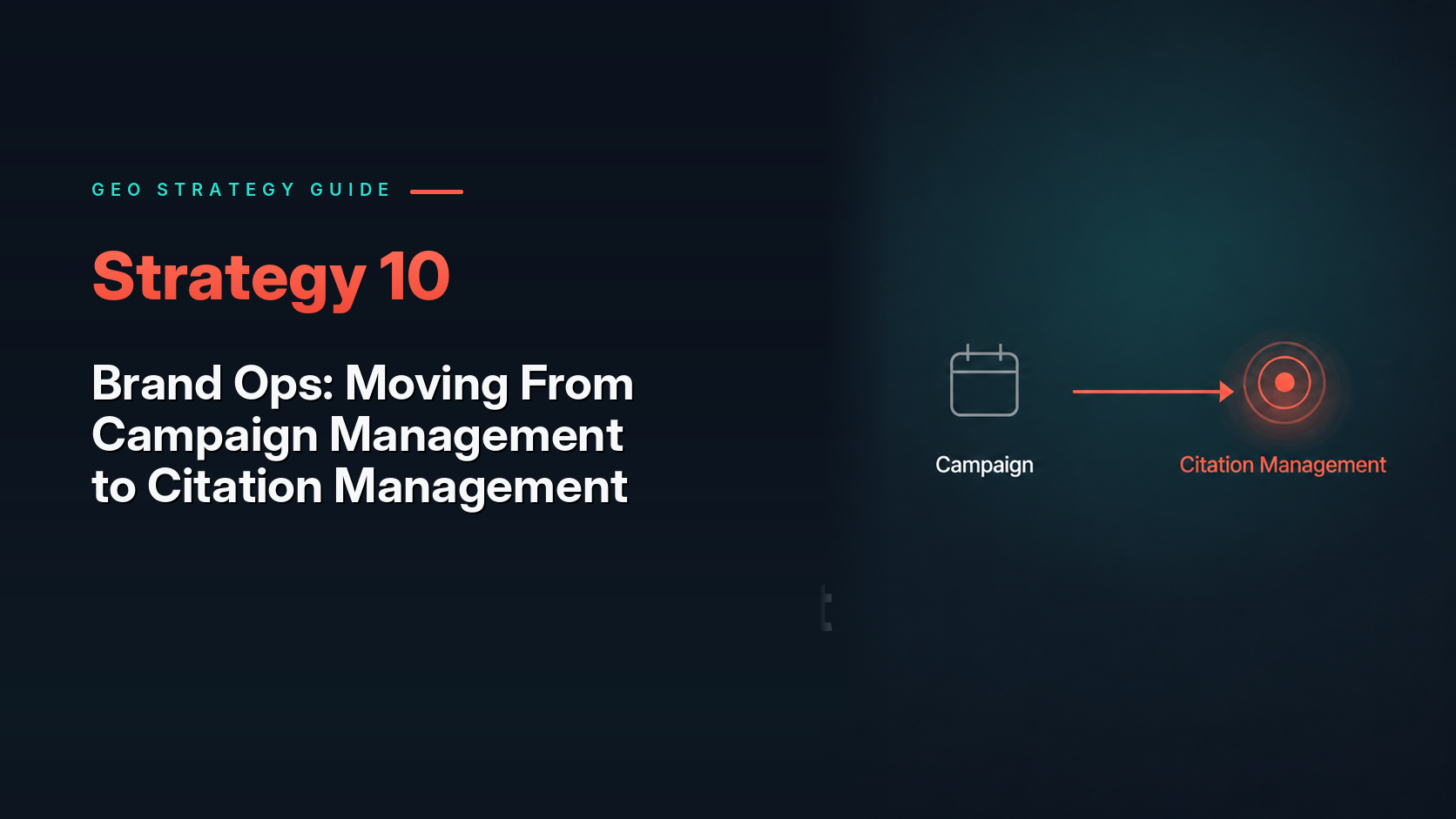
This repeating cycle of diagnosing, reinforcing, measuring, and learning is what can be called Brand Ops: managing a brand not as a series of one-off campaigns, but continuously, inside the actual context of consumer buying situations and how AI structures its answers.
You could just call this “brand management” more broadly. The reason for the more specific term is that brand operations in the AI era involve a different structure of work and a different repeating rhythm than traditional campaign or message management. It requires a recurring operating loop: deciding which CEP a brand should win, observing the language consumers use to describe that CEP, checking which brands AI recommends and why, reinforcing whatever signal is missing inside the organization, then measuring again.
Here, CEP (Category Entry Point) means the specific buying or use scene where a consumer enters a category. “Sunscreen” is a category. “A sunscreen for acne-prone skin that doesn’t feel heavy before makeup” is closer to a CEP. “Air purifier” is a category. “A quiet air purifier good to run around kids” is a specific consumer selection scene.
If GEO is the execution layer that gets a brand understood and recommended inside AI search and generative answers, Brand Ops is the operating system that makes that execution repeat inside the organization. If GEO answers “how do we get called up,” Brand Ops answers “who does this, on what cadence, generating what signal, and measuring it how.”
Where This Usually Breaks Down
A lot of companies struggle right here. At first, they test a handful of AI answers. They check whether their brand shows up. They’re surprised to see a competitor mentioned often. So they reinforce content, build out FAQs, revise product descriptions. Then time passes, and things drift back to the old pattern. A campaign launches, and focus shifts entirely to the campaign. A new product ships, and focus shifts to the launch. Quarterly reporting approaches, and focus shifts back to the existing KPI report. AI-response analysis stays a one-off diagnostic instead of becoming a recurring practice, and CEP-level citation management never becomes a standing part of the workflow.
That’s how a brand falls behind, continuously. An AI answer isn’t a fixed ad placement. It’s not a page-one search ranking that holds steady for a set period. The same question can produce a different answer depending on timing, model, and a user’s context. When a competitor publishes new content, reviews accumulate, news gets covered, or a commerce platform’s product data changes, the signal AI is reading shifts along with it. Brand management in the AI era isn’t a one-time setup. It’s something that has to be watched and adjusted continuously.
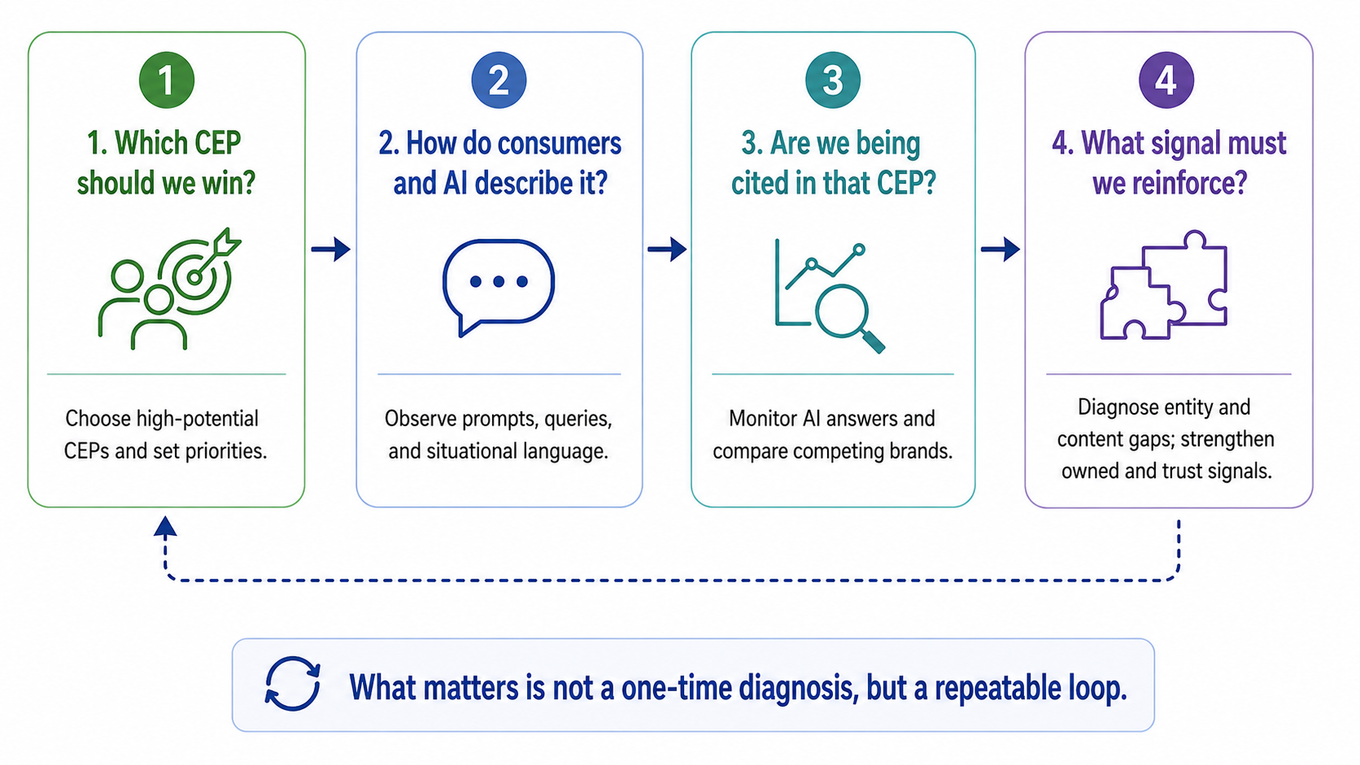
What matters here is rhythm, not speed. This isn’t a call to respond to every question daily, or monitor every AI answer in real time. It means repeatedly checking the same questions against the CEPs a brand has decided matter most, and building a rhythm that connects each result to the next action.
Four Questions to Keep Asking
Making this shift means repeatedly asking a brand four questions:
- Which CEP must our brand be chosen in?
- What language and prompts do consumers use to describe that CEP?
- Which brands does AI recommend for that question, and on what evidence?
- What signal do we need to reinforce to get called up as the answer?
Repeating these four questions is what shifts brand operations from campaign-centered to citation-centered. A campaign-centered organization asks “what should we say this time?” A citation-centered organization asks “when a consumer lands in this situation, can our brand come to mind as the answer?” A campaign-centered organization manages message consistency and checks results after the fact. A citation-centered organization manages the connection between context and evidence, watching the market’s questions and AI’s answers to design the next signal.
This Isn’t Just the Brand Team’s Job
This shift doesn’t belong to the brand team alone. Getting called up by AI requires many different kinds of signal. Brand messaging, content, product detail, reviews, PR, expert evaluation, certification, and commerce information like price, stock, shipping, and availability all matter.
When a consumer asks AI for “a quiet air purifier safe to use around kids,” AI isn’t just reading ad copy. It weighs noise level, filter replacement cost, coverage area, how it handles pet hair, safety around children, real reviews, price, retailers, and brand trust, all together.
So which team owns each of those signals? Noise level and coverage area might be product-team data. Filter replacement cost might belong to commerce and customer support. Safety around kids might need to be explained by the content team. Real reviews might live with the customer-experience team or a retail platform. Brand trust might sit with PR and brand. The signal AI draws on to build a single answer is scattered across many teams inside the organization.
That makes Brand Ops, at its core, a job of aligning signal across departments. Under the old campaign-centered model, each team could operate somewhat independently and still make progress: brand built the campaign, content built the blog and product pages, PR issued releases, commerce managed product data, and data teams built reports. Collaboration mattered, but consumers moved across each touchpoint themselves and pieced the information together on their own.

Now that AI sits in the middle synthesizing information, these scattered signals all get evaluated together inside a single answer. A disconnect inside the organization can show up as a disconnect in what the brand means inside an AI answer.
Say a brand’s campaign says “sunscreen for sensitive skin,” but the product page is missing information about white cast, pilling, and how it feels under makeup, review data isn’t organized, and PR content only talks about ingredient philosophy. In that case, AI has a hard time connecting this brand to a prompt like “a sunscreen I can wear before makeup that won’t bother my acne-prone skin.” Every team did their job, but the signal never connected at the level of the consumer’s actual CEP and prompt.
Brand Ops is exactly the work of building that connection. It doesn’t need to start as a massive company-wide system. What matters is the structure of the repeating questions, not the tooling. The realistic starting point is a small pilot: pick one CEP, gather the scattered signal around it, and check how that signal actually reads to AI and to consumers.
From an Organization That Talks to One That Listens and Acts
At its core, Brand Ops is about turning a brand from an organization that talks into one that listens and acts. A campaign-centered organization mostly talks: stating what kind of brand it is, what value it offers, why its product is good. In the AI era, listening matters just as much. What prompts are consumers actually asking? What criteria does AI use to answer? Why do competing brands get called up? What’s the reason your brand goes silent? Listen first, then speak again.
One caution here: Brand Ops isn’t a concept for structuring and automating everything. Organizing brand and product information into a form AI can understand matters, but a brand still has to work inside human memory too: emotion, experience, scene, symbol, and distinctive brand assets all move together with it.
That’s why Brand Ops has to be both a data operation for AI and a memory operation for people at the same time. The shared unit connecting the two is the CEP. For a person, a CEP is a life scene that brings a brand to mind. For AI, a CEP is a situational coordinate interpreted inside a prompt.
Scenes like “a light snack after work,” “a Jeju hotel to visit with an elementary schooler,” and “a gentle sunscreen to wear before makeup” exist in a consumer’s actual life, and they exist inside AI’s answer structure too. A brand that gets called up by AI isn’t built automatically. It’s the result of an operating rhythm: repeatedly observed, reinforced, measured, and adjusted again.
FAQ
An operating model that repeats diagnosis, reinforcement, measurement, and learning around a CEP on an ongoing basis, instead of managing a brand through one-off campaigns with a fixed start and end date.
A campaign runs on a company’s calendar and reports on what was said. Brand Ops runs continuously, tracking how AI and consumers actually understand a brand inside real buying situations, and reinforcing whatever signal is missing.
No. The signal AI needs to recommend a brand (messaging, content, product data, reviews, PR, commerce information) is scattered across many teams, so Brand Ops is also the work of aligning signal across departments, not a single team’s task.
Continue the series:
- Find Your Best CEP, Then Link It to Your Brand
- Why Only a Few Brands Come to Mind at the Moment of Choice
- Distinctive Brand Assets: The Memory Cue Behind CEP Ownership
- Turning a Consumer Situation Into a Management Prompt
- What to Measure: CEP Demand and AI Citation Signal
- How to Read an AI Answer: A Framework for AI Response Analysis
- The Entity Gap: Where Intended and AI Perception Diverge
- An Owned-Media Strategy Built for GEO, Not Just Ads
- Building Reason-to-Believe Into Your Earned Media Strategy
- Brand Ops: Moving From Campaign Management to Citation Management (this article)
- GEO for Small Teams: Start With One CEP
- From Search Query to Prompt: Why Top of Mind Isn’t Enough
- How to Read Consumer Context From Search Data, Not Just Keywords