Index
GEO Strategy Series, Part 8 of 13. New to GEO?
Catch up on Part 1, Part 2 ,Part 3, Part4, Part 5, Part 6 and Part 7.Key takeaways
- AI doesn’t pick brand candidates based on what a brand brags about. It looks for the brand that best answers the consumer’s actual question.
- Owned media (product pages, FAQs, guides) needs to function as a bank of direct answers: who it’s for, what situation it fits, and what evidence backs each claim, not persuasive ad copy.
- The same core answer should repeat consistently across every owned channel, expressed in language suited to that channel’s role.
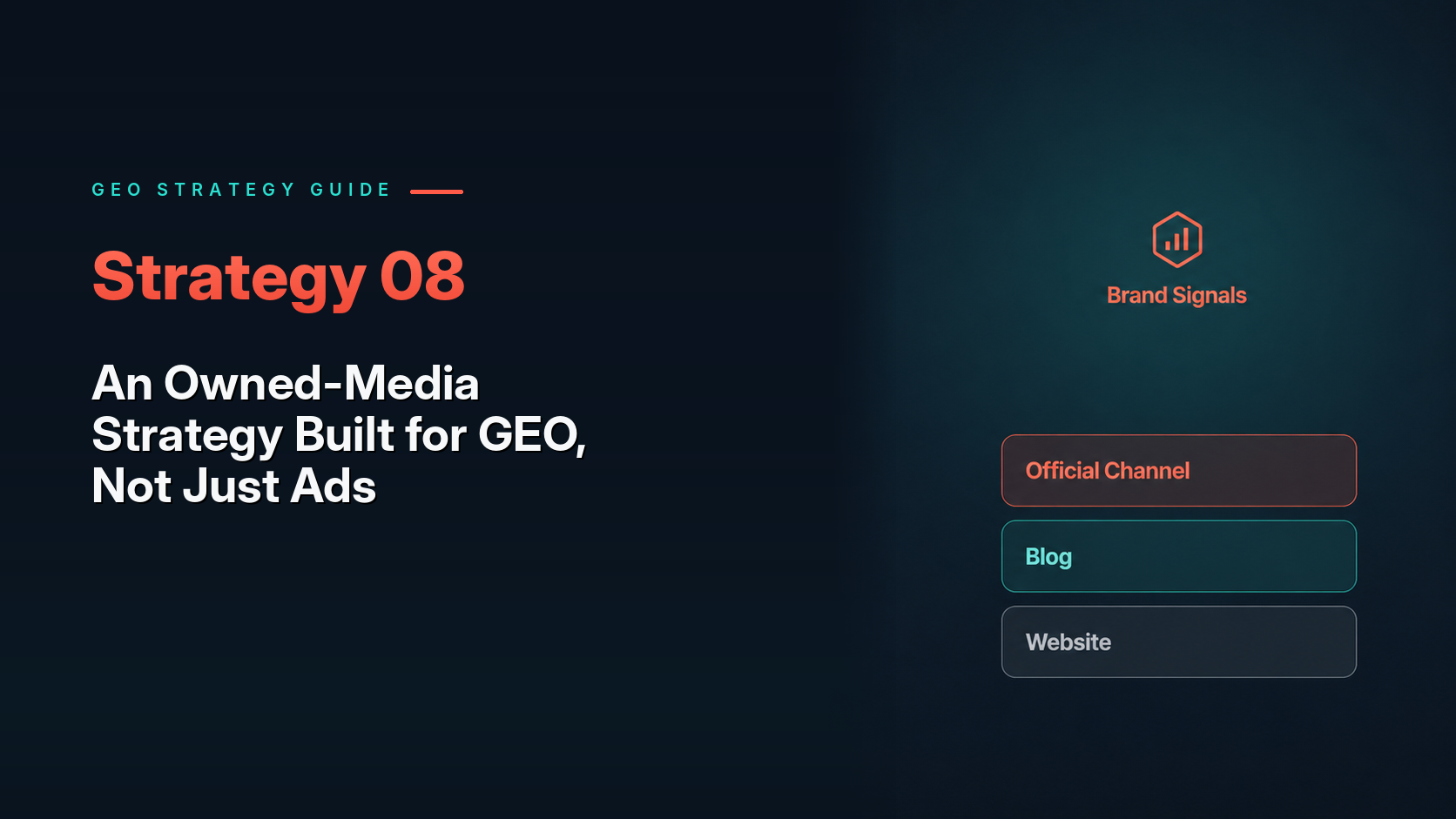
Getting AI to understand your brand as the answer to a specific consumer situation starts with organizing the information you actually control. That starting point is owned media, meaning any channel where the brand directly manages its own message and content: your brand site, product pages, official store, app, official blog, newsroom, FAQ, support documentation, official YouTube channel, and content hub.
Owned media has traditionally focused on persuading the consumer: presenting features, ingredients, price, size, design, promotions, and brand messaging as attractively as possible. In an AI search environment, that role expands. Owned media is still a space for persuasion, but it’s also now the reference library AI consults to understand your brand in the first place.
For AI to recommend your brand, having the product name show up often isn’t enough. AI reads the situation, purpose, conditions, constraints, and selection criteria embedded in a user’s question, then assembles candidates that match. That means owned media needs to clearly spell out what category the brand belongs to, who it’s a fit for, which situations it’s useful in, which selection criteria it satisfies, and what evidence backs each of those claims.
Most Owned Media Is Still Built Around the Product, Not the Question
A lot of brands’ owned media is still organized entirely around the product. Name, features, specs, price, and how-to instructions are usually covered well, but answers to the questions consumers actually ask are often missing. Say a product wants to get called up by AI as “a good option for first-time users.” If the product page is built entirely out of generic phrases like “outstanding performance,” “convenient to use,” and “premium quality,” AI has no way to understand why it’s actually suited to beginners.
What AI needs is more specific: Is it easy to set up the first time? Is the documentation thorough enough? Does it include features that reduce the chance of user error? Is upkeep simple? How does it minimize the problems users commonly run into? What reasons do real users give for finding it easy to use? In other words, owned media needs an information structure that can actually answer a consumer’s question, not sentences that just brag about the product.
Principle One: Write Answers, Not Ad Copy
The first principle for strengthening owned media is building answers to questions, not advertising copy. AI doesn’t pick candidates based on what a brand claims to be great at. It judges which brand is the best fit for the consumer’s actual question. That means product pages and official content need to cover, at minimum, answers to questions like these:
- Who is this product a good fit for?
- Which situations is it especially useful in?
- What discomfort or goal does it solve for the consumer?
- What criteria matter most when choosing between options like this?
- What’s the evidence that it meets those criteria?
- How is it different from comparable products?
- What change can a consumer expect before and after using it?
- What conditions or limitations should someone be aware of before using it?
- In what situations, and for what reasons, do real users rate it highly?
These aren’t just a content checklist. They’re the semantic structure AI needs to understand your brand as the answer to a specific consumer situation. When someone asks AI to “recommend a product that fits me,” AI doesn’t look at the product name first. It looks at the conditions first. It builds candidates by combining situation, audience, purpose, constraints, selection criteria, and trust evidence. Owned media’s job is explaining how your brand and product actually satisfy those conditions.
Principle Two: Don’t Bury the Important Answer in One Place
The second principle is not burying key answers in a single spot. The same core information should show up consistently across product pages, FAQs, comparison content, usage guides, blog posts, video descriptions, captions, image alt text, structured data, and support documentation.
That doesn’t mean repeating identical sentences on every channel. What matters is that the same consumer situation and selection criteria get expressed in language suited to each channel’s role. Say a brand wants to own the scene “a good product for small spaces.” The product page should clearly cover size, installation requirements, usable area, and storage. The FAQ should explain what to watch for and what conditions are recommended when using it in a small space. Comparison content should show the difference against products built for larger spaces. Usage guides should cover actual placement and upkeep. Video content can show exactly how it’s positioned and used in a tight space.
The format differs across each of these, but they should all reinforce the same underlying reason to choose the product. That’s what makes it understandable to both people and AI. The goal of owned media isn’t simply driving more search visibility: it’s leaving behind a consistent information structure explaining why the brand should be chosen, and in which situations.
The Real Work Is Structure, Not Copywriting
Ultimately, strengthening owned media isn’t a copywriting problem. It’s an information-structure problem. It’s not about writing your brand’s message more beautifully: it’s about answering the questions consumers actually ask, in a way both AI and people can understand.
Well-organized owned media doesn’t just favor AI. It’s better information for human consumers too: they can judge more quickly whether a product fits their situation, and compare selection criteria and evidence more easily. Content that’s good for AI and content that’s good for consumers aren’t in conflict. Content that answers real consumer questions concretely ends up being a strong signal for AI as well.
The core of an owned-media strategy comes down to this: decide which consumer situation you want to own, define the selection criteria that matter in that situation, then place that criteria consistently across every official channel. Move past having plenty of product information but not enough real answers. Owned media in the AI era shouldn’t read like a brand brochure. It should function as the reference system that gets your brand understood as the answer to a specific situation.
FAQ
Any channel a brand directly manages message and content on: brand site, product pages, official store, app, blog, newsroom, FAQ, support docs, and official video content.
It used to focus mainly on persuading consumers. Now it’s also the reference library AI consults to understand a brand: so it needs to answer real consumer questions directly (who it’s for, what situation it fits, what the evidence is), not just present ad copy.
No. what matters is that the same underlying consumer situation and selection criteria get reinforced in language suited to each channel’s role, not that every page repeats identical sentences.
Continue the series:
- Find Your Best CEP, Then Link It to Your Brand
- Why Only a Few Brands Come to Mind at the Moment of Choice
- Distinctive Brand Assets: The Memory Cue Behind CEP Ownership
- Turning a Consumer Situation Into a Management Prompt
- What to Measure: CEP Demand and AI Citation Signal
- How to Read an AI Answer: A Framework for AI Response Analysis
- The Entity Gap: Where Intended and AI Perception Diverge
- An Owned-Media Strategy Built for GEO, Not Just Ads (this article)
- Building Reason-to-Believe Into Your Earned Media Strategy
- Brand Ops: Moving From Campaign Management to Citation Management
- GEO for Small Teams: Start With One CEP
- From Search Query to Prompt: Why Top of Mind Isn’t Enough
- How to Read Consumer Context From Search Data, Not Just Keywords