Index
GEO Strategy Series, Part 12 of 13.
Catch up on Part 1, Part 2 ,Part 3, Part4, Part 5, Part 6, Part 7, Part 8, Part 9, Part 10 and Part 11.Key takeaways
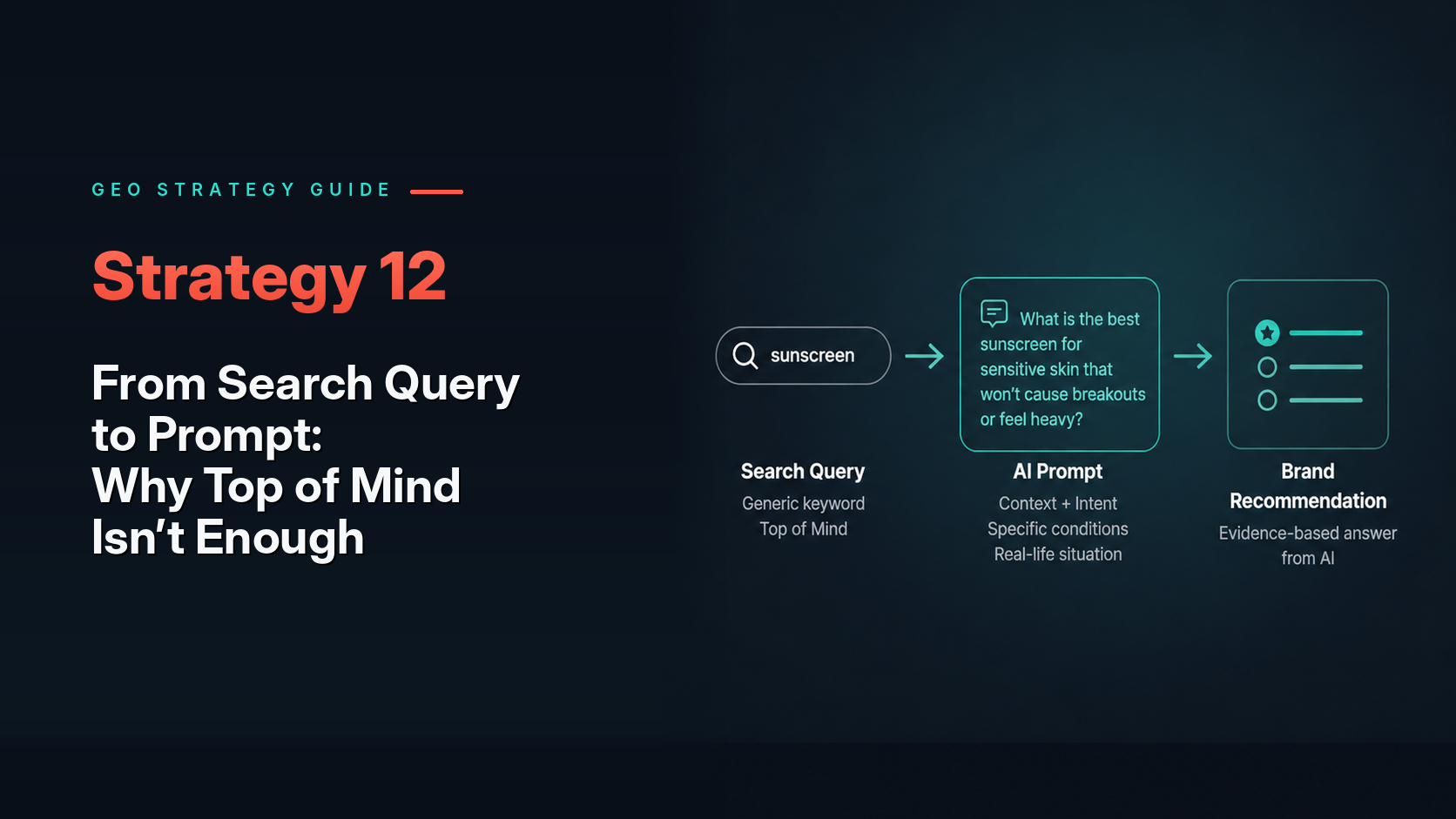
- A search query was always a compressed shadow of a consumer’s real situation; an AI prompt is closer to the full picture: time, place, constraint, and preference, all at once.
- This shifts brand competition from Top of Mind (famous across a whole category) to Top of CEP (first recalled inside one specific, concrete situation).
- Even a lesser-known brand can get recommended over a market leader if its specific attributes match the exact conditions in a consumer’s prompt.
For a long time, the search query was the single most important clue to what a consumer actually wanted. People typed a short phrase into a search box, and brands and marketers analyzed those words to guess at intent. Queries like “protein bar recommendations,” “CRM comparison,” “best running shoes,” or “family hotels near Orlando” were strong signals that someone was looking for something.
But a short query always left most of the story out. Why someone was looking for that product, what situation they planned to use it in, what they wanted to avoid, which conditions mattered most, what price range they had in mind, who they’d be using it with: all of that context usually got dropped. A short query captured a real concern, but only as a low-resolution compression of it.
People didn’t search in short phrases because their situation was actually simple. They searched that way because the search box itself couldn’t take in much context. In real life, a consumer is always deciding inside a complicated situation. But standing in front of a search bar, they had to compress all of that down to a handful of words. So behind a query like “protein snack recommendations,” a lot more context than that was always hiding.
When were they planning to eat it? Where? Could someone with a sensitive stomach eat it? Did it need to avoid getting on their hands? Did they want something crunchy, or something soft? Sweet, or more neutral? How much did calorie or sugar content matter? What price per unit felt reasonable? All of these questions sat hidden behind a query as short as “protein snack recommendations.”
The Query Used to Be a Shadow. The Prompt Is a Portrait.
One of the biggest shifts the AI era has brought is that consumers no longer have to force their situation into a compressed shape. Instead of two or three keywords, a person can now describe their actual situation in full sentences: attaching conditions, naming exceptions, and stating preferences and dislikes almost the way they would in conversation.
Where someone once might have searched “protein snack recommendations,” they can now ask something like this:
“Is there a protein snack I can eat on an empty stomach in the morning without it upsetting my stomach, that’s also easy to eat on public transit on my commute? I don’t like anything that tastes as sweet as chocolate. Something with a nutty texture would be great. And ideally under $3 each.”
That single sentence carries time, place, physical condition, use context, texture preference, taste to avoid, and a price constraint, all at once. The time is first thing in the morning, on an empty stomach. The place is public transit, during a commute. The physical condition is a sensitive stomach. The use case calls for something easy to eat. The taste preference avoids anything too sweet. The texture preference is something nutty. The price needs to stay under $3 a unit.
This shift is bigger than a change in search interface. It’s a change in the actual unit of consumer language marketers need to understand. Where marketers once analyzed keywords typed into a search box to infer intent, they now need to read the range of consumer context embedded inside a long prompt.
If a search query was the shadow of a consumer’s situation, a prompt is closer to a full portrait. A query tells you the subject. A prompt shows you the situation. A query tells you the category. A prompt tells you the reason for the choice and the constraints attached to it. A query says “what am I looking for.” A prompt says “why do I need this right now.”
Why This Matters So Much for Brands
This difference matters enormously for brands. In the keyword era, “which keyword should we be visible for?” was the defining question. That question still matters: SEO hasn’t gone anywhere, and search queries are still the smallest fundamental unit of a consumer’s buying journey. But the AI era has added a more important question on top of it:
“In what situation should our brand be the answer?”
A keyword only reflects the shadow of that scene. A consumer’s actual choice and behavior live inside the much more specific prompt they write. That means a brand now needs to respond to situations, not just words. It’s not enough to make content that matches a keyword: a brand needs to be the answer that fits a consumer’s specific, concrete scene.
Travel is one of the categories where this shift shows up most directly. In the past, a consumer might have searched “family hotels in Orlando.” That query tells you they’re interested in Orlando hotels, but it tells you nothing about what kind of trip they’re actually planning.
Now, a consumer can ask something like this instead:
“I’m planning a four-night trip to Orlando with my four-year-old son and my parents. I need a hotel with a pool for the kids, within 30 minutes of the airport, that includes breakfast. Ideally under $200 a night.”
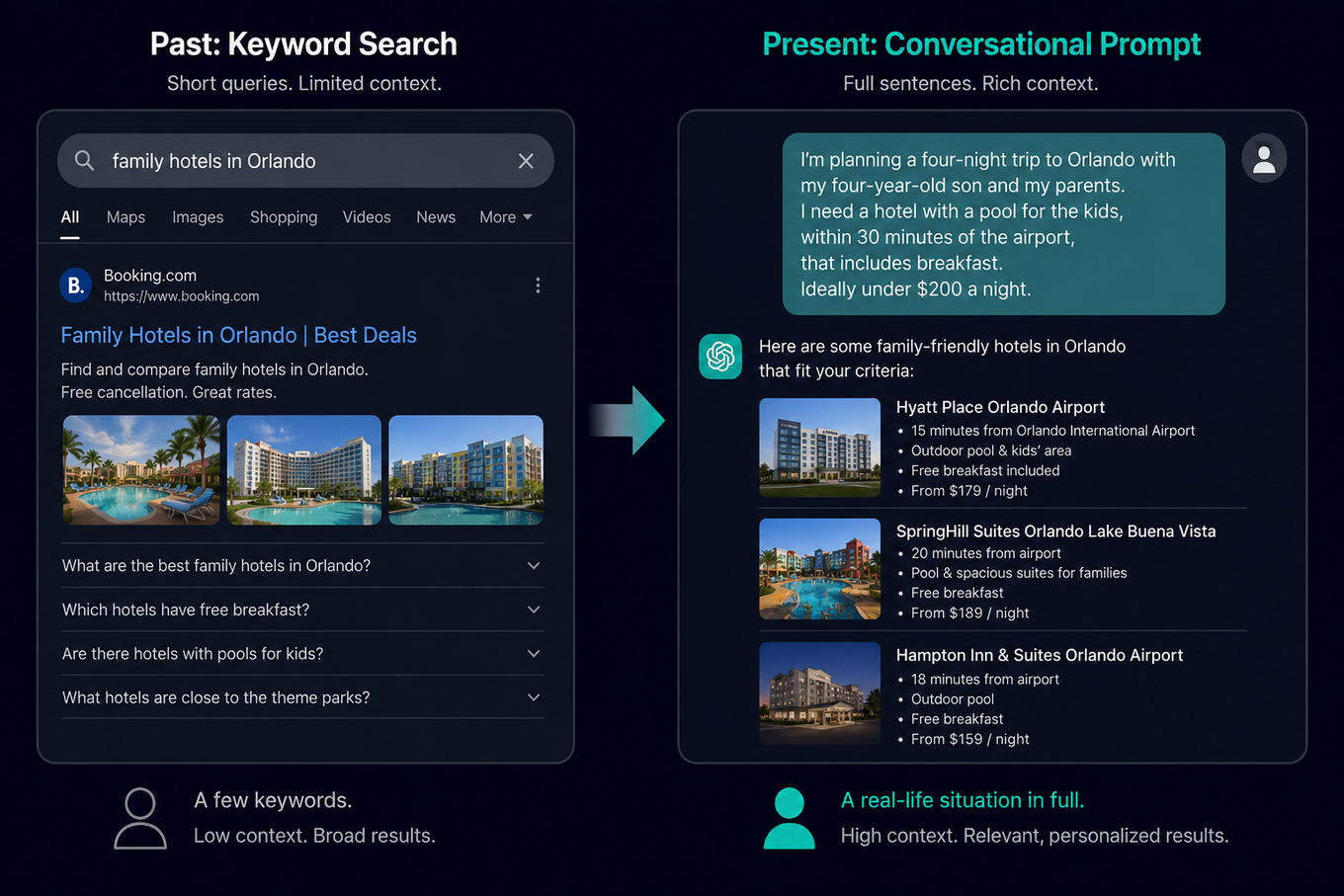
That prompt carries family composition, trip length, must-have amenities, proximity, included services, and budget, all at once. This consumer isn’t just looking for a hotel. They’re trying to solve the complicated logistics of a family trip that has to work for a young child and grandparents at the same time. AI isn’t just reading the category “Orlando hotels” here: it’s interpreting the combination of traveling with a young child, traveling with grandparents, a pool, airport proximity, breakfast, and budget, all together.
In a situation like this, a blog post optimized purely for the keyword “Orlando hotel recommendations” isn’t enough on its own. When AI interprets the combined conditions inside a prompt like that and proposes a shortlist of hotels, a specific property only gets included if its attribute data actually connects to the structure of that prompt. Whether there’s a kids’ pool, how far it is from the airport, whether breakfast is included, whether family-friendly rooms are available, and what the nightly rate looks like all need to be organized in a form AI can actually read.
Why Top of Mind Alone Doesn’t Cut It Anymore
Ultimately, moving from the query era to the prompt era changes the goal of branding itself, and how it gets executed. Being the brand that comes to mind when someone hears a product category name isn’t enough anymore. At the exact moment a specific situation, feeling, and set of conditions come together, a brand needs to be the first thing that comes to mind, or the most natural answer offered, right inside that scene.
This is where the limits of an old branding goal start to show: category-level top-of-mind recall, or Top of Mind.
Brand managers have long aimed to become the top-of-mind brand for their category. Ask “which brand comes to mind first for anti-aging skincare?” and hear SK-II, L’Oréal, and Clinique come up repeatedly, and those brands clearly hold strong top-of-mind status in that category.
In a market flooded with advertising, being the brand that comes to mind first for a product category still matters. A large share of purchases genuinely happen through quick recall and familiarity rather than deep, deliberate comparison. Instant associations like Galaxy and iPhone for “smartphone,” or Amazon and Walmart for “online shopping,” have given brands an enormous competitive edge for decades.
But now that AI sits inside search and recommendation, it’s gotten harder to say that being the single most famous brand across an entire category is an advantage in every situation. AI weighs the specific conditions and scene embedded in a question more heavily than category-wide fame. In other words, AI doesn’t read a category as one lump. It slices it into countless individual situations.
Take the protein-snack example from earlier and put it directly to an AI model: the biggest-selling or most widely known protein bar brand doesn’t automatically get recommended first. AI weighs conditions like “on an empty stomach in the morning,” “won’t upset my stomach,” “easy to eat on transit,” “nutty texture,” “not too sweet,” and “under $3 a unit,” all together.
In that situation, even a lesser-known brand has a real shot at getting recommended, if it has clearly structured attributes like individual packaging, minimal crumbling, one-handed eating, a crunchy texture, low sugar, and a reasonable price. AI isn’t searching for a famous brand. It’s searching for the best-fitting answer to that specific situation.
This isn’t to say Top of Mind stops mattering. Category-level awareness is still powerful, and a brand already lodged in consumer memory still starts from an advantageous position in the AI era. But what a brand has to manage has gotten far more granular. A brand now needs to be legible not just as famous across a whole category, but as the right answer across a range of specific, concrete situations.
From Top of Mind to Top of CEP
Going forward, branding can’t stop at covering one huge market with one big name. It has to expand into getting a brand naturally called up by consumers and AI inside specific scenes. What a brand needs to own isn’t abstract category-wide awareness: it’s small, concrete moments of choice.
Scenes like “thirsty on a hot day,” “need something light to eat after working late,” “packing before a two-night business trip,” “feeling a twinge in your knee walking down stairs,” or “picking a family-friendly hotel in Orlando for a trip with a young kid and grandparents”: these are the new battlegrounds a brand needs to own.
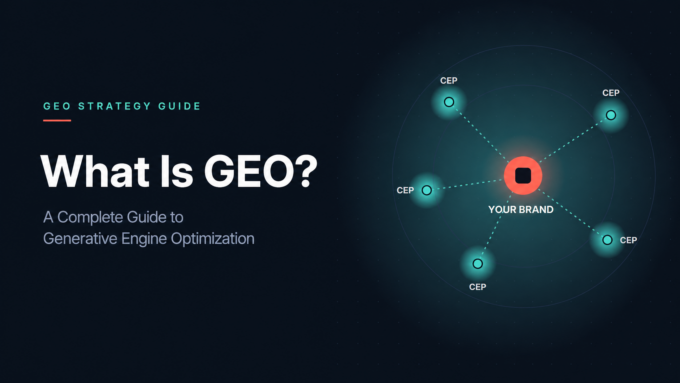
Marketing calls scenes like this a CEP, or Category Entry Point. A CEP is the bundle of situation, place, time, people, discomfort, purpose, emotion, and constraint that brings a specific product category or brand to a consumer’s mind. Put simply, it’s the doorway a consumer walks through into a category.
Consumers don’t buy a product for its own sake. They always reach for a product category to solve a task, reduce some discomfort, escape an emotional state, or make a choice that fits a situation. Thirst on a hot day, hunger after working late, packing before a trip, a twinge of knee pain walking downstairs: moments like these are exactly where a category and a brand open up inside a consumer’s memory.
So brand growth really means getting more people to consider your brand across more situations. From this angle, brand competition in the AI era moves beyond simple Top of Mind competition into Top of CEP competition. The important question is no longer “how famous is our brand?” It’s “in which scene, for what reason, and by whom, does our brand get called up first?”
A stagnant brand usually stays confined to a handful of CEPs. It comes to mind reasonably well for a specific use case, a specific customer segment, a specific purchase reason, but almost never gets called up outside those scenes. A brand like this ends up depending on repeat purchases from an already-familiar customer base, and growth slows. It might be a meaningful brand to existing customers, but it lacks doorways into the lives of non-customers who don’t yet think of it at all.
Non-customers here means people who haven’t experienced or bought your brand or product yet, but could plausibly consume it. Non-customers are a bit different from simple prospects, though. A prospect, from a company’s point of view, is “someone who might buy our product.” A non-customer, from the consumer’s point of view, is closer to “someone who already has a problem or need, but hasn’t connected it to our brand yet.”
Non-customers include people who’ve never heard of your brand at all, people who know it but don’t choose it, people who choose a competitor instead, and even people who don’t feel any particular affinity for your brand. Understanding non-customers isn’t about asking “who could we sell to.” It’s about asking, “in what situations do they enter this category, and why haven’t they thought of our brand yet?”
Growing brands, by contrast, don’t depend on a single flagship CEP. They keep the core CEPs they already hold strongly, while continuously acquiring new ones. They find new moments where people who don’t yet consider the brand start entering the category, not just the situations existing customers already use it in. When a brand connects naturally at that moment, a non-customer finally becomes a prospect, and a prospect gains a real chance of becoming an actual buyer.
Brand growth, in the end, means entering more of more people’s moments of choice. A consumer’s life is full of small buying triggers. A morning commute, right after a workout, after working late, the night before a trip, before heading out with kids, the moment you start thinking about a gift for your parents: each specific scene opens up different needs and constraints. Growing brands secure these scenes one at a time, building more entry points into consumer memory.
Seen this way, the difference between Top of Mind and Top of CEP becomes clear. Top of Mind asks, across an entire category, “how many people know our brand?” Top of CEP asks, inside a specific buying situation, “does the person standing in that moment think of our brand first?” One is a fight over awareness. The other is a fight over owning a situation.
Multiple CEPs exist inside a single category. Even within the same product line, the scene changes, and the selection criteria change with it. Once the selection criteria change, the brand AI recommends can change too. Inside the single category of protein snacks, “protein replenishment right after a workout,” “a substitute for breakfast on an empty stomach,” “a snack for kids,” “solving late-night hunger while working,” and “a snack that’s not too sweet while dieting” are all different CEPs. What a consumer wants differs in each scene, and so does the evidence a brand needs to provide.
The AI era reveals the market at a much finer grain. Needs that used to get lumped together under one keyword like “protein snack recommendations” now show up as specific prompts combining time, place, physical condition, taste, price, and use case. As the market’s resolution goes up, the battleground a brand needs to hold gets more granular too.
That means future brand growth can’t stay confined to a fight over category-wide awareness alone. It shifts into a fight over how often, and how precisely, a brand gets called up first across a large number of CEPs. A brand now has to check not just the short queries consumers type, but where it stands as the answer inside the long, specific prompts they write.
In the keyword era, the brand that owned the keyword had the advantage. In the prompt era, the brand that owns the scene has the advantage. And in an era where AI interprets a consumer’s question and proposes the options, the brand read as the most convincing answer inside that scene is the one most likely to get chosen.
The question a brand needs to ask now is clear.
“Which category are we known for?” isn’t enough anymore.
“In which CEP, for which consumer question, and on what evidence, does our brand get called up?”
Brands that can answer that question are the ones most likely to get ahead in the new branding competition of the AI era.
FAQ
Top of Mind asks how many people recall your brand across an entire category. Top of CEP asks whether your brand is recalled first inside one specific, concrete buying situation. A brand can win one without winning the other.
AI weighs the specific conditions inside a prompt more heavily than category-wide fame. A lesser-known brand with attributes that precisely match a prompt’s conditions can outrank a market leader that doesn’t fit as well.
Yes, category-level awareness still gives a brand an advantageous starting point. It’s just no longer sufficient on its own; a brand now also needs to be legible as the right answer across many specific, concrete situations.
Continue the series:
- Find Your Best CEP, Then Link It to Your Brand
- Why Only a Few Brands Come to Mind at the Moment of Choice
- Distinctive Brand Assets: The Memory Cue Behind CEP Ownership
- Turning a Consumer Situation Into a Management Prompt
- What to Measure: CEP Demand and AI Citation Signal
- How to Read an AI Answer: A Framework for AI Response Analysis
- The Entity Gap: Where Intended and AI Perception Diverge
- An Owned-Media Strategy Built for GEO, Not Just Ads
- Building Reason-to-Believe Into Your Earned Media Strategy
- Brand Ops: Moving From Campaign Management to Citation Management
- GEO for Small Teams: Start With One CEP
- From Search Query to Prompt: Why Top of Mind Isn’t Enough (this article)
- How to Read Consumer Context From Search Data, Not Just Keywords