Index
GEO Strategy Series, Part 3 of 13.
Catch up on Part 1 and Part 2.Key takeaways
- A distinctive brand asset is any cue, such as color, mascot, tone, or packaging, that makes someone recognize a brand before reading its name.
- As a brand expands into more CEPs, distinctive assets are what stop each new scene from feeling like a different brand.
- In the AI era, distinctive assets can’t live in visuals alone. The same cues need to repeat inside text and structured data so AI can read them too.
A scene-brand connection like “this is the brand for this” is what mental availability and brand salience are built from. But one problem remains: if your brand shows up with a different look, tone, and set of signals every time, each scene can start to feel like a slightly different brand, even though it’s you.
This gets worse the more CEPs a brand tries to hold. “Healthy late-night snack,” “quick late-night snack,” “low-calorie late-night snack” sit close together. Show up looking different in each one, and people stop experiencing them as a single, coherent brand.
What a Distinctive Brand Asset Actually Does
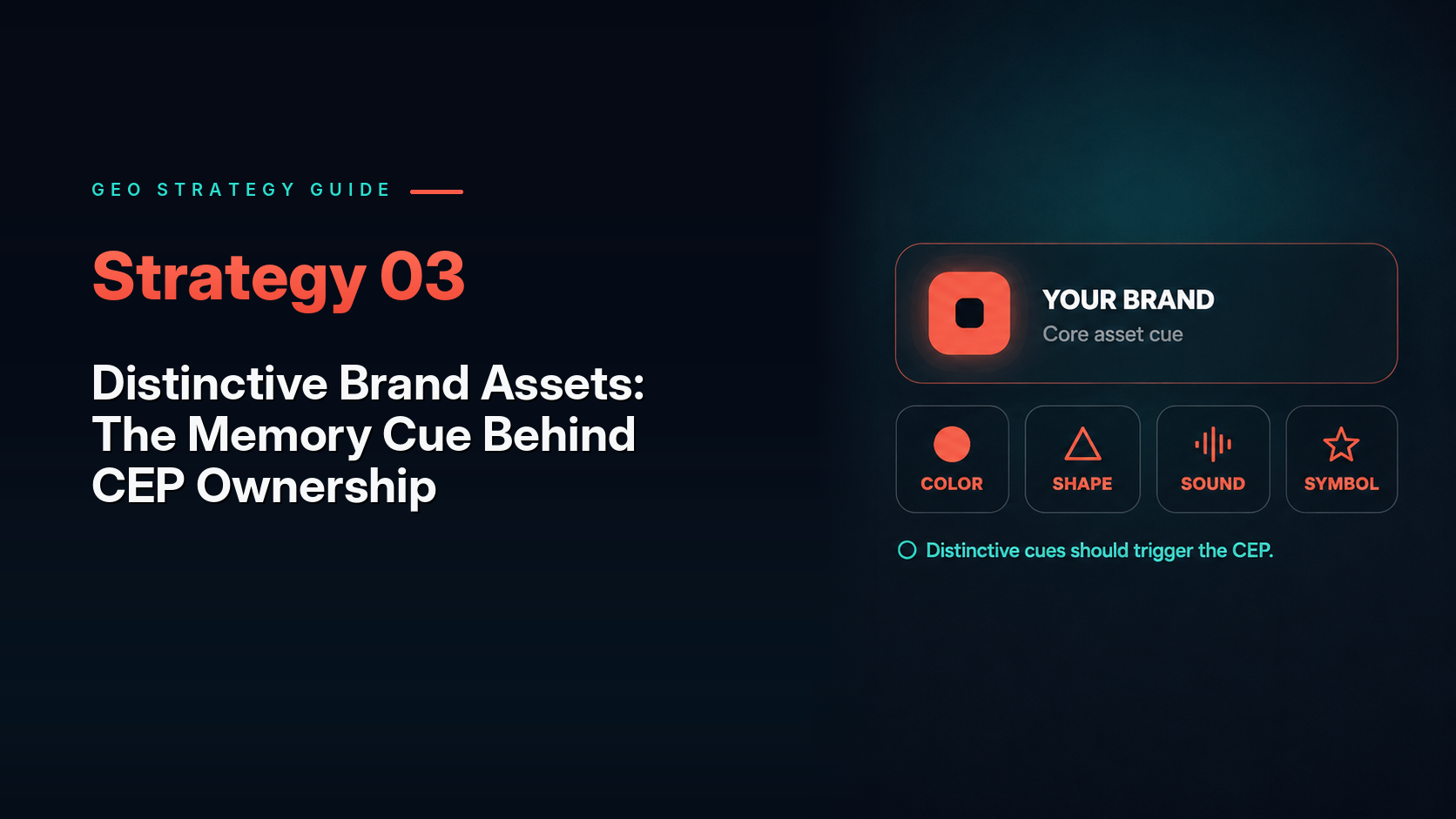
This is the problem distinctive brand assets solve. A distinctive brand asset is any cue that makes someone recognize your brand before they even read the name: color, logo, mascot, packaging, typeface, sound, tone of voice, tagline, app interface, delivery box, notification copy, product shape, even the feel of a store. What matters isn’t whether the cue is eye-catching. It’s whether seeing that cue makes someone instantly think of your brand specifically.
Distinctive assets let people recognize the same brand across different scenes. When someone encounters your brand in one context, then again in another, they don’t reinterpret it from scratch each time. A familiar color, tone, package, or icon tells them “same brand” almost instantly: and the more that recognition repeats, the sharper the link between the scene and the brand becomes.
Coca-Cola’s Santa Claus and polar bear work this way. Santa became a memory cue linking Coca-Cola to the winter CEP of Christmas. The polar bear extended that link further, to winter, cold, and the pleasure of sharing a drink together. Neither was just an ad character: both became distinctive assets that made Coca-Cola recognizable, and recallable, inside a specific seasonal, emotional scene.
Real Examples: Google, Amazon, Duolingo
Google isn’t remembered through one single visual. Its four-color palette, repeated across Search, Gmail, Maps, and Drive, is what makes each product still feel unmistakably “Google” even as the services and interfaces differ.
Amazon built the same effect around delivery speed. The Prime badge, the smile-arrow mark, and the promise of fast, reliable shipping repeat across the site until “Amazon” stops meaning “online store” and starts meaning “the place that gets it to me fast.” Even across wildly different product categories, that badge does the same job every time.
Duolingo shows how far tone and character can carry a brand. The green owl, the deadpan-savage notification copy, and the distinct typeface repeat everywhere, in the app, in emails, on social posts, until people recognize “Duolingo” from the voice alone, before they see the logo.
Why Growth Makes This Harder, Not Easier
A growing brand can’t stay in one scene forever. Without strong distinctive assets, each new scene drifts apart from the others, and people lose track of what the brand actually stands for. With strong distinctive assets, the opposite happens: the scenes change, but the brand still reads as one thing. Distinctive assets are what prevent the confusion that naturally comes with expanding across multiple CEPs: the same color, tone, packaging, character, or service experience lets people recognize it’s still the same brand, no matter which scene they meet it in.
This isn’t just visual polish. It’s the mechanism that binds many different scenes into one brand memory. The more a brand expands, the more this matters: it’s what keeps the expansion from scattering into unrelated fragments instead of accumulating into a single asset.
What Makes an Asset Actually Work
A few conditions separate a real distinctive asset from decoration.
It has to be distinctive. A color, phrase, image, or mood that competitors can use just as easily won’t function as a memory cue.
It has to repeat. Something used once or twice and dropped doesn’t stick in memory.
It has to show up consistently across touchpoints. If ads, product, app, store, and content each look and sound different, they won’t fuse into one brand memory.
It has to connect to the CEP you’ve chosen. When a brand’s distinctive cue matches the meaning of the scene people expect, it stops being a mere identifier and becomes a real memory asset.
A distinctive brand asset doesn’t have to be one single visual element, either. Color can be the strongest asset a brand has, but color alone usually isn’t enough. In digital environments especially, tone of voice, interface design, notification copy, and even the phrasing that shows up in search results all become memory cues. People don’t remember a brand as one static logo: they remember it as a bundle of small, recurring signals.
Why This Matters Even More in the AI Era
People recognize brands through color, shape, and sound. AI reads brands through text, data, context, reviews, product attributes, and outside mentions. That means a distinctive brand asset can’t live in visuals alone anymore, the same distinctive cues need to show up repeatedly in content and structured data too. As AI systems move toward multimodal understanding, reading text, images, video, and audio together, a distinctive brand asset increasingly has to work as both a design asset people can see and a semantic asset AI can read.
What a brand needs to do next is straightforward:
- Decide which CEP you want to own.
- Understand the emotion and conditions people expect inside that scene.
- Design the specific color, shape, tone, sound, packaging, and experience cues that capture that meaning best.
- Repeat those cues consistently across every touchpoint.
Only then does a brand get recognized as the same answer across different scenes, every time.
If a CEP is a question of when your brand should come to mind, a distinctive brand asset is a question of what someone sees and hears when it does. A CEP only becomes a real brand asset once that scene is repeated and reinforced through distinctive assets that carry across every place a customer meets your brand.
FAQ
Any cue that makes someone recognize your brand before reading its name: color, logo, mascot, packaging, typeface, tone of voice, sound, or even app notification copy. What matters isn’t whether it’s eye-catching, but whether it triggers instant brand recognition.
Without them, each new scene a brand enters can start to feel like a slightly different brand, since context and messaging naturally shift scene to scene. Distinctive assets are what let people recognize it’s still the same brand across all of them.
Both, but differently. People recognize a brand through color, shape, and sound. AI reads a brand through text, data, and outside mentions: so the same distinctive cues need to repeat inside content and structured data, not just visuals, for AI to pick up on them too.
Continue the series:
- Find Your Best CEP, Then Link It to Your Brand
- Why Only a Few Brands Come to Mind at the Moment of Choice
- Distinctive Brand Assets: The Memory Cue Behind CEP Ownership (this article)
- Turning a Consumer Situation Into a Management Prompt
- What to Measure: CEP Demand and AI Citation Signal
- How to Read an AI Answer: A Framework for AI Response Analysis
- The Entity Gap: Where Intended and AI Perception Diverge
- An Owned-Media Strategy Built for GEO, Not Just Ads
- Building Reason-to-Believe Into Your Earned Media Strategy
- Brand Ops: Moving From Campaign Management to Citation Management
- GEO for Small Teams: Start With One CEP
- From Search Query to Prompt: Why Top of Mind Isn’t Enough
- How to Read Consumer Context From Search Data, Not Just Keywords