Index
GEO Strategy Series, Part 1 of 13.
Key takeaways
- Discovering a CEP (Category Entry Point) and owning it are two different jobs. A CEP is an open coordinate on the map until a brand repeatedly stacks meaning, memory cues, and evidence onto it.
- A brand becomes the answer to a specific moment through three paths at once: getting recalled from memory, found in search, and cited by AI.
- US search data shows “healthy late-night snacks” gets nearly double the volume of the plain term “late-night snack,” proof that specific, condition-based CEPs are where real demand concentrates.
Your team pulls up search data around “late-night snacks.” The raw keyword looks simple. The surrounding queries don’t.
People aren’t just searching “late night snacks.” US searches for “healthy late-night snacks” average about 9,900 a month, nearly double the roughly 5,100 monthly searches for the plain “late-night snack.” Alongside it sit “low-calorie late-night snacks,” “healthy late-night snacks for weight loss,” and “quick and easy late-night snacks.” Each query adds a condition: time, effort, and how it fits a health goal.
(Source: ListeningMind, US average monthly search volume, May–July 2026.)
That’s a real insight. It’s also where most teams stop.
Spotting the Moment Isn’t the Same as Owning It
Marketers call these situations Category Entry Points, or CEPs: the specific moments when a consumer needs your category. A CEP isn’t a demographic. It’s a scenario: a time, place, feeling, constraint, or task that pulls someone into your product category in the first place.
“Something light and healthy to eat late at night, without much effort” is one CEP. Finding it is a real step forward. But finding it doesn’t make it yours.
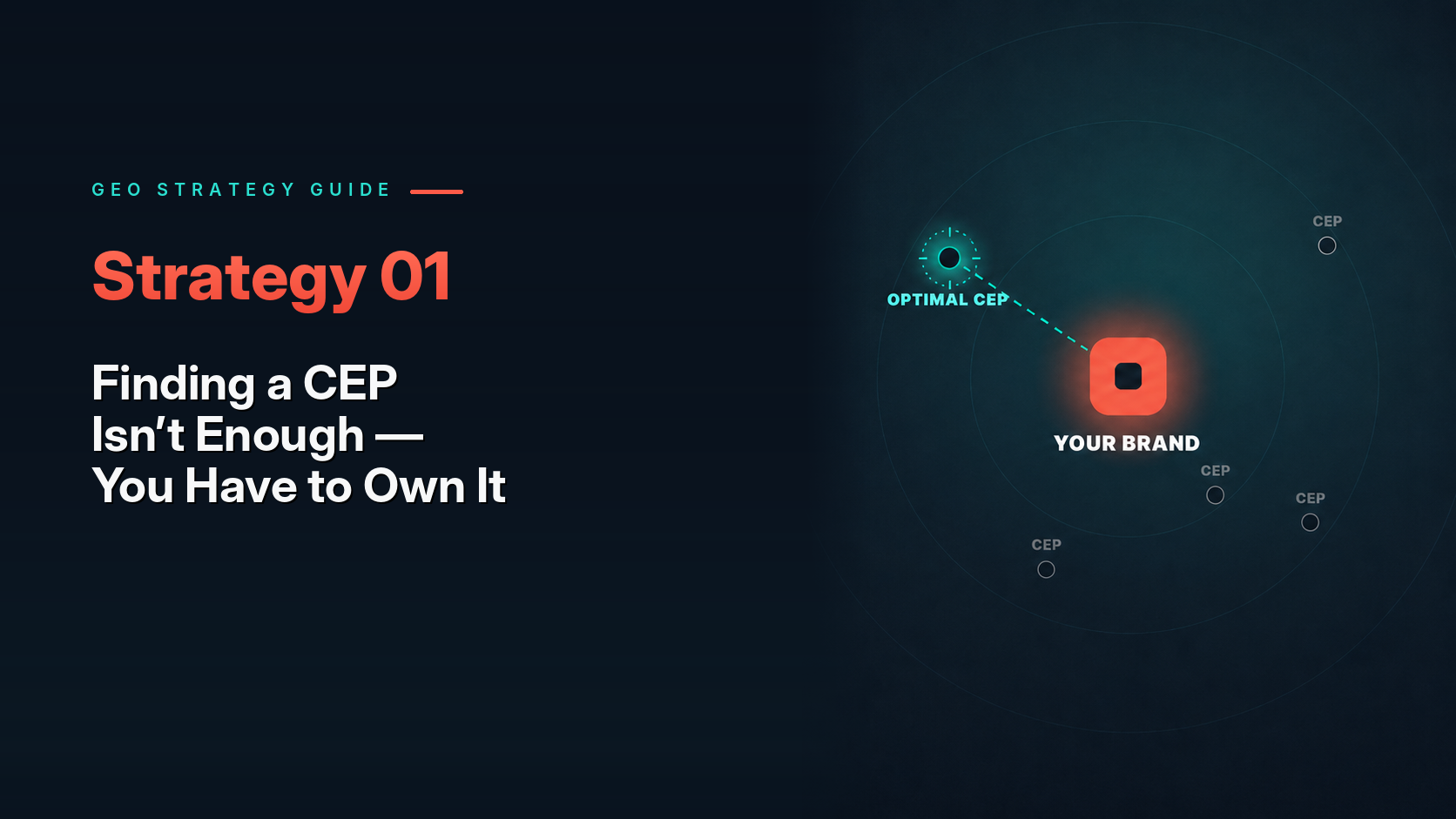
Think of a CEP as an open coordinate on a map, not a piece of land you already own. Other brands can occupy the same spot. The work of brand strategy is stacking your meaning, memory cues, product proof, and content onto that coordinate, again and again, until your brand is what shows up when that moment happens.
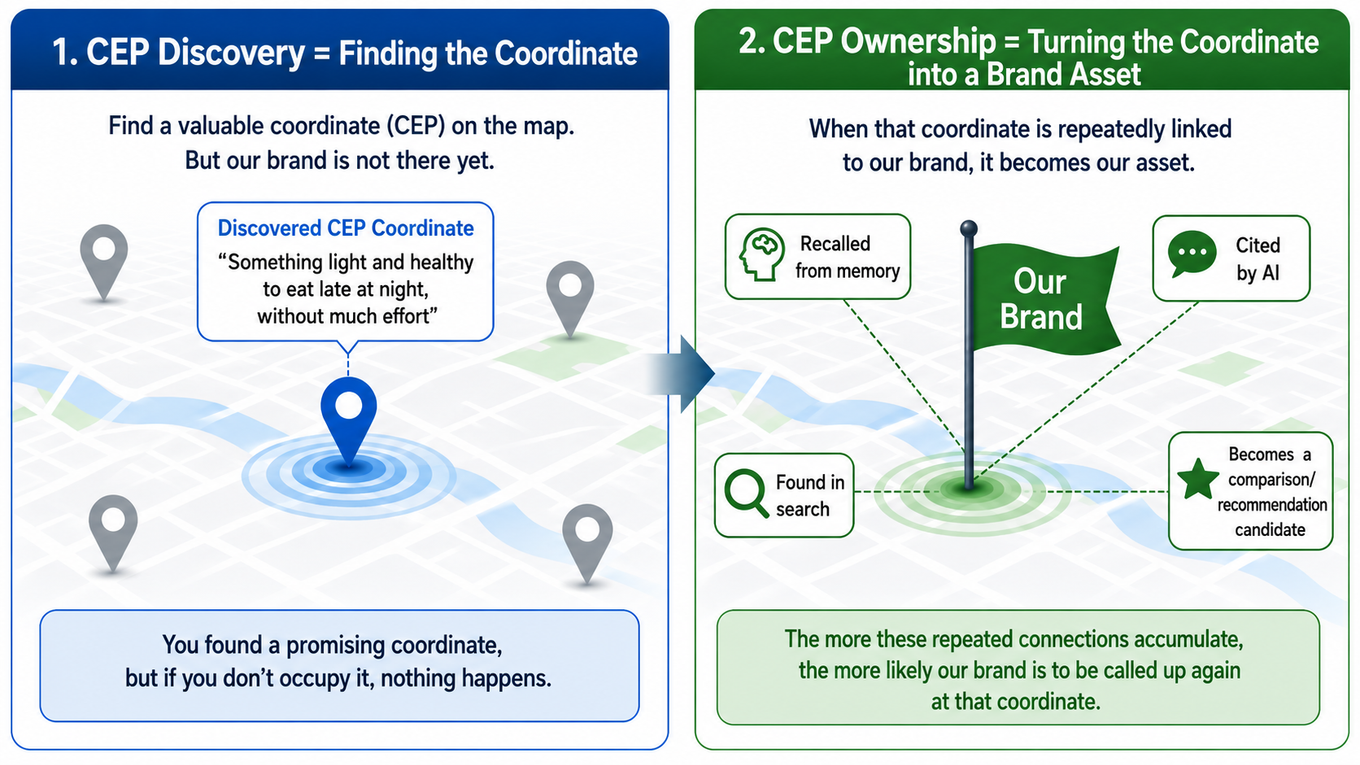
A coordinate isn’t a physical location. It’s the mental and semantic space a shopping moment occupies: in a person’s memory, and in an AI model’s vector space, where it determines how close a prompt sits to your brand and product information.
One Moment, Three Paths to the Same Decision
Picture someone getting home late. They’re hungry, but a heavy meal feels wrong, and they don’t want it working against a health goal they’re already tracking.
What happens next branches three ways:
- Memory: They open the app they always use and pick something familiar.
- Search: They type “healthy late-night snacks” or “low-calorie late-night snacks.”
- AI: They ask an assistant, “What’s a healthy, quick late-night snack that won’t derail my diet?”
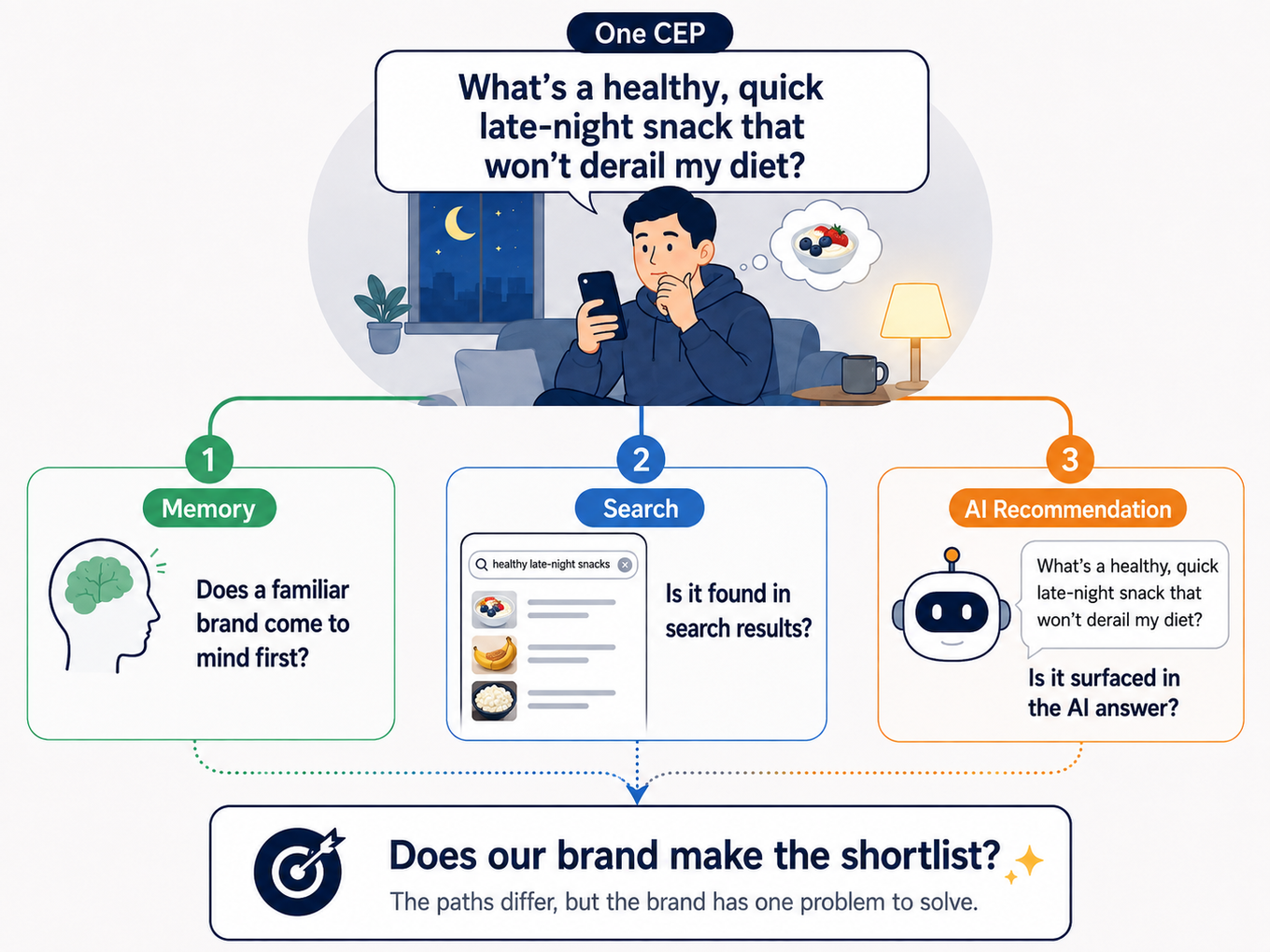
Three different behaviors, one identical test for your brand: does it make the shortlist? Get recalled by memory. Get surfaced by search. Get cited by AI. Different route, same question.
Why So Many Teams Stop at “We Found the Insight”
Search data can hand you the opportunity. But if your brand’s memory structure, content, product information, and customer experience aren’t actually built around that moment, the opportunity just sits there. It’s a possibility floating outside the market, not inside it.
Most teams stop right after the insight. They get the data, the finding, even a sharp line of copy for the deck. Then they don’t ask the next set of questions:
- How often does our brand come to mind for this specific moment, today?
- What does our brand actually look like in the search results tied to this moment?
- Does an AI model have enough evidence to name us as the answer here?
- Are the cues that make us recognizable actually showing up in this scene, repeatedly?
Skip those questions, and the insight stays an insight. It never becomes a result.
Branding Used to Mean “Known.” Now It Means “the Answer.”
Getting your name out there still matters. An unknown brand is hard to recall, hard to find, and hard to recommend. But being known is no longer the finish line.
With AI search and AI agents now sitting inside the decision path, being known isn’t enough on its own. Your brand needs to be the answer in a specific moment, not just a name someone recognizes.
That shift tracks a bigger one: brand competition is moving from ranking in search results to getting cited inside AI answers. Brands don’t disappear because they got weaker overnight. They disappear because the way people meet brands has changed.
Search results used to give you multiple shots to make your case: an ad, a listing, a landing page, a review, a comparison post. An AI model that compresses the question, narrows the field, and hands over an answer directly gives you far fewer chances to explain yourself. That means the connection between your brand and a given moment has to already exist before the question gets asked.
Repetition Means Consistency, Not Frequency
This is why choosing where to compete matters. Try to be relevant everywhere, and you end up saying a little to everyone: a slightly-relevant keyword here, a slightly-relevant piece of content there. None of it builds a strong connection.
Pick the coordinates you need to own. Then build the connection at each one, repeatedly.
Repetition here doesn’t mean repeating the same tagline. It means the same meaning showing up consistently across every touchpoint a customer actually experiences:
- The product fits the moment.
- The messaging explains the moment.
- The content answers the questions people ask in that moment.
- Reviews and customer experience back it up.
- The information search engines and AI models read points the same direction.
Once those layers line up, both the shopper and the AI model start treating your brand as the answer for that coordinate.
Turning a Coordinate Into an Asset
An asset doesn’t disappear after one use. It compounds, and it fires again the next time that moment shows up. A good campaign should still live in memory after it ends. Good content should keep working as citable evidence long after it’s published.
Skip that step, and every cycle starts from zero: a new insight, a new campaign, a new line of copy to catch attention, with nothing carried forward. Real brand growth doesn’t come from a pile of one-off discoveries. It comes from the same connection firing again and again.
Finding a coordinate doesn’t hand it to you. Owning it means your brand keeps showing up as the same answer, in memory, in search, and in AI, every time that moment opens up.
Which raises the real question: why does one brand come to mind automatically at the moment of choice, while another never does?
FAQ
Finding a CEP means spotting a real buying situation in search data or consumer behavior — it’s an insight. Owning it means your brand actually gets recalled, found, and cited by AI inside that situation, built through repeated product fit, messaging, content, and reviews all pointing the same direction. A discovered CEP stays an open coordinate until a brand does that work.
Look for real, specific search volume around the condition-based version of the term (not just the generic category word), and check that your product can genuinely deliver on the condition. A CEP with high search interest but no real product fit isn’t a coordinate worth chasing yet.
Continue the series:
- Find Your Best CEP, Then Link It to Your Brand (this article)
- Why Only a Few Brands Come to Mind at the Moment of Choice
- Distinctive Brand Assets: The Memory Cue Behind CEP Ownership
- Turning a Consumer Situation Into a Management Prompt
- What to Measure: CEP Demand and AI Citation Signal
- How to Read an AI Answer: A Framework for AI Response Analysis
- The Entity Gap: Where Intended and AI Perception Diverge
- An Owned-Media Strategy Built for GEO, Not Just Ads
- Building Reason-to-Believe Into Your Earned Media Strategy
- Brand Ops: Moving From Campaign Management to Citation Management
- GEO for Small Teams: Start With One CEP
- From Search Query to Prompt: Why Top of Mind Isn’t Enough
- How to Read Consumer Context From Search Data, Not Just Keywords