Index
GEO Strategy Series, Part 7 of 13.
Catch up on Part 1, Part 2 ,Part 3, Part4, Part 5, and Part 6.Key takeaways
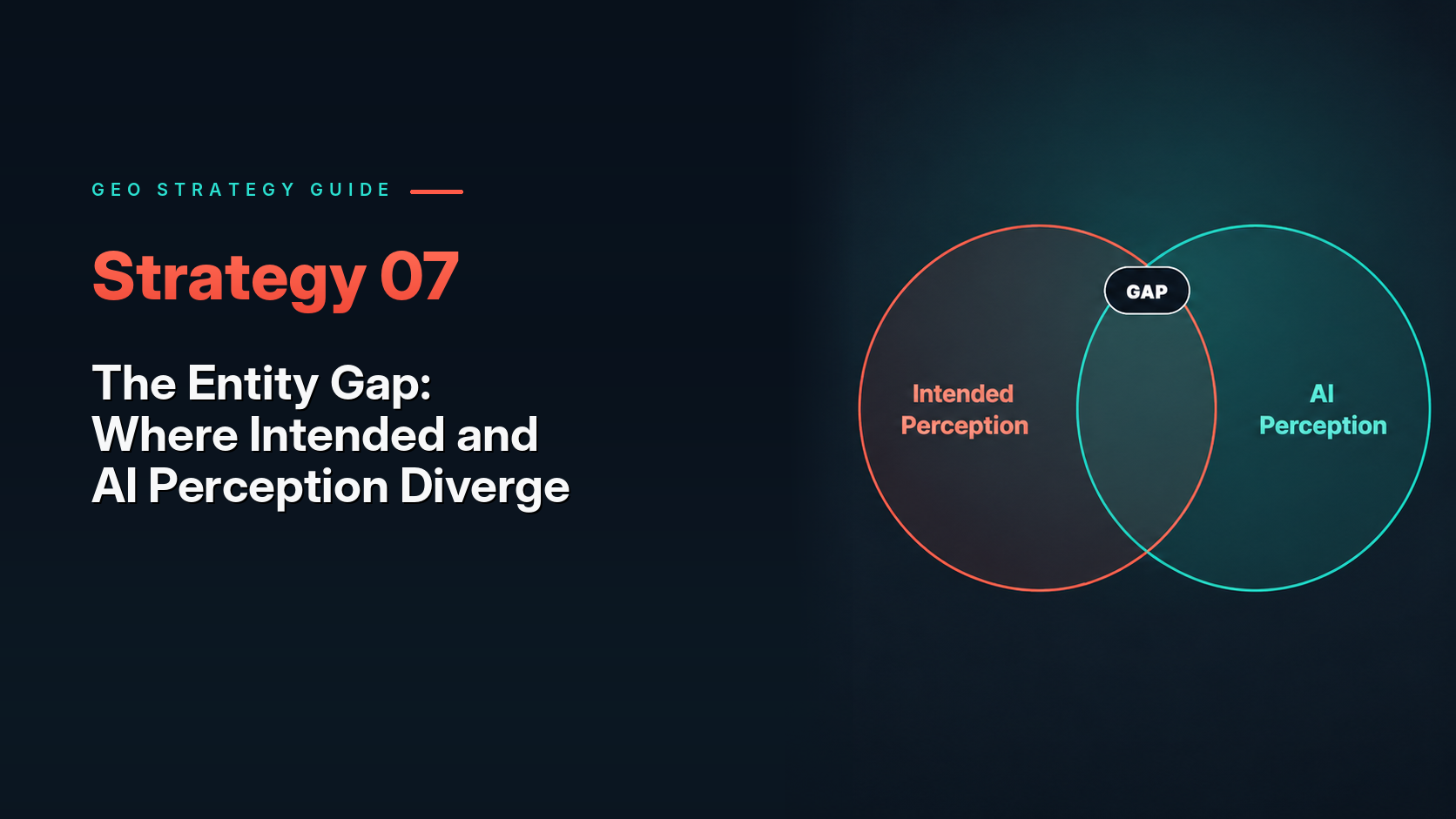
- An entity gap is the difference between how a brand intends to be perceived and how AI actually describes it. AI reads that perception from web-wide information traces, not brand intent.
- There are five distinct types: category gap, attribute gap, relationship gap, CEP gap, and trust gap, each with a different cause and a different fix.
- Diagnosing which gap is present matters more than just noting a low visibility score.
AI response analysis isn’t just about confirming your brand shows up in an answer. Measuring whether it appeared, where it ranked, which sources got cited, and whether the framing was positive tells you the current state. It doesn’t tell you why. A drop in brand mentions doesn’t always mean the same underlying problem. Sometimes AI has your brand filed under the wrong category. Sometimes your core product attributes aren’t showing up clearly enough. Sometimes your brand just isn’t connected to the specific situation a user described, or there isn’t enough outside trust signal for AI to recommend you with confidence.
That’s why AI response analysis has to go one step past “did we show up?” You need to be asking: What kind of brand does AI think we are? Which situations get us recommended, and which get us excluded? What reasoning does AI give when it does recommend us? Does that reasoning match the positioning we intended? And are the sources AI is drawing from actually trustworthy? Answer these, and AI response analysis stops being a visibility check and becomes an actual diagnostic tool for brand perception.
What an Entity Gap Actually Is
The framework for this diagnosis is the entity gap, the difference between how a brand has intentionally presented itself and how AI actually constructs that brand in its answers. “Intended” here doesn’t mean the image someone on the brand team pictures in their head. It means what’s actually written on the official website, product pages, FAQs, comparison content, product data, and brand descriptions. AI doesn’t read a brand manager’s intentions. It reads the trail of information left across the web. So when AI describes your brand differently than intended, the cause usually isn’t AI itself. It’s more likely the information structure AI has to work with.
AI doesn’t just copy one official page and repeat it back. It searches across many sources, looks for language and evidence that repeats and seems credible, and combines that into an answer: official sites, product pages, reviews, communities, media articles, expert content, video, purchase pages, and FAQs all feed into it. That means single-page optimization isn’t enough for brand management in the AI era. What matters is aligning the brand signals scattered across all these sources so they point the same direction.
Say your official site describes a product as “a gentle, mineral-based sunscreen for sensitive skin.” But outside reviews only ever call it “an affordable sunscreen,” community posts talk about it purely as a “tone-up sunscreen,” and old reviews are full of complaints about white cast. AI won’t understand your brand strictly according to the official site’s framing. It reads all the traces left across the market and weights its answer toward whichever signal repeats most and looks most credible. The gap between your official intent and AI’s actual answer is the entity gap.
Five Types of Entity Gap
Entity gaps break down into five broad types: category gap, attribute gap, relationship gap, CEP gap, and trust gap. All five come from how AI understands a brand, but each has a different cause and a different fix. What matters in AI response analysis isn’t just noting that a score is low. It’s identifying which type of gap you’re actually looking at.
1. Category gap
Category gap happens when AI files your brand under a different category than you intended. A brand wants to be understood as a “dermatologist-developed skincare brand for sensitive skin,” but AI describes it simply as “a sunscreen brand” or “a tone-up sunscreen brand.” That’s a category gap. This isn’t a case of the brand being unknown. It’s known, but AI has filed it under a different bucket than the one the brand wants.
Category gap affects every recommendation context downstream. If AI understands your brand as “a regular sunscreen” instead of “dermatological skincare,” it’s less likely to surface for sensitive-skin or gentle-formula questions. It might still show up for tone-up or budget-focused questions, but if that’s not the position the brand wants to hold long-term, that visibility isn’t really a win. Closing a category gap means using consistent category language: in brand descriptions, product pages, category explanations, FAQs, and comparison content. Instead of a broad phrase like “a good sunscreen,” repeat the specific category you actually want to occupy: “sensitive skin,” “dermatological skincare,” “gentle mineral formula,” “irritation-tested.”
2. Attribute gap
Attribute gap happens when the core product attributes you want to emphasize don’t show up clearly in AI’s answer. Where category gap is about which bucket AI puts you in, attribute gap is about which specific features AI actually remembers and describes. A brand wants “gentle,” “mineral filter,” “minimal white cast,” “won’t sting eyes,” “good under makeup,” and “safe for acne-prone skin” to be the story. But if AI’s answer only mentions “affordable” or “popular” or “lots of reviews,” that’s an attribute gap.
This shows up most often in product-recommendation questions. Ask AI “recommend a sunscreen for daily use on sensitive skin,” and even if it mentions your brand, if the stated reason is “high sales volume” or “reasonable price,” it hasn’t actually connected to the attributes you intended. A mention alone isn’t the goal. Being mentioned for the right reasons is. If your brand appears but the explanation doesn’t match your intended attributes, brand perception hasn’t really formed yet.
Closing an attribute gap means making core attributes concrete, in the same language users actually search with, across product pages, FAQs, usage guides, review prompts, and comparison content. Abstract language like “gentle” isn’t enough on its own. Spell it out the way people actually ask: “won’t sting your eyes,” “doesn’t pill even applied before makeup,” “minimal white cast, easy for daily use,” “tested for comfort on sensitive skin.” AI links an attribute to a brand more easily once specific phrasing like this repeats across multiple sources.
3. Relationship gap
Relationship gap happens when AI does mention your brand alongside competitors, but fails to explain what makes your brand distinct within that group. This isn’t a visibility problem: your brand is visible, but described in nearly identical terms to everyone else, so any unique reason to choose it disappears. Say AI recommends “a good sunscreen for sensitive skin” and lists Brand A, Brand B, and yours together. If all three get described as “gentle,” “suitable for sensitive skin,” and “fine for daily use,” your brand hasn’t really carved out a distinct position.
Relationship gap shows up clearly in comparison-style questions. Users asking “which has the least white cast?” or “which is best to wear before makeup?” or “which is gentlest for acne-prone skin?” or “which brand matters more for skin comfort than price?” want a clear answer, not a tie. If AI can’t construct that comparison axis, your brand might make the candidate list without giving anyone a real reason to pick it.
Closing a relationship gap doesn’t mean attacking competitors: it means building clear, comparable criteria. The structure needed is “we’re the better fit under these specific conditions,” not “we’re just better.” Content like “how to choose a low-white-cast mineral sunscreen,” “what makes a sunscreen good to wear before makeup,” or “how to pick sunscreen by skin type” helps AI construct the relationships between brands. Once it’s clear where your brand is strong and in what situations it particularly fits, AI can describe it in a more specific role.
4. CEP gap
CEP gap happens when your brand doesn’t get called up for a specific consumer situation, even if it has decent category-level awareness. A brand might show up for “recommend a gentle sunscreen” but disappear for “sunscreen that won’t pill before makeup,” “sunscreen okay to use after a dermatology treatment,” “sunscreen for acne-prone skin,” or “daily sunscreen that doesn’t sting eyes.” The issue here isn’t overall brand awareness. It’s the connection to that specific CEP.
CEP gap matters enormously for brand management in the AI era. AI doesn’t treat a question as a single keyword. It reads it as a situation with conditions attached. “Sunscreen for exercise,” “sunscreen to apply before makeup,” “sunscreen after a dermatology visit,” “sunscreen for acne-prone skin,” “sunscreen for using around kids,” and “sunscreen that doesn’t sting eyes” are all different consumer situations, even though they’re all “sunscreen.” Looking at which situations call up your brand and which ones don’t reveals which CEPs you actually own, and which ones you’re missing.
Closing a CEP gap requires content that directly addresses that specific use situation. A single line buried in a product page saying “suitable for various situations” isn’t enough. You need situational FAQs, comparison content, review language, expert explanations, and outside content all reinforcing the same scene. If you want to own “sunscreen that won’t pill before makeup,” the texture, absorption, pilling behavior, white-cast level, and real usage feedback all need to connect concretely to that specific scenario. AI can only recommend a brand for a specific situation if there’s enough information trail actually connecting the two.
5. Trust gap
Trust gap happens when there’s a gap between what your owned media claims and the outside trust signals AI actually references. Your official site might say “safe for sensitive skin,” “irritation-tested,” “minimal white cast.” But if outside reviews, expert content, media coverage, community posts, and buyer feedback don’t repeat those claims enough, AI has a hard time treating them as strong evidence. AI doesn’t build its answer purely on a brand’s own claims. It weighs signals confirmed across multiple sources and constructs its answer around whichever information looks most credible.
Trust gap isn’t just about volume of sources. It’s also about quality and recency. Say a product was reformulated and white cast improved significantly, but most reviews online still describe the old version. If AI cites those older reviews and answers “has a white cast,” there’s a mismatch between the current product and what AI says about it. The issue there isn’t that the brand failed to explain the update: it’s that there isn’t enough current, credible outside evidence for AI to reference. An updated official page doesn’t fix this if the surrounding information ecosystem hasn’t caught up.
Closing a trust gap means aligning what owned media claims with what earned media confirms. The core buying factors and evidence your official site emphasizes need to repeat in the language of outside reviews, expert content, media coverage, community discussion, and buyer feedback. It’s also worth checking whether the sources AI cites most often actually reflect your product’s current state. A trust gap isn’t a question of “did we say it.” It’s a question of “is it actually being confirmed in the market in a way AI can trust and cite.”
Each Gap Needs a Different Response
These five gaps each call for a different fix. Category gap means clarifying your brand definition and category language first. Attribute gap means making core buying factors more concrete across product details, FAQs, review language, usage guides, and comparison content. Relationship gap means clarifying comparison criteria and relative strengths against competitors. CEP gap means building content and review signal that directly addresses specific use situations. Trust gap means checking the quality and recency of outside sources and aligning owned-media claims with outside trust signals.
What matters most is not treating an entity gap diagnosis as a one-time event. AI’s answers aren’t fixed. New content gets published, reviews accumulate, communities repeat different phrasing, and new media or expert content shows up, all of which can shift how AI understands your brand. That’s why you need a core prompt set you ask on a regular cadence, tracking which category your brand gets described under, which attributes it’s recommended for, which competitors it appears alongside, which CEPs it’s missing from, and which sources back all of it up.
The most common mistake in brand diagnosis for the AI era is managing only whether the brand appeared in an answer or not. Appearance is just the starting point. What matters more is figuring out which coordinate AI has placed your brand at, whether that coordinate matches your intended brand strategy, and if it doesn’t, which information signal needs reinforcing. AI response analysis, in the end, isn’t a visibility check. It’s a way of setting correction priorities. Getting AI to understand and recommend your brand the way you intend means continuously checking and aligning the entire trail of information behind the answer, not just the answer itself.
FAQ
The difference between how a brand intends to be perceived, based on what’s actually written across its official channels, and how AI actually constructs and describes that brand in its answers.
Category gap (AI files you under the wrong category), attribute gap (your key features aren’t showing up), relationship gap (you’re mentioned but not differentiated from competitors), CEP gap (you’re missing from a specific situation), and trust gap (your claims aren’t confirmed by outside evidence).
Because each type has a different cause and a different fix. A category gap needs clearer category language; a trust gap needs stronger, more current outside evidence. Treating every gap the same way (just “make more content”) usually doesn’t close the specific gap that’s actually hurting you.
Continue the series:
- Find Your Best CEP, Then Link It to Your Brand
- Why Only a Few Brands Come to Mind at the Moment of Choice
- Distinctive Brand Assets: The Memory Cue Behind CEP Ownership
- Turning a Consumer Situation Into a Management Prompt
- What to Measure: CEP Demand and AI Citation Signal
- How to Read an AI Answer: A Framework for AI Response Analysis
- The Entity Gap: Where Intended and AI Perception Diverge (this article)
- An Owned-Media Strategy Built for GEO, Not Just Ads
- Building Reason-to-Believe Into Your Earned Media Strategy
- Brand Ops: Moving From Campaign Management to Citation Management
- GEO for Small Teams: Start With One CEP
- From Search Query to Prompt: Why Top of Mind Isn’t Enough
- How to Read Consumer Context From Search Data, Not Just Keywords