Index
GEO Strategy Series, Part 6 of 13.
Catch up on Part 1, Part 2 ,Part 3, Part4, and Part 5.Key takeaways
- An AI answer isn’t a simple recommendation list: it has three layers: the answer frame, the brand mention, and the content citation.
- Track four KPIs together: brand mention, content citation, brand sentiment, and AI-driven traffic, reading any one alone can be misleading.
- A brand can be mentioned with weak evidence, or have its content cited while the brand itself gets left out, these are two separate problems needing two separate fixes.
Once your management prompts are built, the next step is checking how AI actually answers them. This isn’t a yes/no check on whether your brand showed up. You need to see which CEPs your brand appears as a candidate in, which ones it’s missing from, and, when it does appear, what reasoning and evidence back the recommendation. That’s what tells you whether to strengthen your product pages, situational content, reviews, expert evaluations, or media trust signals next.
This work splits into two stages. First, measure exactly how AI currently reads, compares, and recommends your brand, that’s AI response analysis. Second, interpret the gap between how AI perceives your brand and how you intended it to be perceived, that’s entity gap analysis. If response analysis is about seeing the current state, entity gap analysis is about turning that gap into your next action item.
The full sequence runs: send a management prompt to AI, analyze the response, diagnose the entity gap between intended and actual perception, interpret what type of gap it is, then connect it to the next content task.
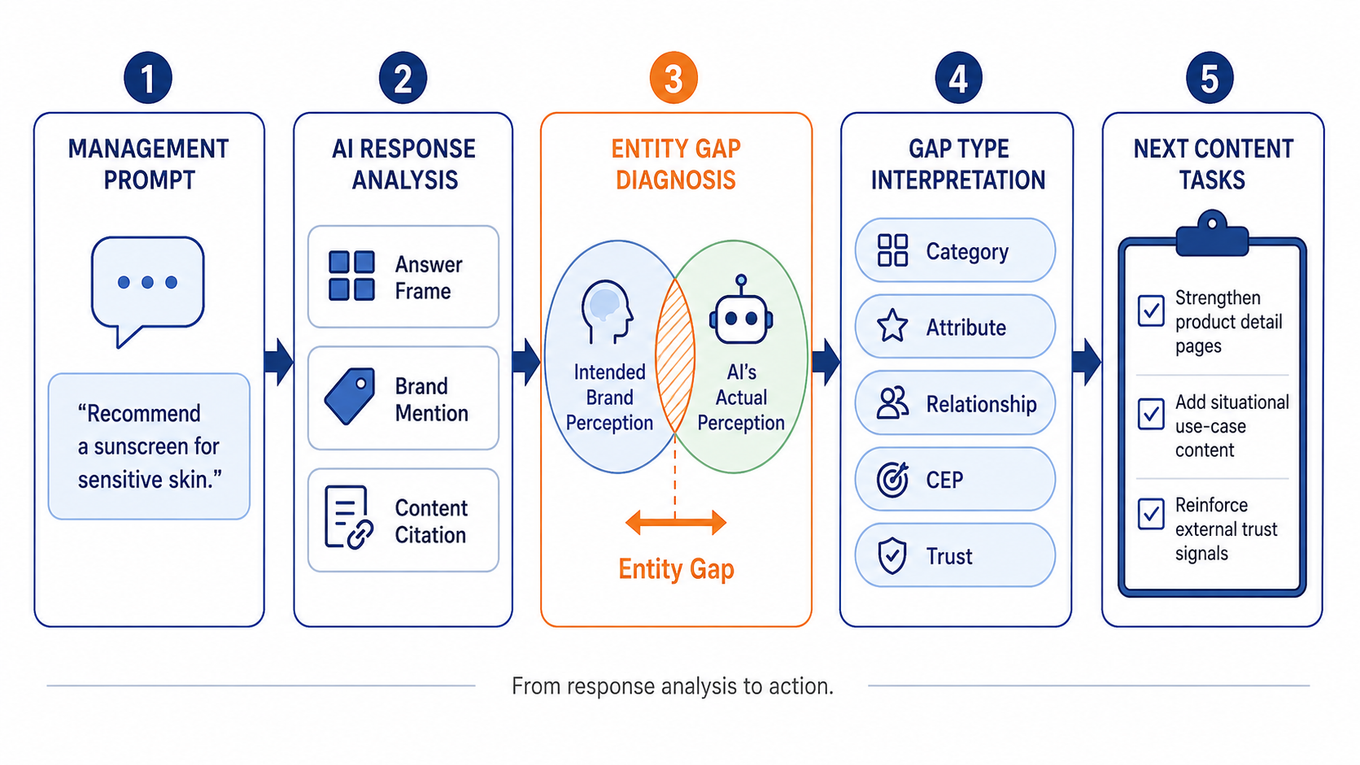
Most Brands Ask the Wrong First Question
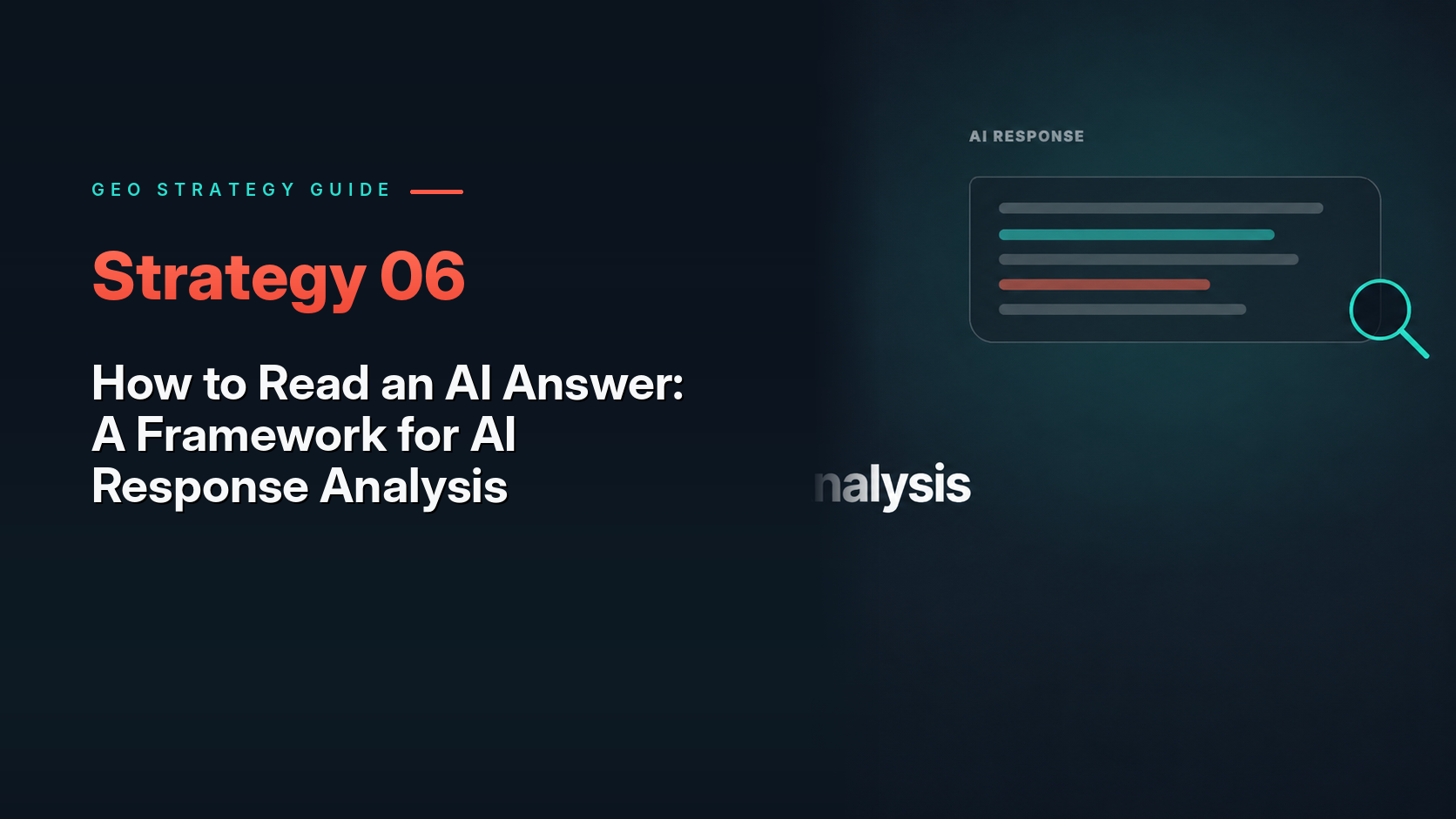
Most brands checking their AI presence only ask “did we show up or not?” But an AI answer isn’t a simple list of recommendations. It has layers: the overall frame AI used to interpret the question and narrow down candidates (the answer frame), how individual brands get discussed within that frame (brand mention), and the sources backing up those mentions (content citation). Let’s look at each layer.
The answer frame is how AI interpreted the question itself. Ask “recommend a sunscreen for sensitive skin,” and the answer changes depending on whether AI treats that as an ingredient-safety question, a patch-test question, or a price-to-satisfaction question based on reviews. The frame AI chooses shapes everything that follows.
Brand mention looks at whether your brand appears in the answer, and if it does, what role it’s given. Where you rank matters less than why you were called up, and for which CEP. Getting described as “the go-to pick for sensitive skin” and getting described as “a cheaper alternative” are two completely different outcomes, even if both count as a “mention.”
Content citation looks at what sources and information AI actually pulled from to build its answer. Official product pages, brand sites, FAQs, reviews, community posts, media articles, and video content are all raw material AI can draw on. What matters isn’t whether a source exists, it’s whether the specific sentence or passage cited actually answers the user’s question directly. For “sunscreen that won’t pill under makeup,” a concrete claim like “minimal white cast” or “feels great under makeup” carries far more weight than a plain ingredient list.
Four KPIs to Track
In practice, AI response analysis breaks down into four trackable metrics.
Brand mention: how often your brand shows up in non-branded prompts, the ones that don’t name any brand.
Content citation: which sources AI leans on to explain your brand: your own content, outside reviews, community posts, or media coverage.
Brand sentiment: whether AI frames your brand in a positive, neutral, or negative context.
AI-driven traffic, which real users actually land on which pages through links or recommendations inside an AI answer.
Read These Together, Not in Isolation
These four numbers mean little read one at a time. High brand mention with weak content citation can mean AI is talking about your brand without solid grounding. High content citation with negative sentiment can mean the sources getting cited are actually working against you. Positive mentions with no AI-driven traffic can mean you’re earning trust but failing to convert it into a deeper brand experience.
The two worth watching together most closely are brand mention and content citation. A brand can show up as a recommended candidate while the evidence behind it leans on outdated reviews or third-party retailer copy. The reverse happens too: your own content gets cited while the brand itself gets left out of the actual recommendation. Whether your brand appears in an AI answer, and whether that answer’s evidence comes from your own content, are two separate questions.
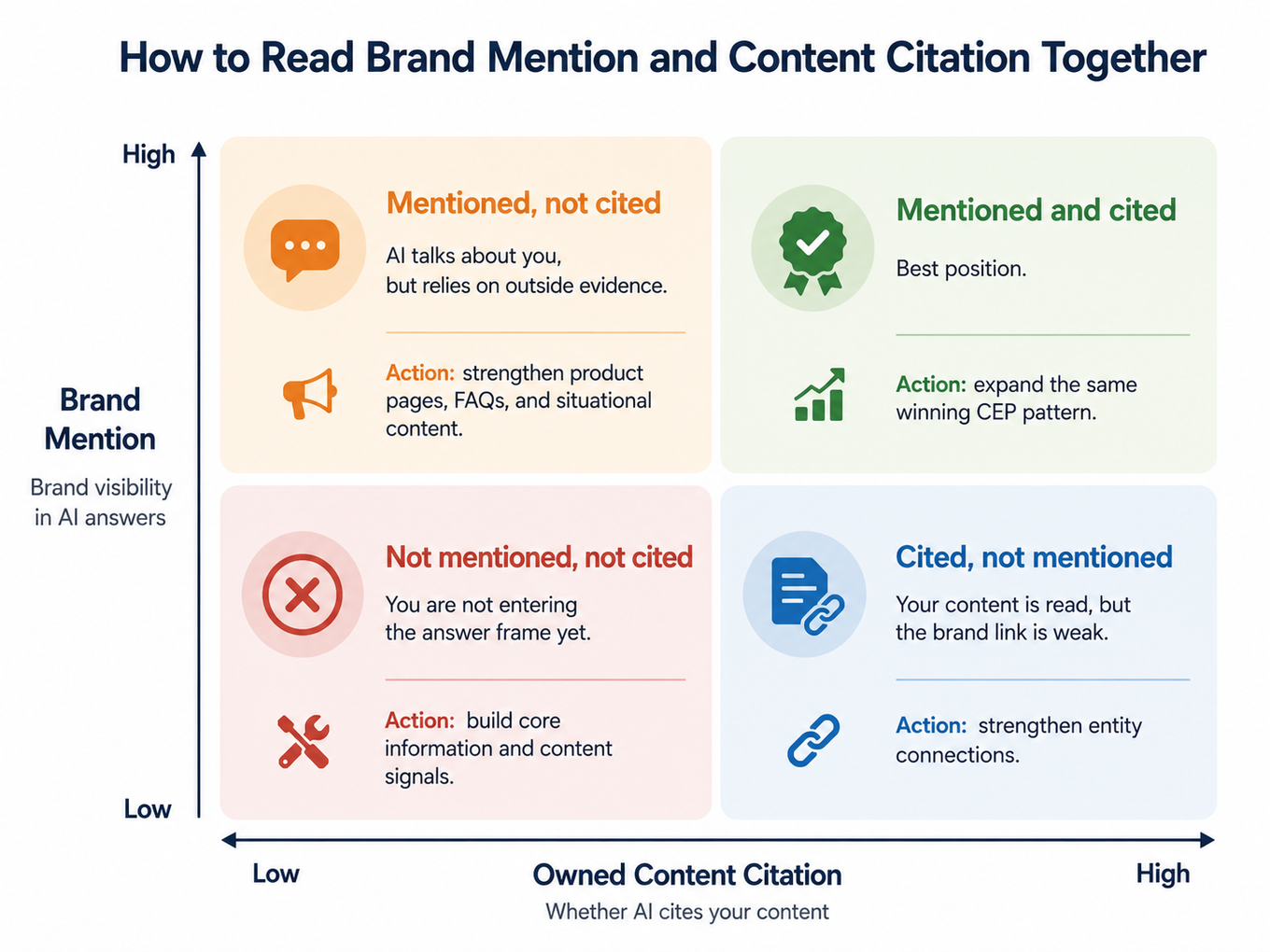
If both brand mention and owned-content citation are high, that’s the strongest position, expand the same pattern that’s already working into more CEPs. High mention with low owned-content citation means AI is talking about your brand, but leaning on outside information to do it: reinforce your product pages, FAQs, and situational content. Low mention with high owned-content citation means your content is getting read, but the link between your brand, product, attributes, and use case is still weak, sharpen the entity connections inside your content. If both are low, you haven’t earned a real foothold in AI’s answers yet, and need to build basic information and content signal from the ground up.
What This Is Really For
The goal of AI response analysis isn’t confirming visibility. It’s reading which questions bring your brand to mind, what reasoning AI gives, and what evidence that reasoning rests on. Looking at brand mention alone can lead to false confidence. Looking at content citation alone can lead to false despair. Only when you read both together does it become clear what to strengthen next, which CEP to prioritize, and where brand management needs to head in the AI era.
FAQ
The answer frame (how AI interpreted the question), the brand mention (whether and how your brand is discussed), and the content citation (what sources AI actually drew from to build the answer). Checking only whether your brand “showed up” misses the other two layers.
Four, read together: brand mention (how often you appear in non-branded prompts), content citation (which sources AI cites when explaining you), brand sentiment (positive, neutral, or negative framing), and AI-driven traffic (real visits generated through AI answers).
It usually means AI is talking about your brand, but leaning on outside information (old reviews, third-party retailer copy) to do it. The fix is reinforcing your own product pages, FAQs, and situational content so AI has stronger owned evidence to cite.
Continue the series:
- Find Your Best CEP, Then Link It to Your Brand
- Why Only a Few Brands Come to Mind at the Moment of Choice
- Distinctive Brand Assets: The Memory Cue Behind CEP Ownership
- Turning a Consumer Situation Into a Management Prompt
- What to Measure: CEP Demand and AI Citation Signal
- How to Read an AI Answer: A Framework for AI Response Analysis (this article)
- The Entity Gap: Where Intended and AI Perception Diverge
- An Owned-Media Strategy Built for GEO, Not Just Ads
- Building Reason-to-Believe Into Your Earned Media Strategy
- Brand Ops: Moving From Campaign Management to Citation Management
- GEO for Small Teams: Start With One CEP
- From Search Query to Prompt: Why Top of Mind Isn’t Enough
- How to Read Consumer Context From Search Data, Not Just Keywords