Index
Recently, I had the opportunity to speak at Search SEOul 2026, where marketers and SEO professionals from Korea and around the world came together to discuss how search is changing.
My keynote started with Generative Engine Optimization and its current place in the search landscape. But the core message went beyond GEO: consumers already use AI to find, compare, and get recommended products. That’s a shift beyond GEO into AI commerce, and it’s already underway.
As AI takes on a bigger role in the customer journey, the question is no longer just whether AI can find and recommend your brand. What happens when the customer itself becomes an agent that can choose a product and eventually complete the purchase?
This post is that keynote, in writing.
Search SEOul 2026 · KEYNOTE RECAP
The customer agent is arriving
Korea’s monthly search volume dropped from 11.44 billion to 10.56 billion over three years, from August 2023 to June 2026. Most of that decline traces back to Naver, which lost 1.70 billion searches. Google only absorbed 0.82 billion of them.
The rest didn’t move to another search engine. It moved to AI answers instead. Globally, the zero-click search rate climbed from 43.9% in 2016 to 60% in 2025.
The real issue isn’t traffic loss. It’s who owns the moment a customer meets your brand. Purchase decisions can now close inside an AI answer, before a shopper ever reaches your site. That costs brands three things at once: lead capture, brand experience, and behavioral data.
That said, the shift isn’t all downside. AI referred visitors convert 42% more often, spend 37% more per visit, and bounce 32% less than average visitors (Adobe Digital Insights, April 2026). Smaller volume, much higher intent.

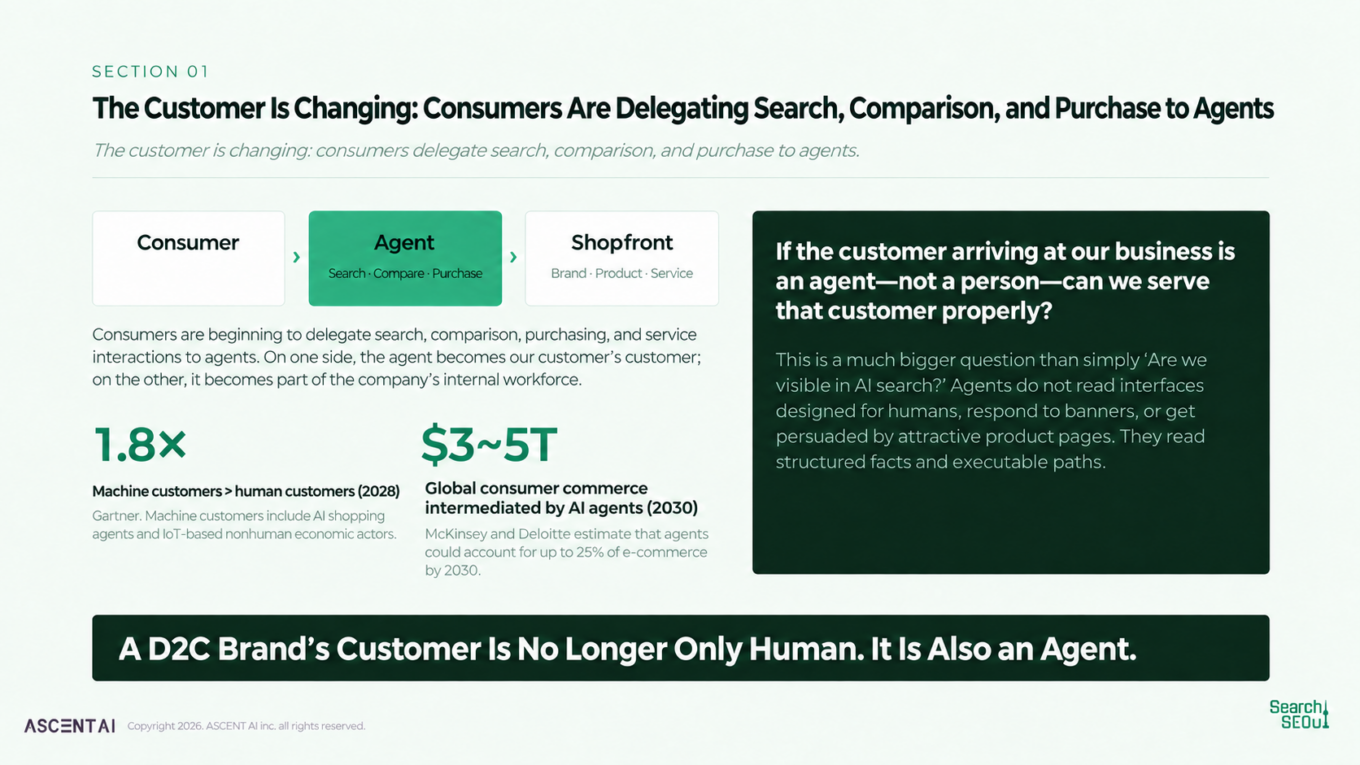
The deeper change: customers themselves are becoming agents. Gartner projects machine customers will outnumber human customers 1.8-to-1 by 2028. McKinsey and Deloitte put the AI agent mediated consumer commerce market at $3 trillion to $5 trillion by 2030.
“If the customer walking into your business isn’t a person but an agent, can you actually serve it?”
Agents don’t read UI built for humans. They don’t respond to banners. They aren’t swayed by a beautifully designed product page. They rely on structured facts and executable paths rather than the visual cues designed to persuade human shoppers.
Three questions every brand now has to answer
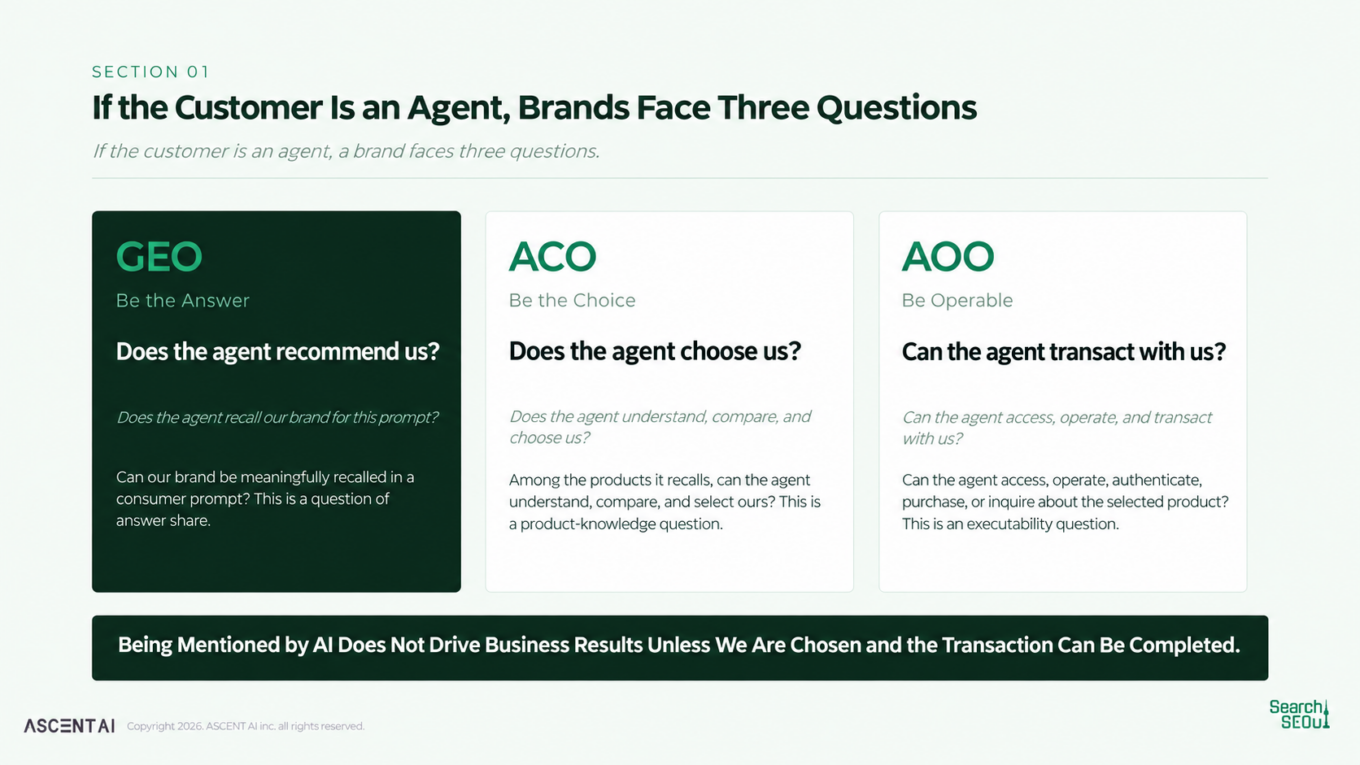
Once the customer is an agent, three questions decide whether you get the sale:
GEO·BE THE ANSWER: Does AI recommend you?
ACO·BE THE CHOICE: Does the agent choose you?
AOO·BE OPERABLE: Can the agent actually transact with you?
Getting mentioned isn’t enough. If the agent can’t choose you or complete the transaction, the mention never becomes revenue. These three questions are the spine of everything below.
Intent lives inside the prompt
Ask an AI “recommend a protein bar,” and it lists categories: protein bars, cookies, granola. Ask AI another question like “recommend a protein snack that won’t get my hands messy, for the 20-minute walk from work to the gym,” and it names one brand, complete with reasons.
A prompt isn’t a keyword. It’s a purchase situation, written out in natural language, at full resolution.
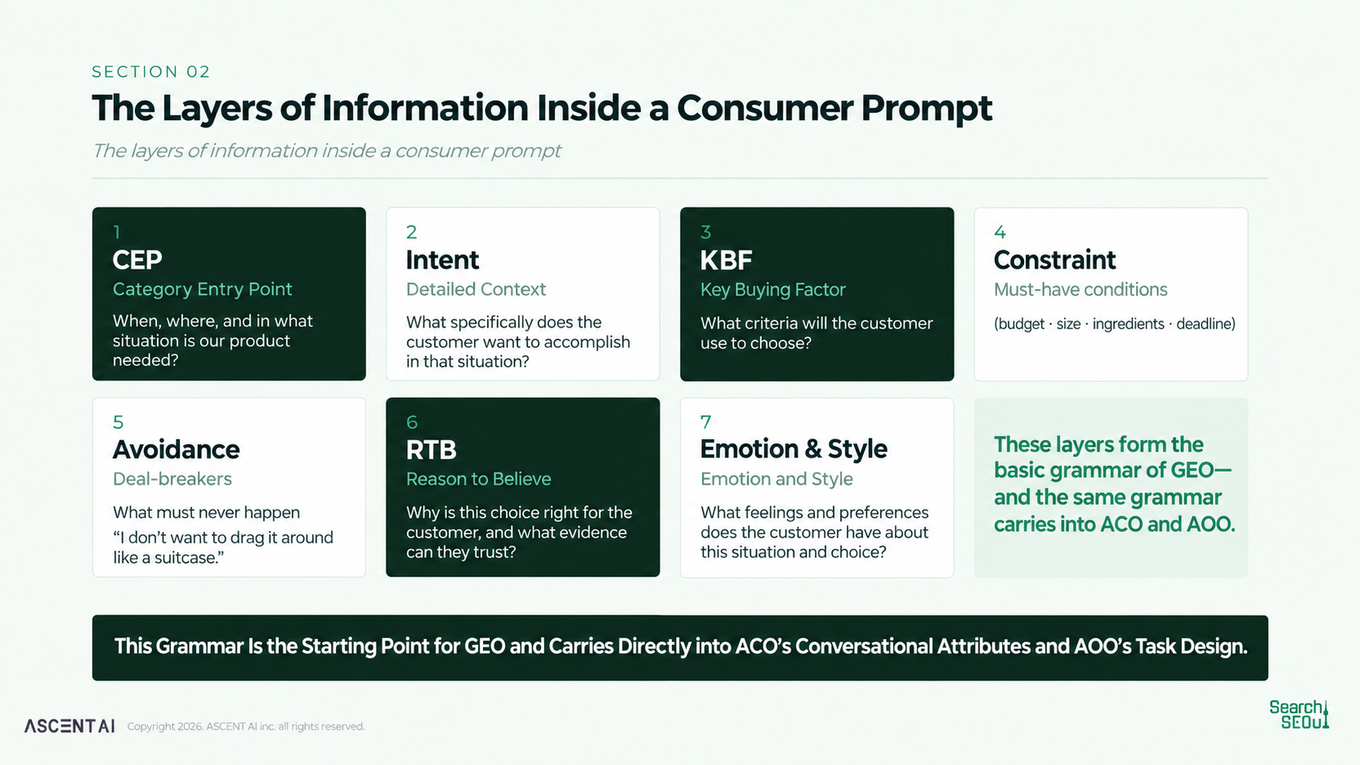
Inside that prompt sits a stack of signals.
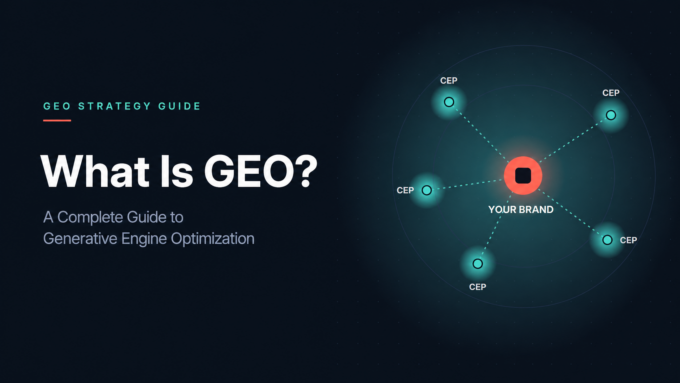
- CEP (what situation triggers the need), intent (what the person wants to do),
- KBF (what they’re weighing it against), constraints and things to avoid,
- RTB (what evidence they’ll trust), and emotional tone.
AI doesn’t read a brand as a name. It reads a brand as a coordinate in a multidimensional vector space, then calls whichever brand sits closest to the prompt’s coordinates.
“Humans remember names. AI calculates relationships.”
The situation that triggers a prompt always comes before the brand. Someone searching “compare IRA providers” already went through a layoff notice first. That upstream situation data rarely lives in a company’s CRM. It lives in search data instead.
GEO: own the AI’s semantic space
Branding now happens in two spaces at once: human memory (does the brand come to mind for a given CEP?) and AI’s semantic space (does the brand get generated for a given prompt?). Miss either one, and the brand disappears at that touchpoint.
GEO isn’t about how many times a brand name shows up. It’s about designing the semantic neighborhood AI reads a brand through.
The data backs this up. Sulwhasoo, Korea’s top searched luxury skincare brand, doesn’t get called for “menopause skincare.” Avène and La Roche-Posay do instead. “Eye cream for your 50s” goes to AHC. Brands have to win each purchase scene individually, not just their category. Owning a keyword isn’t the goal anymore. Owning the purchase scene is.
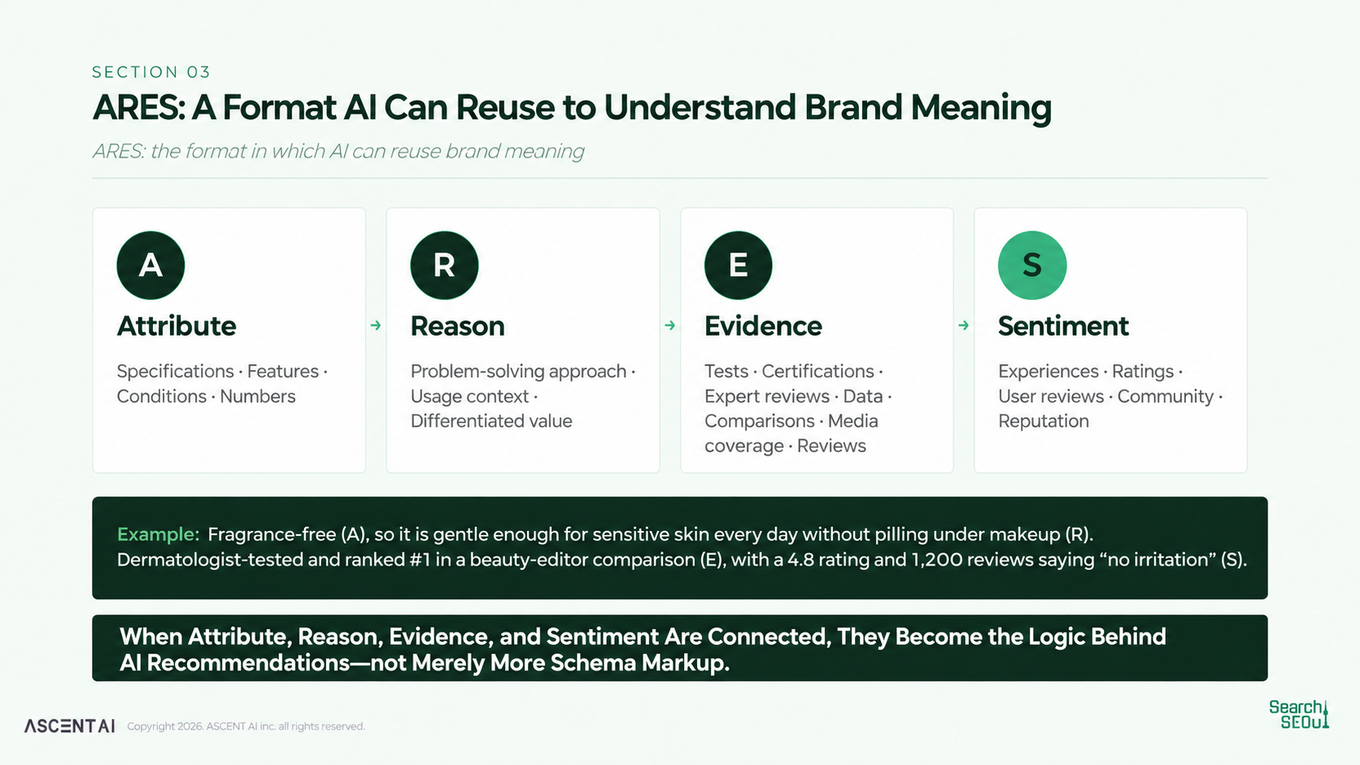
In practice, that means running a loop:
- find the CEP, define a managed prompt, analyze AI responses
- find content gaps, then reinforce owned and trust evidence media
- Gaps break down into five types: category, CEP, attribute, relationship, and trust. GEO isn’t a content project.
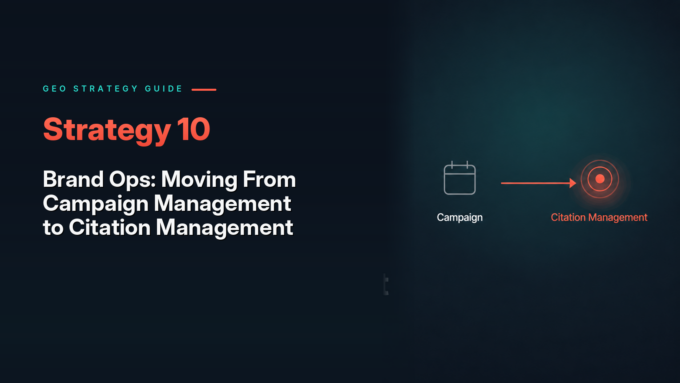
It’s an operating loop, measured by managed prompt, not keyword, and run by CEP, not campaign.
Korea’s media landscape has its own quirks worth flagging. Press and media dependency is the lowest of 13 countries surveyed, at 35.6%. Blog dependency is the highest, at 16.5%. Namu Wiki gets cited 3.8 times more often than Wikipedia. Naver blogs barely get cited by ChatGPT or Gemini, though. Open web platforms like Tistory are practically required if those two models matter to you.
ACO: from recommendation to choice
GEO covers brand knowledge. ACO extends the same logic (CEP, KBF, RTB, evidence) to product knowledge. The question shifts from “does the agent recall us?” to “does the agent choose us?”
Agents check 10 dimensions before picking a product: identity, attributes, offer (price), availability, reviews and evidence, compatibility, substitution options, shipping, return policy, and trust signals. On top of that, they need a conversational layer that answers real customer questions (“is this shoe waterproof?”) and a negotiation layer for bundling and swapping items. The agent isn’t picking one product: it’s assembling a cart.
The practical fix: build one product master that renders two ways, a human readable page and machine readable structured data (exact specs, live stock status, in JSON). One notable detail: Google can already build its own product feed by crawling landing pages, yet it still asks merchants for verified feed data directly. That’s a quiet admission that a page alone isn’t trustworthy enough.
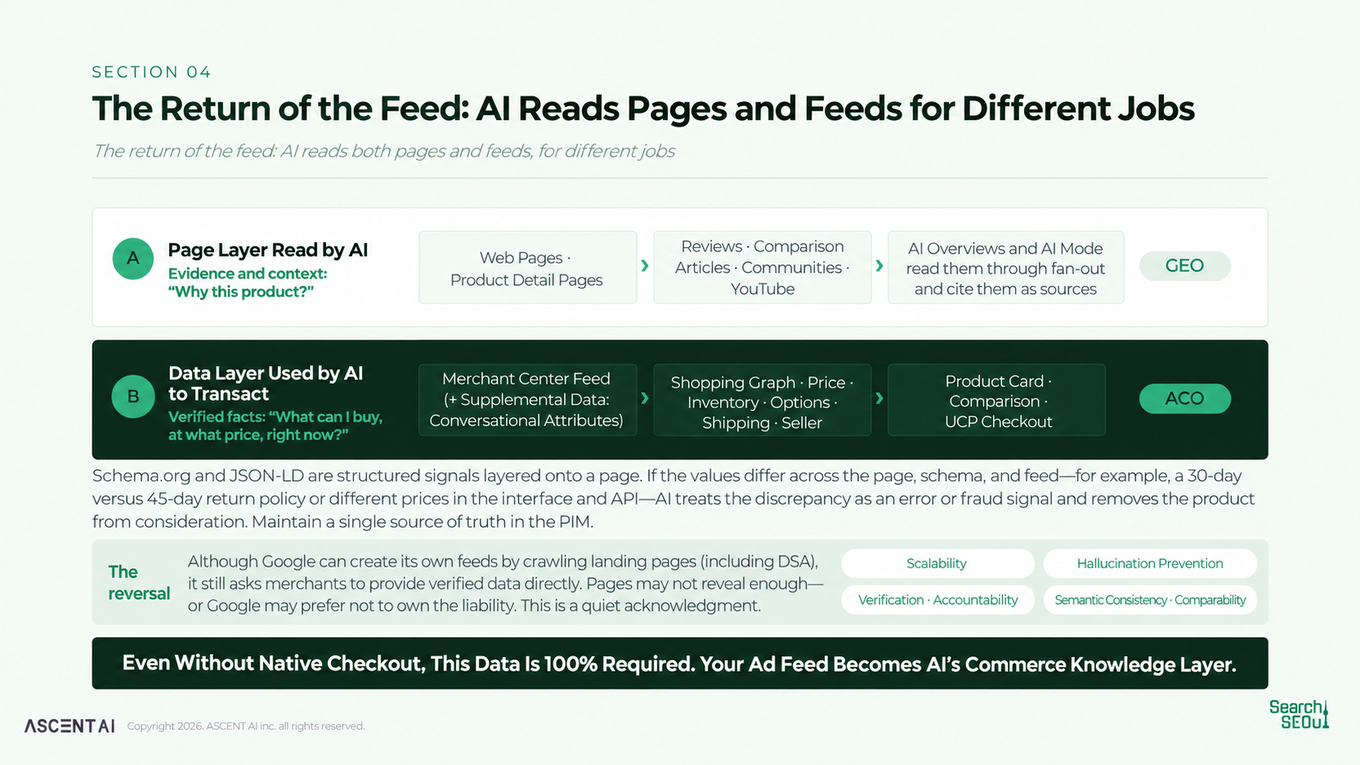
This opens a real, if conditional, opportunity for D2C brands. AI tends to favor data accuracy over brand recognition, which levels the field against large retailers somewhat. The condition: AI has to be able to discover what makes the product different in the first place.
AOO: from choice to action
Getting recommended and chosen means nothing if the agent can’t scroll, click, and complete a guest checkout on your site. ASCENT AI tested 241 Korean company websites. The results:
- 44%(139 sites) blocked agent access outright, some via their own robots.txt file
- 25%(60 sites) let agents in but returned nothing usable
- 9%(22 sites) had the right content, but agents couldn’t find it
- 23%(60 sites) delivered a complete, usable answer
The gap between the best and worst performers was stark. The top scoring site (grade A) let agents discover and complete tasks cleanly. The lowest-scoring site (grade D) had zero links in its raw HTML, so agents couldn’t navigate past the homepage. A site that looks perfectly fine to a human, and ranks well in search, can still fail every agent that visits.
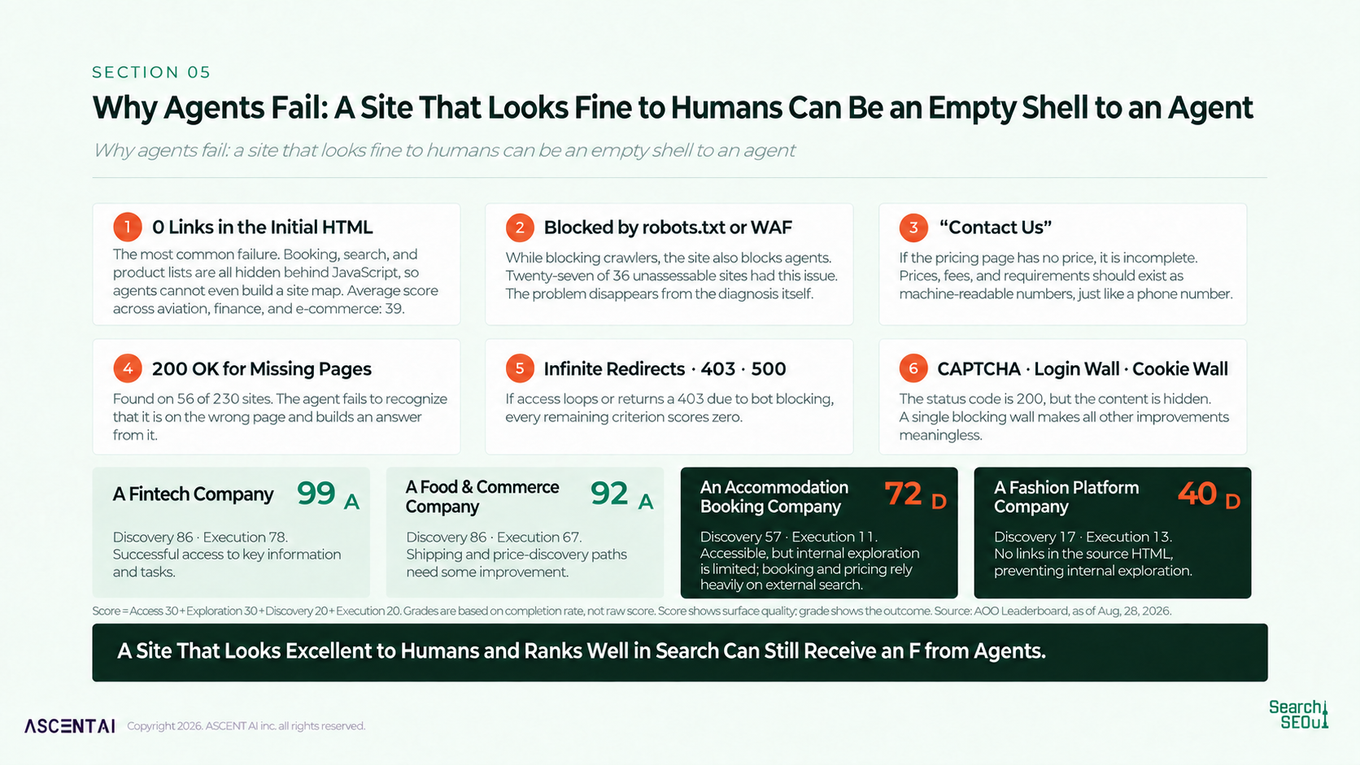
AOO gets measured across five stages: access, navigation, discovery (via llms.txt), completion (real, checkable information), and contract (API/MCP). If access and navigation fail, nothing past that point even gets measured. Start with the basics: stop blocking agents in robots.txt, and put real pricing, shipping, and return information directly on the page.
Conclusion: from logo, to coordinate, to agent
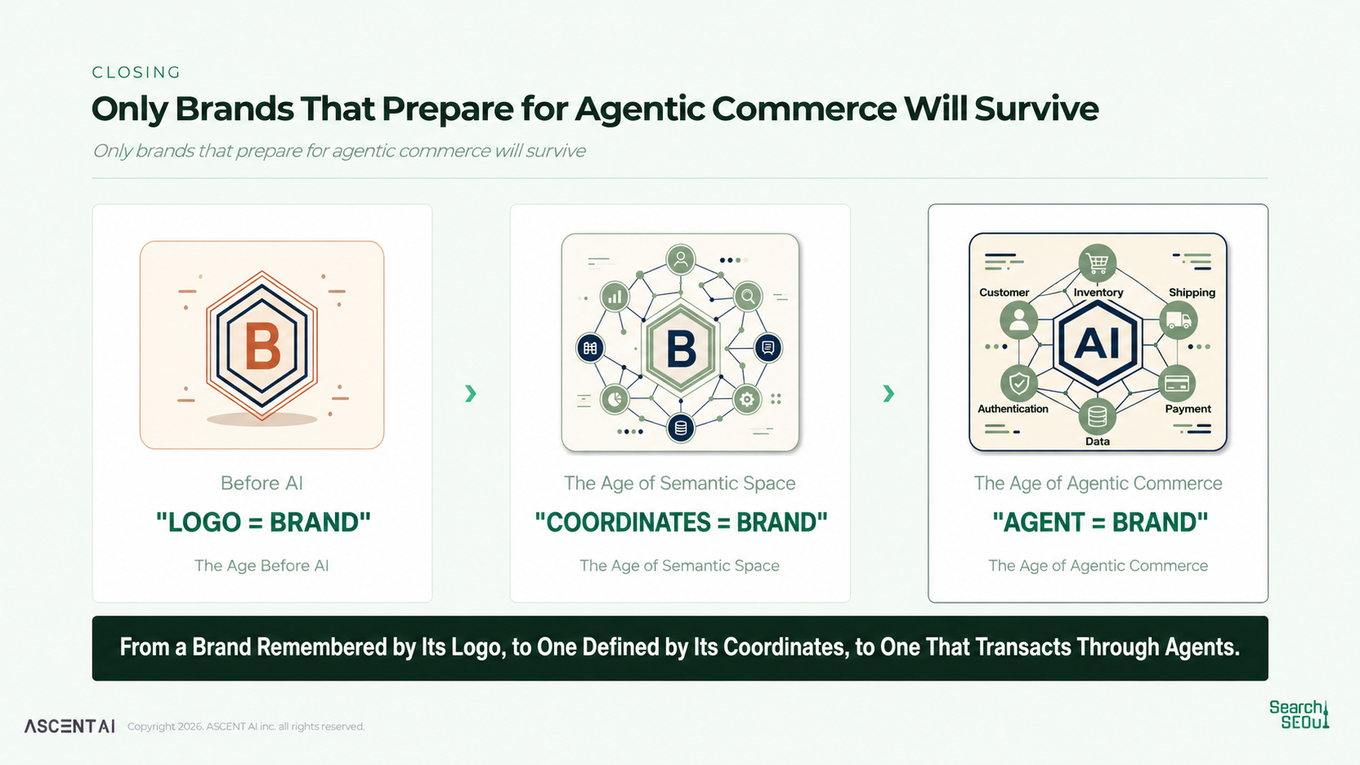
- Before AI: logo = brand
- The semantic-vector era: coordinate = brand
- The agentic commerce era: agent = brand
The customer’s situation starts it all: situation, then CEP, then KBF/constraints/RTB, then the prompt. From there, GEO, ACO, and AOO run in sequence and end at purchase. The interface keeps changing. Why the customer wants this, right now, doesn’t.
TV and print repetition used to be branding. Now branding means getting AI to understand your brand, trust it, and recommend it. The next D2C advantage comes down to two things: build a genuinely good product, and give AI the ability to discover, trust, and buy the difference.
Search SEOul 2026 · Seyong Park, CEO, ASCENT AI