
A large local food keyword feels commercial. Someone searches for a cuisine near them, sees nearby restaurants, and appears ready to spend. It is tempting to treat the search volume as a direct count of buyers.
This episode takes the fifth question from our original Coffee analysis: “Our number one keyword has huge volume. Doesn’t that mean huge buyer intent?”
Thai and Vietnamese search sets both contained prominent dish and recipe terms. That raised a more useful question: when someone first explores either cuisine, do they begin with cultural knowledge, or with a dining experience they are preparing to choose?
To follow that question from initial attention to more specific behavior, we first mapped where cultural learning and experience validation appeared across the customer journey, then checked the search volume attached to those terms. We next examined the themes shared by both cuisines and the themes that separated them. Finally, we compared what people searched next around each seed term. Journey Finder and Query Finder supported the first view, Cluster Finder the second, and Path Finder the final comparison.
Why 1.5 Million Searches Still Do Not Equal 1.5 Million Buyers
In the Thai food Query Finder set, “thai food near me” recorded 1,500,000 monthly searches. “thai restaurant near me” added 673,000, while the broader “thai food” query recorded 550,000.
| Thai query | Monthly search volume |
| thai food near me | 1,500,000 |
| thai restaurant near me | 673,000 |
| thai food | 550,000 |
| pad thai | 264,333 |
| isarn thai soul kitchen kirkland | 49,500 |
That looks close to the bottom of a funnel. The phrase contains a cuisine, a location need, and an implied next step. Yet search volume measures how often the phrase appears. It does not tell us how many people purchased, which restaurant they selected, or whether the search ended in a transaction. It gives us a large demand signal that still needs a behavioral explanation.

High Volume Means More When You Know the Journey Stage
First, we needed to understand whether people were moving through the journey by learning about the cuisine or by validating an experience they were preparing to have. Journey Finder placed the related searches across the customer decision journey, while Query Finder showed whether the terms visible at each stage were isolated examples or meaningful search demand.
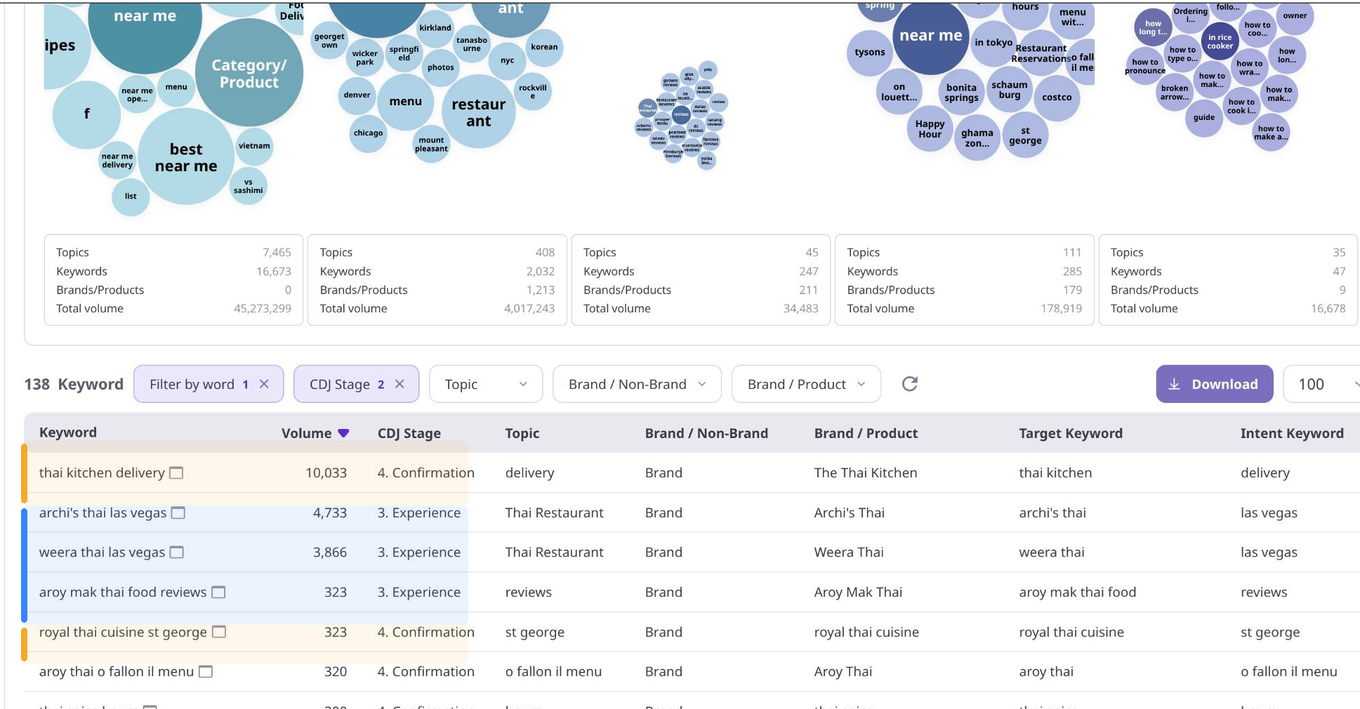
In the selected Thai Experience and Confirmation views, searches moved into delivery, named restaurants, reviews, menus, hours, and locations. “thai kitchen delivery” recorded 10,033 monthly searches. Other visible examples included Archi’s Thai and Weera Thai in Las Vegas, Aroy Mak Thai Food reviews, Royal Thai Cuisine, and menu or hours checks.
The volume and the journey stage answer different questions. Volume shows the size of a term. The CDJ stage shows the decision job it is performing. A review query asks for reassurance. A menu query tests fit. An hours query removes a practical barrier. A delivery query changes how the meal will be obtained.
The Vietnamese view showed a different mix in the captured Initial Exploration data. Visible food terms included “vietnamese restaurant near me” at 450,000, “vietnamese food near me” at 301,000, “vietnamese dishes” at 145,000, “vietnamese pho” at 35,566, and “traditional vietnamese food” at 2,266.
The same view also contained broad language terms such as “vietnamese” and “vietnamese f.” Those are not reliable food demand. The category must be cleaned before its volume is interpreted. Once that context is separated, the remaining terms show local discovery alongside dish, recipe, and traditional food exploration.
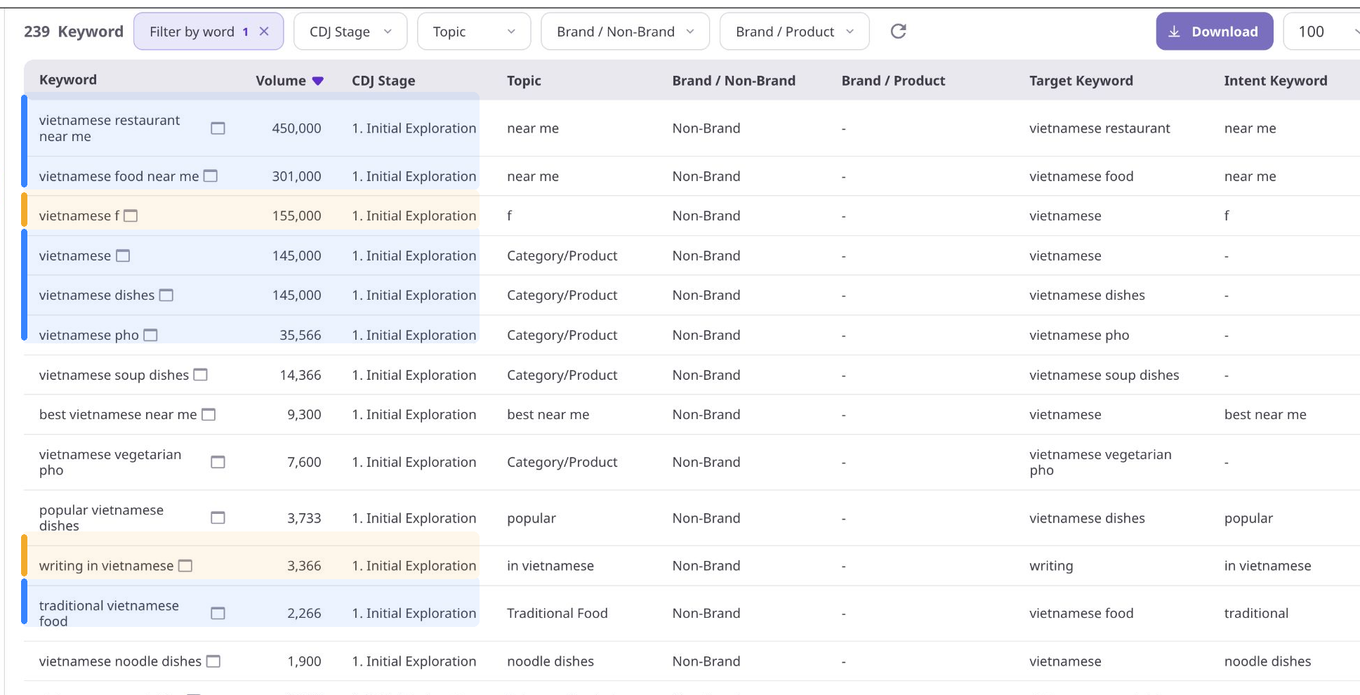
This first view suggested two different directions. Thai showed visible movement into restaurant experience and confirmation. Vietnamese showed more early exploration around dishes, tradition, and access. The pattern was worth testing further, but it was not yet a category wide conclusion.
Shared Cuisine Interest Splits Into Different Decision Routes
Next, we needed to see whether those early journey signals expanded into shared territory or separated into cuisine specific needs. Using Thai food and Vietnamese food as the comparison seeds, Cluster Finder showed which themes appeared around both categories and which clusters developed more strongly around one cuisine.
The shared area included broad cuisine, dish, and recipe themes. A “Thai Food and Culture” cluster reached 539,290 in total volume and carried both seed markers, while a “Vietnamese Cuisine and Recipes” cluster reached 94,281 and also connected to both networks. The overlap shows that a first time explorer can move through dish knowledge, recipes, and cultural context in either category.
The cuisine specific expansions were more revealing. Thai developed visible clusters around recipes, restaurant dining, reviews, and menus. Vietnamese developed clusters around steamed buns, Vietnamese recipes, Westminster restaurant discovery, New Year foods, and other cultural or dish specific themes.
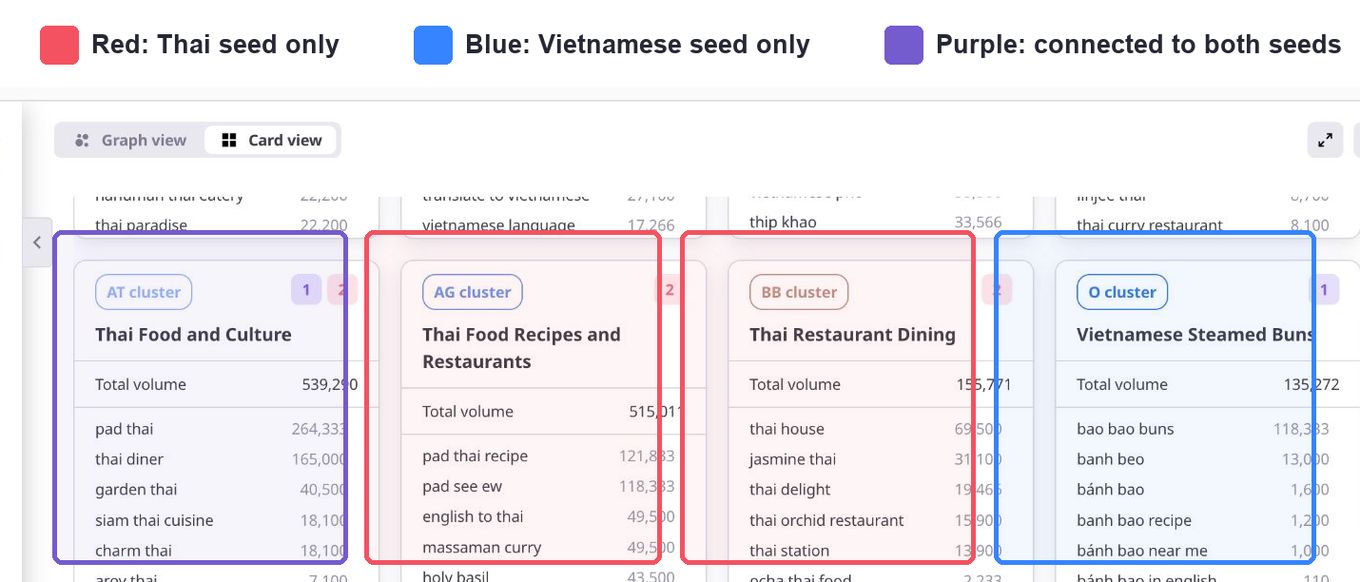
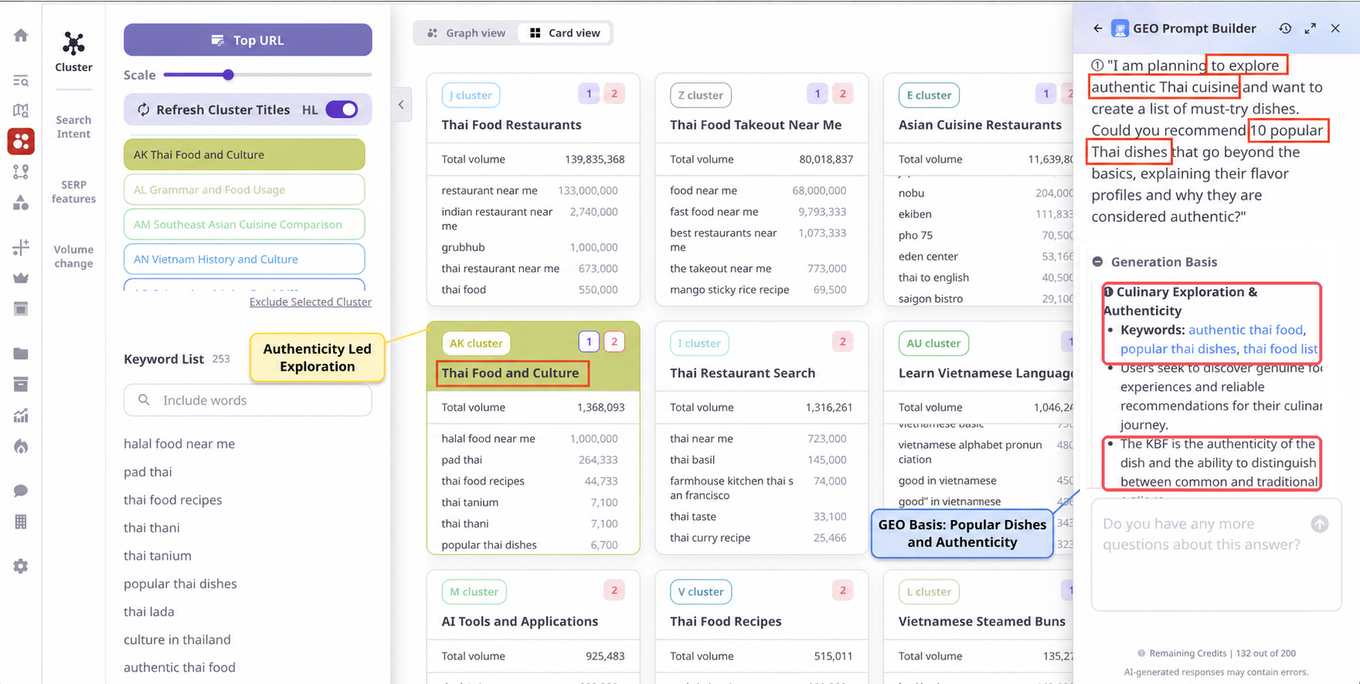
Cluster titles still need inspection. A broad cultural label can be dominated by one large dish term. The label organizes the network, but the keywords and their volumes explain what drives it. For the final publication, a selected cluster can also be checked with the Cluster Finder AI Agent. Persona Analysis or GEO Prompt Builder can summarize the full cluster and test whether the dominant need is cultural learning, practical cooking, restaurant choice, or another behavior.
Two Similar Categories Lead to Different Next Searches
Finally, we needed to see what an early stage explorer investigated next after entering each cuisine. We compared “thai food” and “vietnamese food” as US seed terms in Path Finder Keyword Comparison and asked a specific audience question: if someone is just beginning to explore Southeast Asian food, what does each category lead them to investigate next?
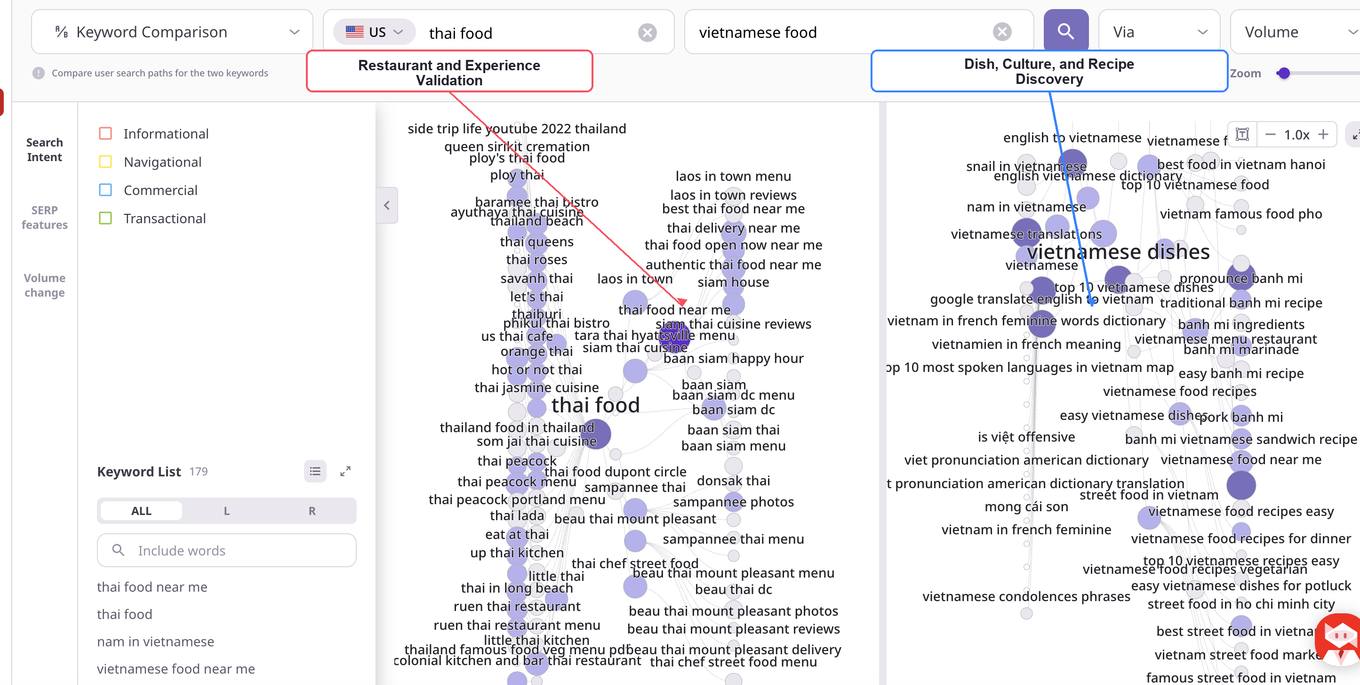
The Thai path is comparatively narrow and experience oriented in this captured network. It moves repeatedly through restaurant names such as Baan Siam, Sampannee Thai, Beau Thai, Thai Jasmine Cuisine, and Siam House, then into menus, reviews, photos, happy hour, delivery, near me, and open now searches. The user is often learning in order to validate a place, remove practical uncertainty, and decide where or how to eat.
The Vietnamese path is wider and more culturally exploratory in the same comparison. Searches move through vietnamese dishes, top 10 vietnamese dishes, traditional banh mi recipe, banh mi ingredients, easy recipes, street food in Vietnam, translation, and pronunciation. Local discovery still appears through vietnamese food near me and banh mi near me, so this is not a purely cultural path. It is a broader learning route that connects cuisine, dish knowledge, language, and eventual access.
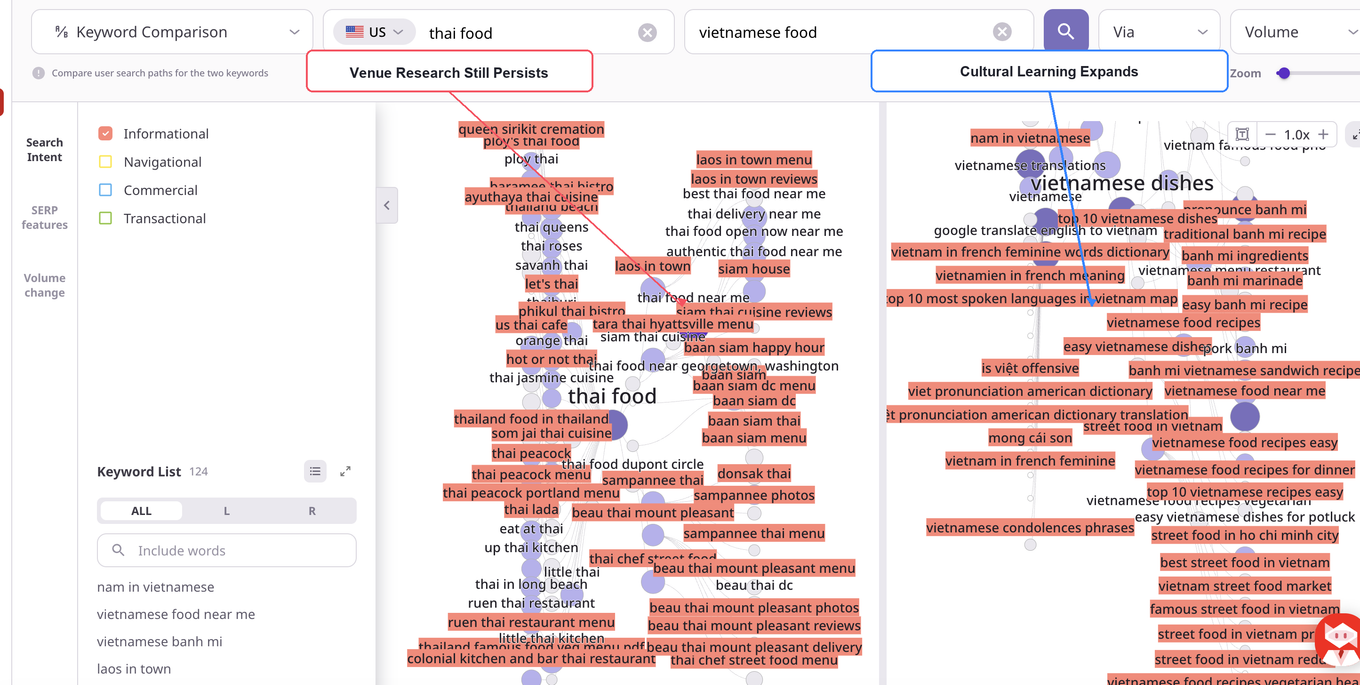
This is why the intent label cannot finish the analysis. Both sides contain Informational searches, but the job performed by that information differs. On the Thai side, information frequently supports a restaurant decision. On the Vietnamese side, it more often helps the user understand the category before narrowing to a dish or local option.
This is a directional reading of the selected paths, not a claim about every US consumer or the total demand for either cuisine. Path Finder shows which behaviors are connected to each seed in this analysis. It does not show that one cuisine has more intent, more buyers, or a larger market.
What the Comparison Actually Revealed
Across the full comparison, both cultural learning and experience based exploration were present, but they were organized differently. Journey and query data showed where meaningful volume appeared in the customer decision journey. The cluster view showed common cuisine and recipe territory followed by cuisine specific expansion. The path comparison then showed that the Thai network leaned toward restaurant and experience validation, while the Vietnamese network leaned more visibly toward dishes, recipes, language, street food, and cultural discovery before local access.
The finding is not that Thai search is only experiential or Vietnamese search is only cultural. Both contain local, practical, and informational behavior. The finding is that the selected networks organize early exploration differently, and a single volume number cannot explain that difference.
Volume Shows Attention and The Path Shows Intent
The 1.5 million keyword is commercially important. It does not represent 1.5 million buyers. It represents a large local decision arena in which consumers move through discovery, comparison, proof, and access.
The final answer A large keyword measures the scale of attention, not the number of buyers. Buyer intent becomes clearer only when volume is connected to the customer decision journey, the themes that expand around the category, and the next searches people make. In this comparison, Thai food more often led an early explorer toward restaurant and experience validation, while Vietnamese food more often expanded through cultural context, dishes, recipes, language, and then local access.
Data note: Query Finder volumes are search estimates from the captured ListeningMind views. Path, Cluster, and Journey examples are selected seed analyses. The Path Finder comparison describes route composition, not the total amount of intent in each cuisine. None of these views should be read as sales, market share, or purchase counts.

Hi, I’m Nam Hyun Cho, part of the Growth team at ListeningMind.
If this content made you curious about what your own category looks like, let’s just look at it together — 15 minutes, your data, no slides.