Why can a basketball shoe remain culturally alive long after its original season, while another disappears when its technology is no longer new? The difference often begins with the athlete. A defining performance gives the shoe an image, fans give that image a memory, and repeated search turns the memory into demand that a brand can renew.
ListeningMind’s U.S. search data makes that cycle visible across three layers of the market. Query Finder compares demand for basketball players, footwear brands and specific signature models. Pathfinder maps how people move through the search language surrounding past icons Michael Jordan and Kobe Bryant and active stars LeBron James and Stephen Curry, connecting highlights, career stories, statistics and shoes. SERP history then checks which performances, releases and news events sit behind changes in volume.
Read together, the data explains why athlete influence remains fundamental to basketball footwear. Fans do not search only for a product specification. They return to the player, the moment and the identity the shoe allows them to wear. That connection between performance, memory and product is what gives a signature line the possibility of becoming immortal.
Great performances become products people keep searching for
Michael Jordan and Kobe Bryant show two versions of basketball immortality. Both remain connected to footwear in search, but the paths around them are different.
ListeningMind Pathfinder shows “Kobe Bryant highlights” branching into his death, last game, family, career, jerseys and shoes. His network is shaped by remembrance. People search for the player’s life and encounter products that keep his identity present.
Jordan’s path is broader and more commercial. Highlights and dunks connect with biography and statistics, while basketball shoes, Air Jordan, gym, golf and Space Jam extend his identity into merchandise and culture.
The contrast matters because search does not preserve every athlete in the same way. Kobe’s footwear appears inside a continuing conversation about a life, a loss and the people around him. Jordan’s footwear appears inside an already expanded cultural system. One path begins with remembrance; the other moves through a commercial vocabulary that has become almost independent of retirement.
Yet both paths arrive at the same category. A performance becomes more durable when people can retrieve it through a player name, recognize it through a visual code and encounter it again as a product. That is where sporting achievement becomes repeatable demand.
Fame must become a searchable product
Athlete fame and footwear demand are related, but they are not identical. The Top 10 athlete name table places current attention beside enduring legacy: LeBron James leads at 42.59 million estimated annual searches, Michael Jordan remains third at 13.499 million, and Stephen Curry reaches 10.202 million. Victor Wembanyama ranks second in name demand yet has no model in the signature Top 10, while Ja Morant ranks seventh and Ja 3 leads the specific model ranking.
The table measures exact athlete name queries. It is not a ranking of ability, cultural value, footwear sales or market share.
The gaps between the athlete and model rankings reveal the commercial challenge. Victor Wembanyama ranks second in athlete name demand but does not place a signature model in the shoes topic Top 10. Ja Morant ranks seventh as an athlete, yet Ja 3 leads every specific basketball shoe query in this analysis. Attention around a person creates an opportunity; a clearly named and distributed product determines whether that attention becomes searchable footwear demand.
Jordan provides the reverse case. He no longer generates live game headlines, but his name still ranks third. That durability suggests a legacy can retain demand after the athlete’s competitive career ends, provided the market has products and stories capable of renewing it.
Jordan turned an iconic image into commercial language
ListeningMind reads Jordan much as the sneaker market has read him for decades: not only as a retired player, but as a living product language. Flight, Chicago colors, the Bulls dynasty and the Jumpman turned his performances into visual codes that consumers still recognize.
Those codes began with specific basketball images: the elevation toward the rim, the red and black associated with Chicago and the shoes worn through a championship dynasty. Repetition turned the images into recognition. Product naming, colorways and retro releases then made that recognition available to generations that never watched Jordan play live.
Pathfinder connects “Michael Jordan highlights” with dunks, statistics and basketball shoes. Query Finder then quantifies the product demand: “Michael Jordan shoes” generates an estimated 8,700 monthly searches and 124,000 annually. Related demand extends into basketball, Air Jordan, gym, golf and Space Jam footwear.
The sequence is visible without claiming that every highlight search becomes a sale. Performance language sits inside the same search environment as biography and merchandise. Query volume then confirms that the footwear vocabulary remains active. Jordan’s greatest moments have not survived only as archive video; they continue to organize the way people discover products.
Retro releases, anniversary editions and new performance models give old memories new retail dates. Consumers can do more than remember Jordan. They can search for, wear and buy the image again.
That renewal system explains why Jordan represents more than nostalgia. Nostalgia looks backward. A functioning product system repeatedly places the past back into the present through launches, collaborations and updated performance shoes. Each release gives the original image another point of entry into contemporary culture.
Kobe Bryant’s legacy remains informational and commercial. His name generates nearly 8 million in estimated annual search volume. “Kobe basketball shoes” reaches 362,800 annually, “Kobe Bryant shoes” reaches 243,300 and “Nike Kobe basketball shoes” reaches 87,900. SERP results connect that demand with current Protro releases, not archive content alone.
The shape of Kobe’s Pathfinder network makes those numbers more meaningful. Searches for his final game, family and death sit beside searches for jerseys and shoes. People are not entering the network through a single product funnel. They are returning through memory and biography, then encountering footwear as one of the most tangible ways to keep that relationship active.
Nike’s Protro strategy preserves the identity of Kobe’s shoes while updating cushioning, traction and support for today’s game. Vanessa Bryant renewed the Bryant family’s Nike partnership in 2022 to keep Kobe and his second daughter Gigi products available and extend their influence to future generations.
How Protro turns remembrance into performance
Since 2023, Nike and Vanessa Bryant have released Halo editions around Kobe’s Aug. 23 birthday, leading into Mamba Day on Aug. 24. Each release turns remembrance into a product that fans and players can still take onto the court.
That distinction separates Protro from a conventional retro program. The familiar silhouette preserves the memory, but the performance update allows the shoe to participate in new games. Kobe’s image is therefore not confined to displays or collections. It returns whenever another player competes in the product.
Brunson gives Kobe’s legacy a new New York Chapter
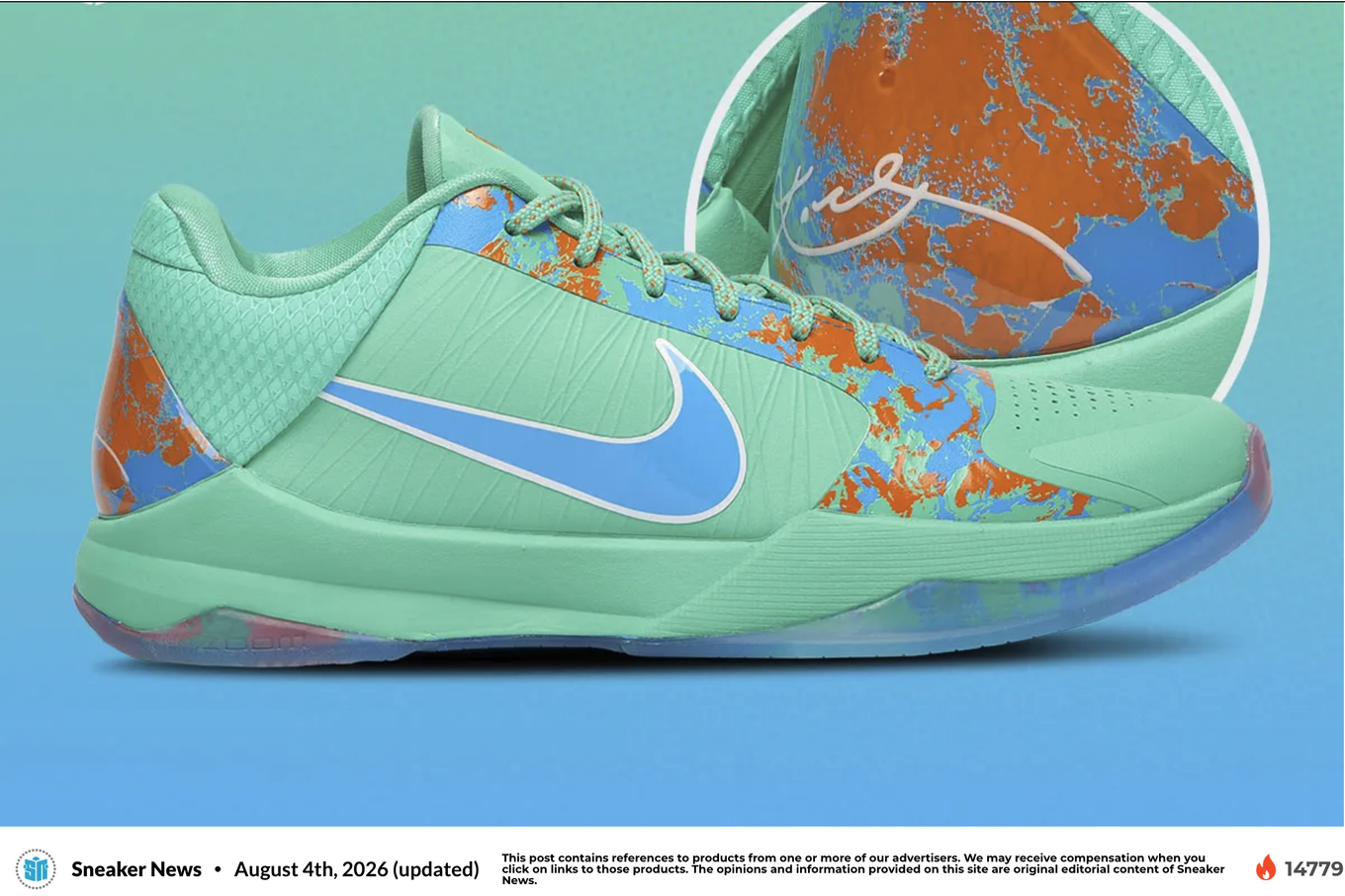
Jalen Brunson brought that mechanism into a defining 2026 performance. He debuted the Kobe 5 Protro “NY vs. NY” in Game 1 of the Eastern Conference finals as the Knicks erased a 22 point deficit. The colorway became part of the visual story of New York’s championship run, which ended with Brunson winning Finals MVP and delivering 45 points in the title clinching Game 5. Nike then brought the model to consumers through a limited New York City release during the Finals and a wider release in August. Performance gave the shoe its image; the release gave fans a way to participate in it.
The story contains two generations of athlete meaning. Brunson received Kobe 9s directly from Bryant while he was still in high school. Years later, he used another Kobe model to create a defining image of his own. The “NY vs. NY” series release did not simply borrow Bryant’s name. Jalen Brunson’s playoff performance and his pathway of creating the legacy added a new New York chapter to an established Kobe silhouette.
The topic data makes the distinction of Jordan’s and Kobe’s visible. The “Kobe Bryant shoes” query set carries 23,628 in topic volume, compared with 18,440 for “Michael Jordan shoes.” Jordan searches spread across an expansive product and cultural universe; Kobe searches bind the player and the shoe more directly. People search for products shaped by Jordan, but when they search for Kobe, they still search for his shoes.
LeBron and Curry are building live archives
Lebron turns milestones into product chapters
Jordan and Kobe established the category’s enduring legacy model. LeBron James and Stephen Curry show how it develops during an active career.
Their archives behave differently because their defining abilities and news cycles are different. LeBron’s search demand can accelerate around milestones, team speculation and new chapters in an unusually long career. Curry’s identity is more tightly organized around a repeatable basketball act: shooting. Both can support products, but they give brands different kinds of material to translate.
LeBron leads the athlete dataset with 42.59 million estimated annual searches and a recent increase of 396%. Nike’s LeBron XXIII translates 23 career stories into 23 colorways, turning an evolving career into a searchable product archive.
The scale of that increase should be read as attention, not automatic footwear sales. It shows the value of an athlete whose next decision, record or season can reactivate a large audience. The colorway system gives Nike a product structure capable of meeting those moments with a corresponding story.
Curry’s shooting identity outlasts the news cycle
Curry’s athlete name demand declined 45%, but Pathfinder data shows a stable identity organized around highlights, shooting, statistics and basketball shoes. Topic “Stephen Curry basketball shoes” carries an estimated 9,433 monthly searches within that journey.
Curry demonstrates why a falling name trend does not mean the athlete’s product meaning has disappeared. Headline interest can cool while the search language around a defining skill remains connected to shoes. His shooting identity supplies the consistent bridge between performance content and footwear discovery.
The comparison reveals two dimensions of a living athlete archive. Query Finder measures when overall attention accelerates or cools. Pathfinder shows whether the ability that defines the athlete remains connected to product discovery.
Jordan and Kobe show what happens after the archive matures. LeBron and Curry show the archive being built in real time, while new performances, records and products are still adding searchable material.
Specific models show a dominant leader and rising challengers
No.
Model
Athlete
Brand
Monthly
Annual
Change
1
Nike Ja 3
Ja Morant
Nike
75,000
1,863,100
+173%
2
Nike LeBron 22
LeBron James
Nike
3,033
688,800
+50%
3
Nike Sabrina 3
Sabrina Ionescu
Nike
25,833
308,700
+83%
4
Nike LeBron 23
LeBron James
Nike
19,466
306,820
+22%
5
Converse Shai 001
S. Gilgeous-Alexander
Converse
20,833
230,900
+22%
6
Reebok Angel Reese 1
Angel Reese
Reebok
10,033
168,100
+22%
7
Nike Ja 2
Ja Morant
Nike
5,966
160,100
+710%
8
Nike Ja 1
Ja Morant
Nike
2,233
159,100
-33%
9
adidas AE 1
Anthony Edwards
adidas
5,700
142,600
+50%
10
Nike A’One
A’ja Wilson
Nike
10,033
136,100
+311%
Nike owns seven of the Top 10 models by estimated annual search volume. That concentration confirms a model-level advantage, but it does not describe a closed market.
Nike’s strength comes from depth rather than one isolated hit. Ja Morant, LeBron James and the company’s other signature athletes give it multiple stories, generations and price points through which consumers can enter the basketball category. Ja 3 is the standout: its estimated 75,000 monthly searches place it well above every other specific model in the table.
Converse Shai 001 offers the clearest current performance example. ListeningMind estimates 20,833 monthly searches, 230,900 annually and 22% growth. That demand sits beside Shai Gilgeous-Alexander’s 2024-25 scoring title, league MVP, NBA championship and Finals MVP, and silmiar performance results from 2025-26 season. The timing supports alignment between achievement and product attention, although it does not prove that the awards alone caused the increase.
Growth is not limited to Nike. Converse Shai 001 rose 22%, Adidas’s Anthoy Edward’s first signature line adidas AE 1 rose 50%, and Li-Ning’s Way of Wade 12 reached 27,466 estimated monthly searches with 22% growth. Across brands, the common asset is a recognizable athlete attached to a specific product.
The athletes do not offer interchangeable stories. Ja Morant gives Nike explosiveness. Anthony Edwards gives adidas power and sharp changes of direction. Shai gives Converse control and rhythm. Way of Wade converts Dwyane Wade’s legacy into a current performance platform. The shared rule is not one aesthetic or technology. It is the ability to make a basketball identity legible through a product name and design.
Athlete language is embedded in product discovery
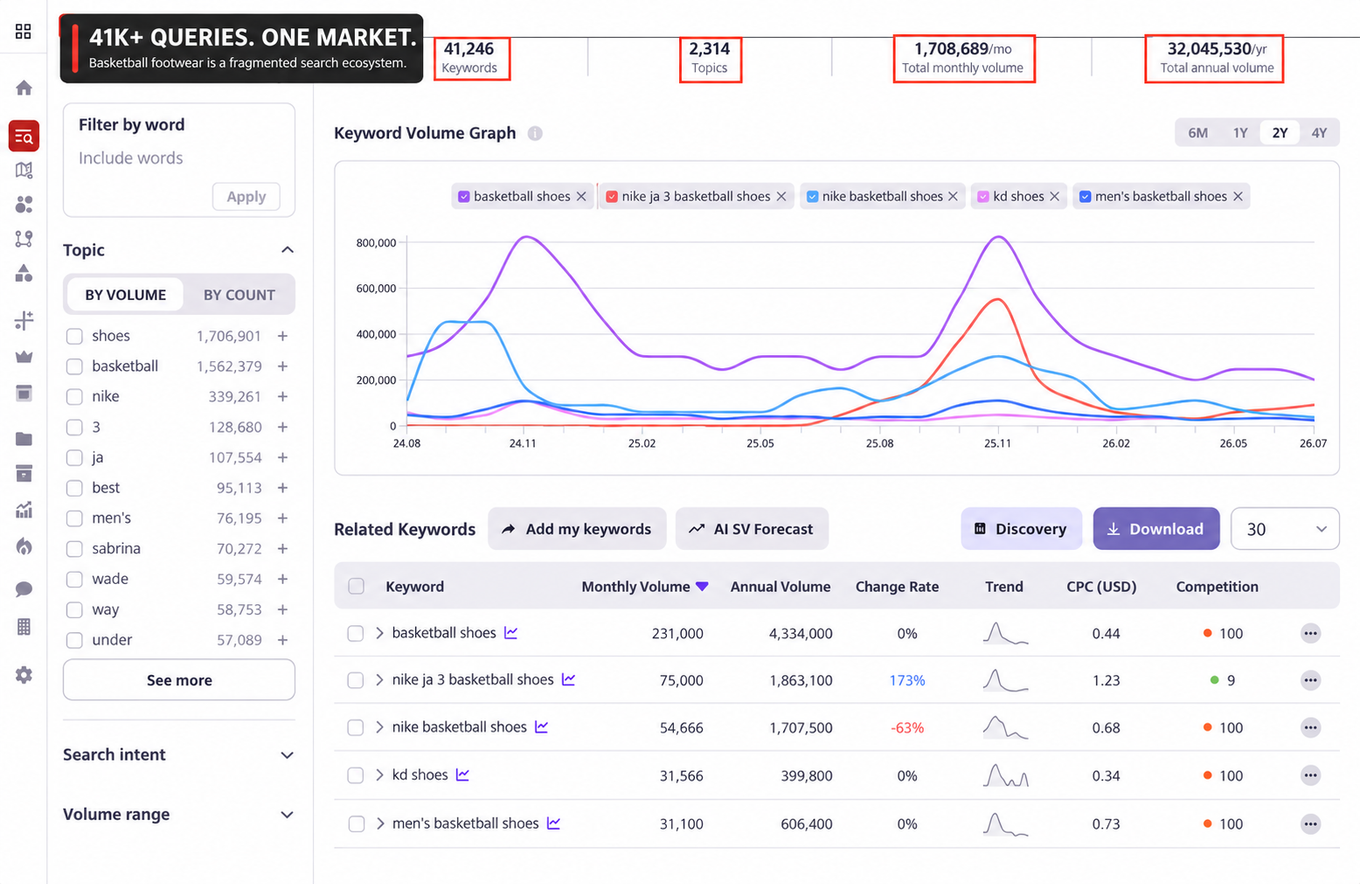
The U.S. basketball footwear universe contains more than 41,000 related keywords and 2,300 topics, representing roughly 1.7 million estimated monthly searches and 32 million annually.
That scale provides the market context for the athlete stories. The analysis does not begin by selecting a famous player and assuming influence. It begins with the language people already use across footwear, brands and athletes, then tests where those vocabularies overlap.
Volume ranked topics show athlete identity inside product demand. Category terms lead, followed by Nike at 339,261. Athlete linked terms include Ja at 107,854, Sabrina at 70,272, Wade at 59,574 and Kobe at 50,847.
Reading the athlete, footwear and brand datasets together identifies which names organize demand. Query Finder measures their scale, Pathfinder maps the surrounding search language, and SERP history checks whether a spike reflects performance, a product release or unrelated news.
The three tools answer different questions. A high volume topic identifies an entity worth investigating. An exact query shows how much demand is attached to a player, brand or shoe. A path reveals the surrounding interests, while SERP history supplies the real world event needed to interpret a change. Used in sequence, they turn a list of keywords into a market story without treating co-occurrence as proof of causation
One market rule is producing different brand outcomes
The brand table does not show a simple Nike collapse or a complete challenger takeover. It shows broad brand queries and athlete led products moving at different speeds.
That distinction matters in a market where a parent brand and its signature products can perform differently. A consumer may bypass the general category term and search directly for the athlete or numbered model. Brand level decline can therefore coexist with strength inside a company’s athlete portfolio.
Rank
Exact query
Monthly
Annual
Change
1
Nike basketball shoes
54,666
1,707,500
-63%
2
adidas basketball shoes
23,833
453,600
+22%
3
New Balance basketball shoes
18,366
287,000
-45%
4
PUMA basketball shoes
8,700
193,600
-33%
5
Li-Ning basketball shoes
26,566
185,900
+410%
6
Air Jordan basketball shoes
8,700
182,100
-18%
7
Under Armour basketball shoes
7,100
143,200
-33%
8
Converse basketball shoes
5,800
123,500
-18%
9
Reebok basketball shoes
4,133
78,700
-18%
10
Skechers basketball shoes
10,433
75,800
+22%
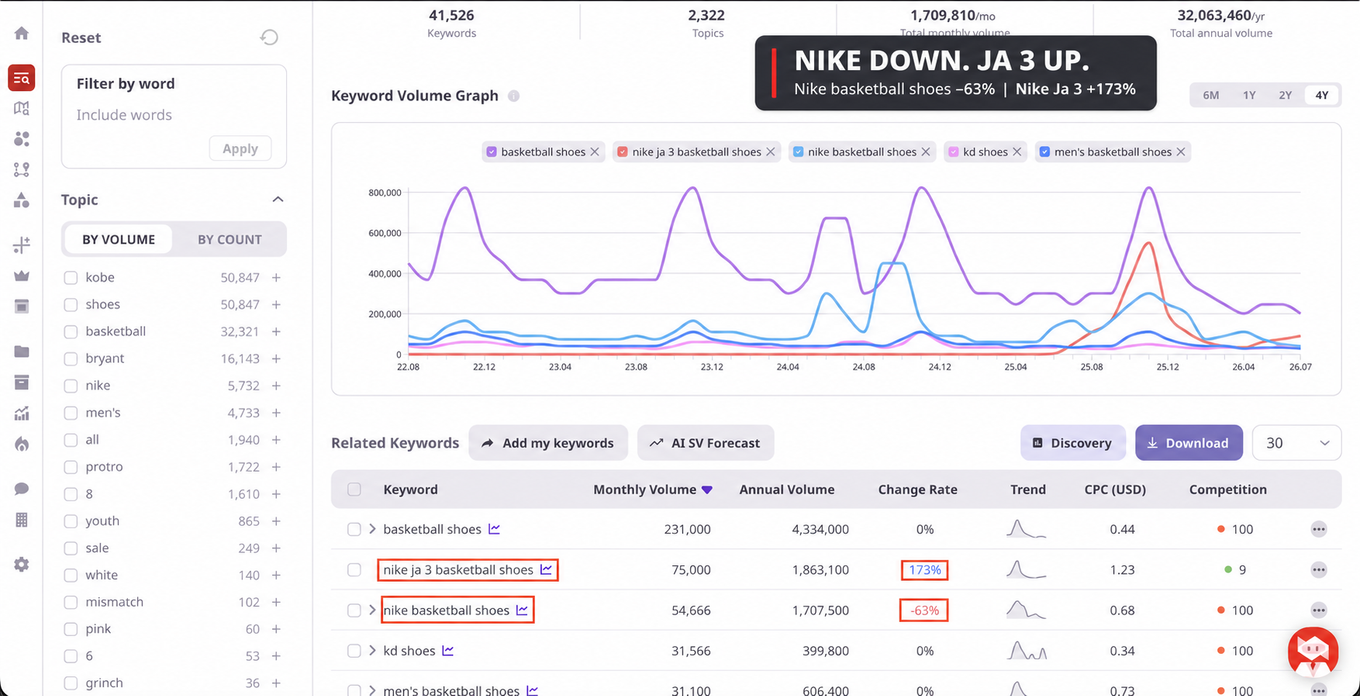
Nike’s broad basketball query fell 63%, while “Nike Ja 3 basketball shoes” rose 173%. Ja 3 reached 75,000 estimated monthly searches, above 54,666 for the generic Nike query. The contrast suggests that Nike’s athlete portfolio currently carries more momentum than its broad category language. It is not a market share comparison because the same person can search both terms.
For Nike, the result is both reassuring and cautionary. The company still owns most of the leading basketball shoes models, but consumers appear willing to organize discovery around a specific player rather than the corporate name. Athlete depth protects Nike’s position even when its broad basketball term loses momentum.
Li-Ning presents the opposite brand-level signal. “Li-Ning basketball shoes” rose 410%, “Way of Wade shoes” increased 123%, and Way of Wade 12 reached 27,466 estimated monthly searches with 22% growth.
The three increases operate at different levels: parent brand, signature franchise and current model. Their simultaneous direction makes Li-Ning notable. The company is gaining attention not only for one release but across the vocabulary that connects the brand to basketball.
Dwyane Wade supplies the established signature franchise. Stephen Curry added a current performance story and wider global attention through Li-Ning’s long term partnership with Curry Brand. The data does not show that Curry caused Way of Wade growth. It shows Li-Ning’s brand, legacy line and current athlete strategy gaining attention at the same time.
This is why Li-Ning represents more than a challenger with a rising percentage. It is adopting the category’s foundational system: use elite performance to create meaning, build that meaning into a repeatable signature platform and let the athlete become an entry point to the parent brand. Jordan and Kobe show how powerful that system can become over time. Li-Ning is now building its own version across established legacy and active performance.
The evidence across Jordan, Kobe, LeBron, Curry and other current athletes who are making their names, today’s signature models points to the same market rule. Performance creates a recognizable image. Search keeps the athlete and the moment active. A signature product turns that attention into something people can discover, wear and renew.
Jordan built the completed commercial language. Kobe shows how remembrance can return as a modern performance product. LeBron and Curry are building their archives in real time. Nike still dominates the model ranking, while Li-Ning shows that a challenger can gain ground by connecting athlete credibility, signature products and brand discovery.
Great players retire. Their sneakers keep playing.
Hi, I’m Nam Hyun Cho, part of the Growth team at ListeningMind.
If this content made you curious about what your own category looks like, let’s just look at it together — 15 minutes, your data, no slides.
People do not consider ramen for one universal reason. Category entry points, AI brand visibility, and connected search paths reveal how convenience, recovery, comfort, restaurant choice, and packaged product needs create different routes to consideration.
A high volume food keyword can reveal where consumer attention is concentrated, but it cannot tell us how many people completed a purchase. By comparing Thai and Vietnamese food searches across journey, cluster, and path data, this analysis shows how similar category searches can lead to different decision routes.
Country level cuisine rankings show where broad attention begins, but they do not reveal what Americans actually want to eat. Query Finder data shows how that demand shifts toward specific dishes, recipes, restaurants, and meal formats—and why search volume and change rate must be read together.
Cultural exposure to Korean and Japanese food can spark a craving long before anyone searches your category. See whether AI recommends your brand when that moment arrives.