A keyword can tell us the category someone entered. It rarely tells us why the search began at that exact moment, what restriction shaped the choice, or which brand had a credible reason to appear.
The sixth question in our Original Coffee analysis asked: “How do we find the actual moment someone decides to buy, not just people who search this word?”
In “When Culture Creates the Craving, Does AI Know Which Brand to Recommend?”, examined Korean and Japanese food and found that cultural discovery could lead into more concrete food occasions. This episode narrows that broad comparison to one category both cuisines can share: ramen. The question is no longer whether people search for ramen. It is what they are trying to accomplish when ramen enters consideration.
The analysis follows three steps. CEP Finder identifies the situations that can activate the category. AI Optimizer checks whether a selected brand is called and whether owned content is cited inside those situations. Path Finder is then used to test whether a CEP related query leads toward concrete product, preparation, restaurant, retail, or purchase behavior.
Start With One Shared Category, Then Ask What Activates It
The CEP matrix surfaced 20 different category entry points in the captured project. They included a night shift, a tight end of month budget, a family weekend meal, a hotel microwave, a shared office kitchen, illness, late night study, and winter comfort.
The product can remain ramen while the reason for considering it changes completely. A consumer may need a dependable meal between tasks, something that works with one microwave, a low effort office lunch, a dietary fit, a warm recovery meal, or a more satisfying family dinner.
Ramen Enters Consideration Through Convenience, Recovery, and Experience
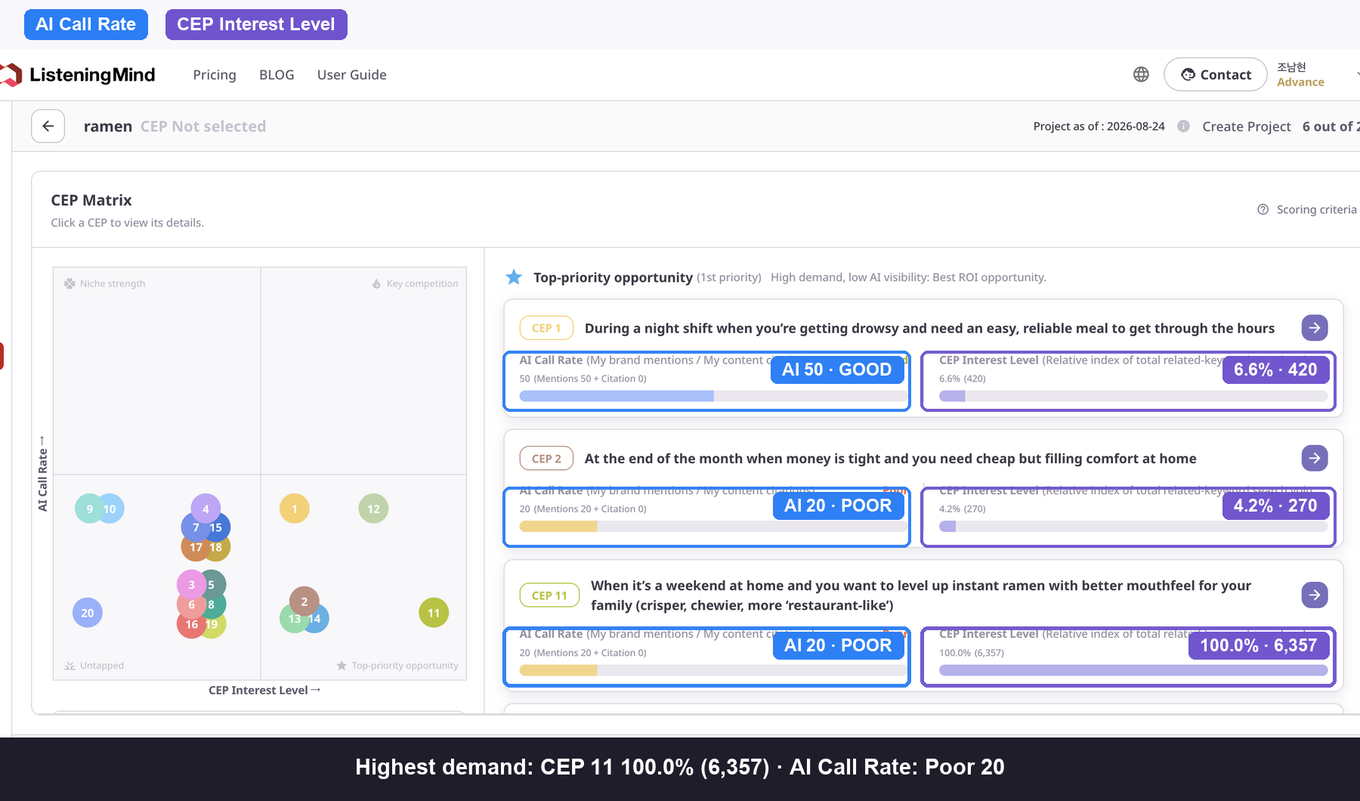
The largest captured ramen entry point was a weekend family occasion: improving instant ramen with a crisper, chewier, more restaurant like texture. Its CEP Interest Level was 100.0%, representing 6,357 in related keyword volume in this project.
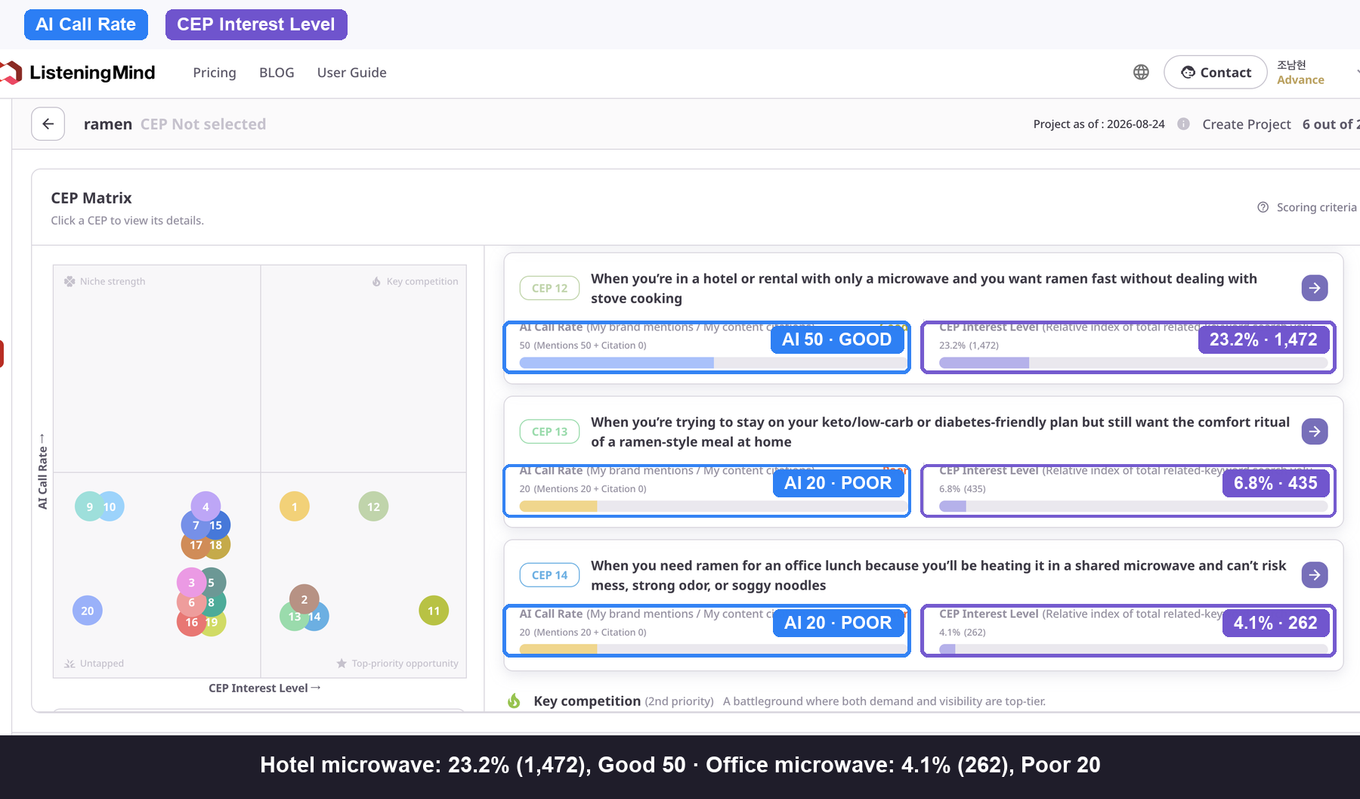
Practical access appeared repeatedly across other entry points. A hotel or rental with only a microwave reached 23.2%, or 1,472. A keto, low carb, or diabetes friendly plan reached 6.8%, or 435. A night shift need for an easy, reliable meal reached 6.6%, or 420. A shared office microwave with concerns about mess, odor, and texture reached 4.1%, or 262.
These figures should not be added together and treated as one convenience market. They show that speed, simple preparation, and access outside a full home kitchen recur in several distinct consumer situations.
| Ramen entry situation | CEP interest | Related keyword volume |
| Weekend family meal with better texture | 100.0% | 6,357 |
| Hotel or rental with only a microwave | 23.2% | 1,472 |
| Keto, low carb, or diabetes friendly plan | 6.8% | 435 |
| Night shift and an easy reliable meal | 6.6% | 420 |
| End of month and cheap filling comfort | 4.2% | 270 |
| Shared office microwave with low mess and odor | 4.1% | 262 |
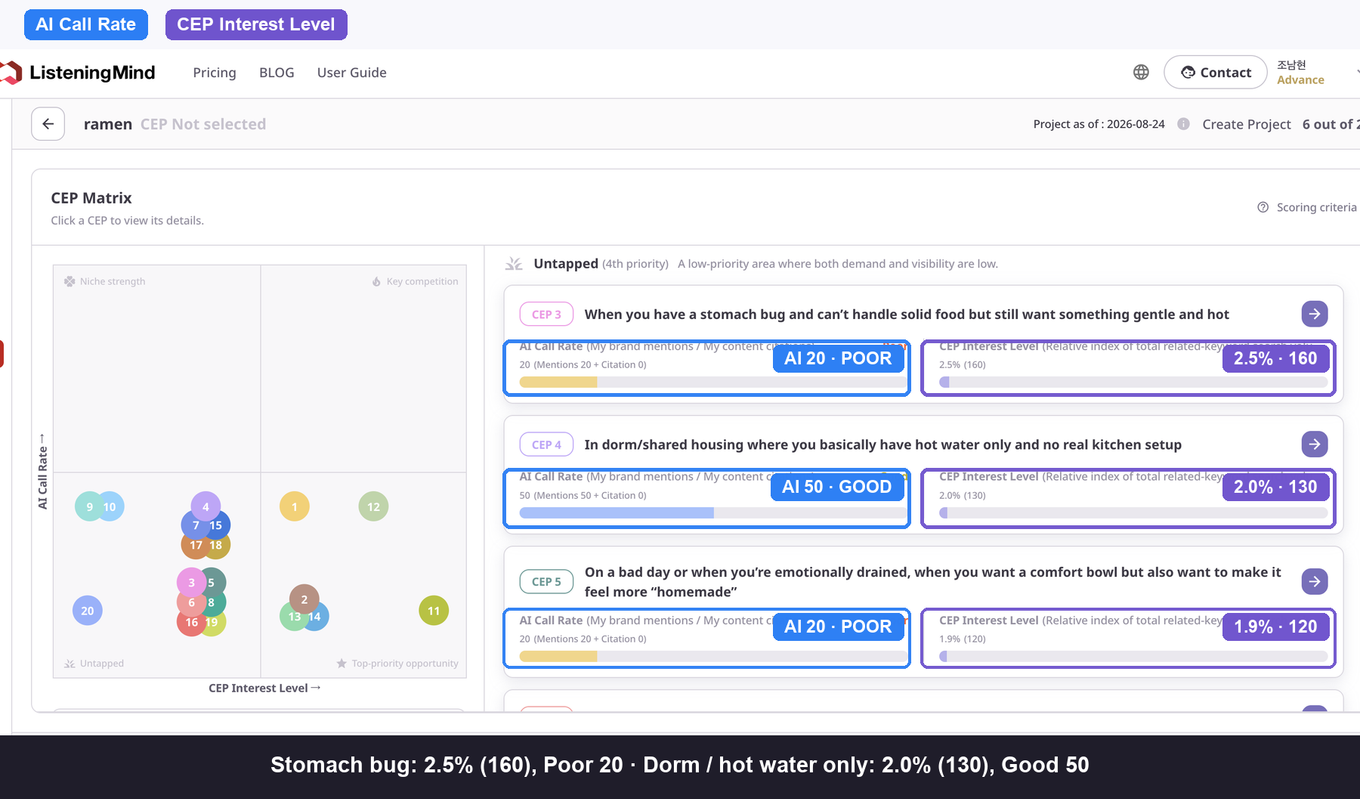
A second pattern came from environment and physical state. The project included a stomach bug and a need for something gentle and hot at 160, an early cold or flu moment at 87, and winter warmth at 80. These are smaller captured demand pools, but they show ramen entering consideration as a fast route to warmth, comfort, or recovery.
CEP Finder Defines the Occasion; AI Optimizer Tests Brand Visibility
The CEP sentence is generated by combining Nano Intents and Key Buying Factors in the project. We then summarize the restriction stated or implied in that sentence. Finally, we interpret the evidence a brand would need to resolve that restriction. The last two columns below are analytical summaries, not direct ListeningMind fields.
| CEP situation | Constraint stated or implied in the CEP | Brand evidence implied, analyst interpretation |
| Hotel or rental | No stove | Microwave preparation and a reliable result |
| Office lunch | Shared space | Low mess, low odor, and stable texture |
| Weekend family meal | Basic instant ramen feels ordinary | Better mouthfeel and a more restaurant like experience |
| End of month | Money is tight | Affordable, filling, and easy to keep at home |
| Dietary plan | Carbohydrate or health limits | Clear nutrition and suitable product options |
AI Optimizer adds a separate question: when the consumer situation is expressed as a natural language prompt, does AI call the selected brand, and does it cite the brand’s own content? Nongshim and Nissin are the marketer examples carried forward from “When Culture Creates the Craving, Does AI Know Which Brand to Recommend?”. The purpose is not simply to prove that AI knows the brands. It is to test whether either brand is retrieved for the specific reason a consumer may be considering ramen.
The captured ramen project shows why that distinction matters. The weekend family texture occasion had the highest CEP Interest Level at 100.0%, yet its visible AI Call Rate was Poor at 20. The hotel microwave occasion reached 23.2% interest with a Good AI Call Rate of 50, while the office microwave occasion reached 4.1% interest with a Poor AI Call Rate of 20. Demand strength and AI brand visibility do not automatically move together.
Smaller Entry Points Can Reveal a Clearer Consumer Problem
The lower volume cards included a stomach bug and a need for something gentle and hot at 160, dorm or shared housing with hot water only at 130, emotional comfort with a more homemade feeling at 120, late night studying without a kitchen at 107, and a cold or flu moment at 87.
None of these figures should be treated as a sales forecast. They are captured related keyword volumes within the CEP project. Their value is diagnostic: each one turns a vague ramen audience into a specific problem that content, packaging, product design, or retail messaging can answer.
The final set continued into finals week, early illness, and winter warmth. These moments share a desire for hot food, but they do not share the same reason for acting. Reliability, recovery, speed, and emotional comfort are different entry mechanisms.
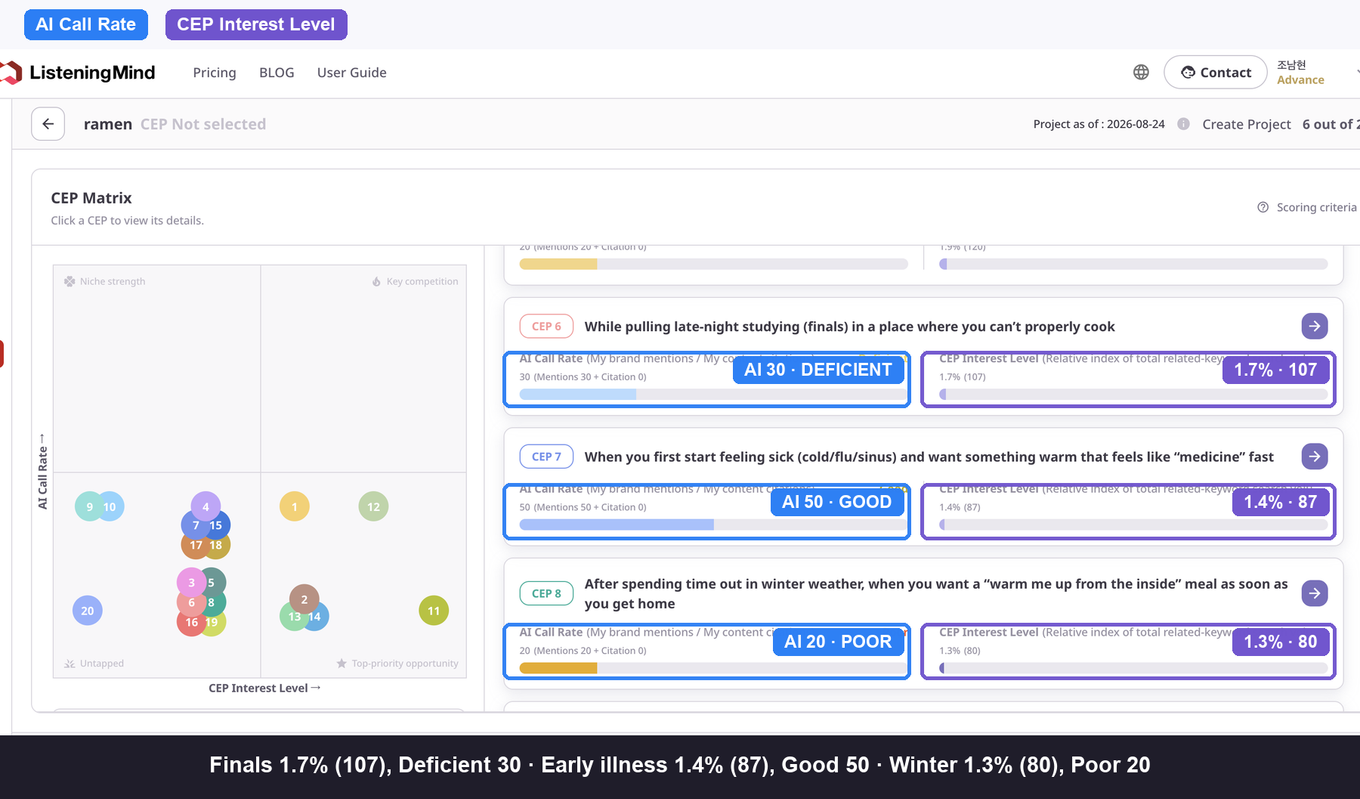
Late study, early illness, and winter comfort use the same category for different outcomes.
Behavioral Check with Path Finder
Path Finder then tested whether changing the category language changed the behavior around it. In the captured US comparison, the two seed terms were “Ramen” and “instant noodles.”
On the ramen side, the path concentrated around local restaurant and visit planning searches, including Jinya Ramen, Jinya Ramen near me, locations, reviews, happy hour, best ramen near me, and ramen near me menu. Here, ramen often functioned as a dining category tied to a place.
On the instant noodles side, the food relevant branch moved toward packaged product discovery and comparison. It included best Korean instant noodles, Korean instant noodles Neoguri, Korean instant noodle brands, Korean ramen instant noodles, Maruchan nutrition and ingredients, Amazon, Costco, and bulk cup searches. This is closer to brand, format, evaluation, and retail behavior.
The instant noodles network also included nonfood uses of the word noodles, such as animation, memes, and games. The conclusion therefore applies to the verified food related branch, not every node in the comparison.
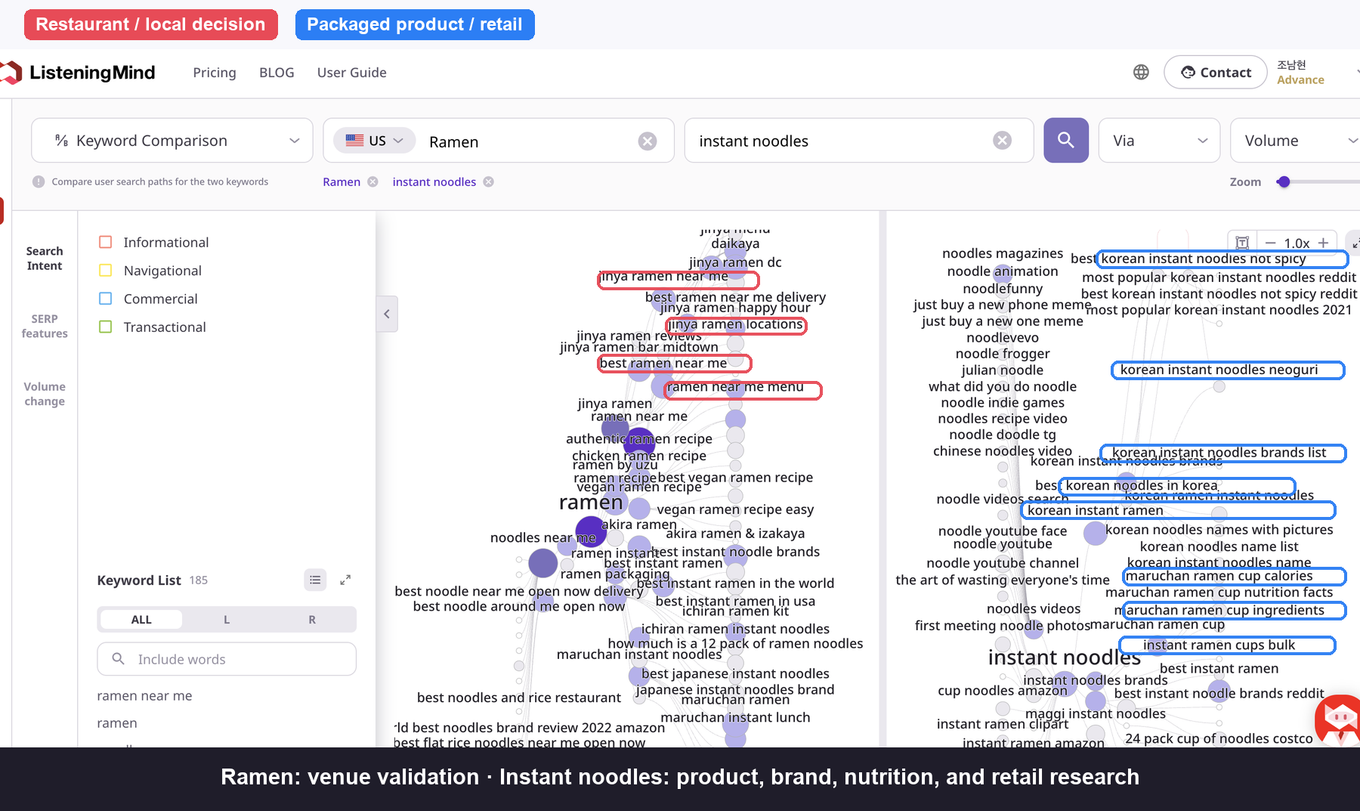
This does not prove that every category entry point ends in a purchase. It does show that the wording used to enter the same broad category changes the next behavior: ramen leans toward restaurant choice, while instant noodles leans toward packaged product and retail consideration.
The Answer to “How do we find the actual moment someone decides to buy, not just people who search this word?”
The purchase consideration moment is not simply “someone searched ramen. CEP Finder shows why the category becomes relevant. AI Optimizer shows whether Nongshim or Nissin is visible within that situation. Path Finder shows that category wording changes the route itself: ramen tends toward local dining and named restaurants, while instant noodles tends toward Korean packaged products, brand comparison, and retail access.
The final answer to the question: A head keyword names the category. A category entry point explains why it becomes relevant now. Path Finder shows which market the wording actually opens. In this comparison, ramen behaves more like a restaurant and local dining category, while instant noodles behaves more like a packaged product and retail category. The strategic opportunity is to connect the situation to the right product evidence and the right route to choice.
Data note: CEP Interest Level is the relative index shown in the captured ListeningMind project, with related keyword search volume in parentheses. AI Call Rate is a visibility diagnosis for the selected brand context. Neither metric is a purchase rate, conversion rate, or market share estimate.

Hi, I’m Nam Hyun Cho, part of the Growth team at ListeningMind.
If this content made you curious about what your own category looks like, let’s just look at it together — 15 minutes, your data, no slides.