Index
🔥 The TCG Market Has Become an IP War
The trading card game market is no longer a quiet contest between card sets. It is an IP war. Pokémon enters its 30th anniversary year with a commanding lead and an ecosystem that stretches across games, animation, cards and digital play. One Piece brings nearly 30 years of storytelling and one of the world’s most devoted manga audiences. Magic: The Gathering already holds a durable place in North America. Yu-Gi-Oh! brings a long running card audience and an official digital game. Marvel keeps pushing its huge character library into new games, collectibles and fan experiences.
These brands are fighting for more than card sales. They want attention, play time, collector loyalty and the next place fans choose to spend. So who is actually winning? ListeningMind examined U.S. search demand, the paths around major brand searches and recent market movement to see who leads, who is gaining and where fans are still looking for something the official brand does not provide.
ListeningMind Team’s Answer
Pokémon leads the trading card game market in scale and ecosystem. Magic has the strongest recent momentum in this analysis. One Piece holds stable demand and reveals the clearest digital product gap. Marvel remains much smaller, but TCG specific interest is rising quickly. The data does not point to one winner. It points to several different races.
The opening score is not close. Pokémon cards alone averages 1.41 million monthly searches. Magic: The Gathering follows at 259,666, Yu-Gi-Oh! at 111,833 and One Piece TCG at 69,500. Star Wars: Unlimited averages 29,100, Digimon TCG 13,000, Marvel trading cards 4,133 and Lorcana TCG 2,133. These representative terms are not a total franchise share. They show how heavily attention is concentrated around a few powerful IPs.
A wild market leader appeared.
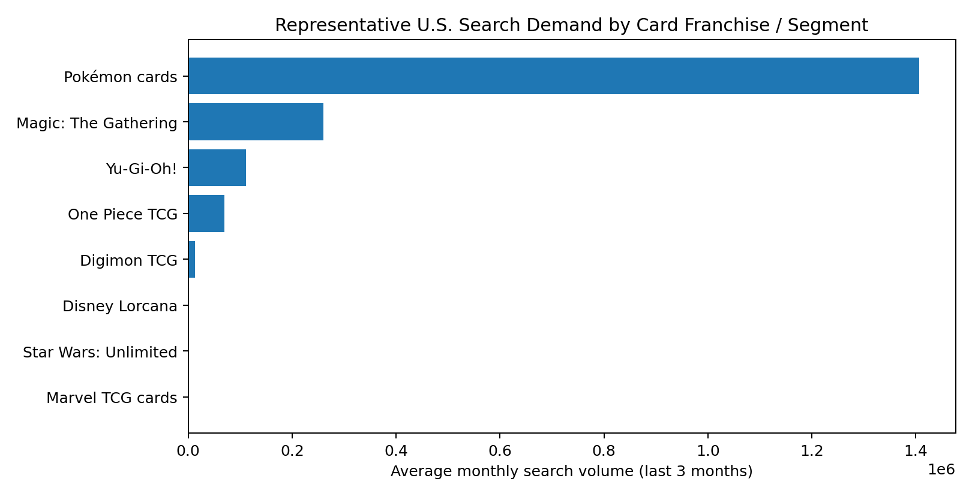
Data note: ListeningMind Keyword Info, United States. Monthly volume means the average monthly search volume over the latest three months. Observed monthly values run through June 2026. The chart uses representative keywords and does not calculate a deduplicated share for each franchise.
🃟 Who Leads the Trading Card Game Market by Search Demand?
Scale makes Pokémon the clear leader, but scale alone does not explain why the lead is so hard to attack. The more revealing question is what fans search for after Pokémon gets their attention.
💡 Pokémon Has Built a Road to the Next Experience
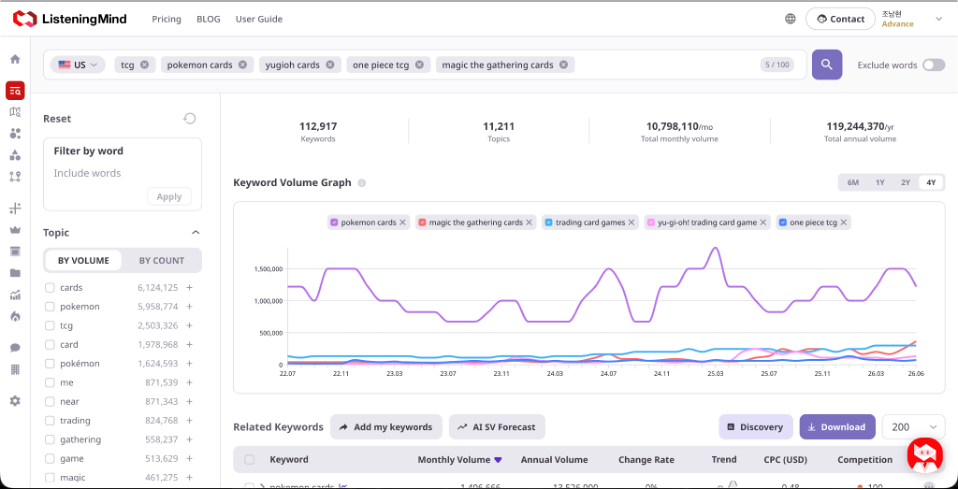
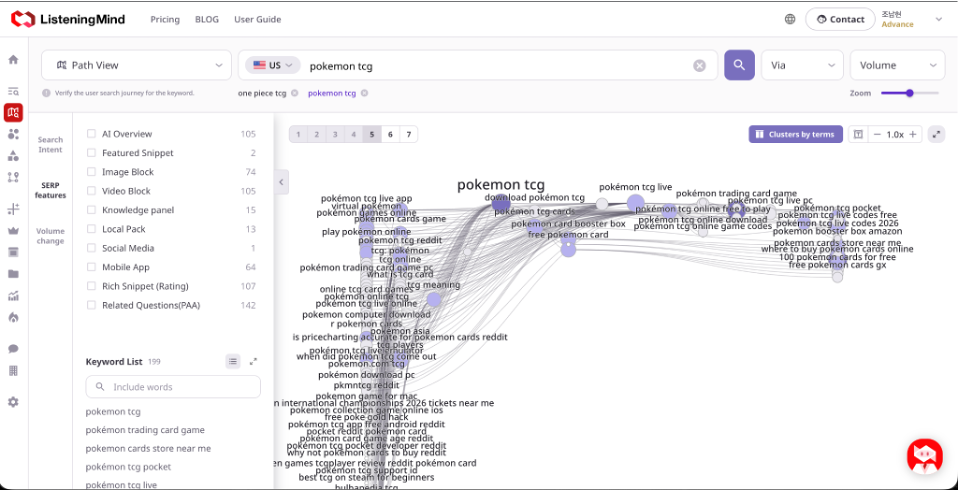
Searches around “pokemon tcg” repeatedly connect physical cards with TCG Live, online play, downloads, PC access, codes, retail availability and TCG Pocket. ListeningMind’s Path Finder shows these recurring links before and after a core search. It analyzes search patterns, not identifiable people. In plain terms, it shows where interest tends to go next.
Pokémon is not just winning the first search. It has gathered the right partners and built a clear route to the next experience.
❓What Brings One Piece Fans Into the TCG Market?
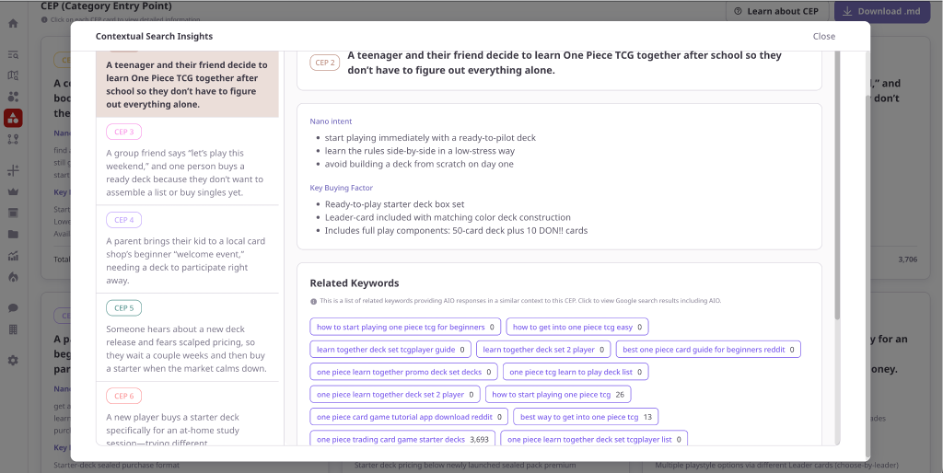
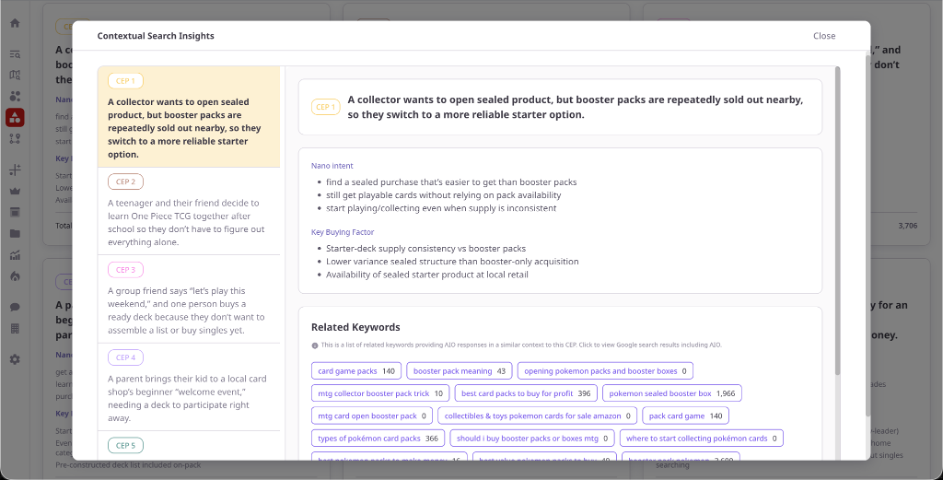
These two evidence reveal why a single label such as“One Piece fan”is not enough. A Category Entry Point, or CEP, is the moment or situation that brings someone into a market. CEP Finder shows those moments and the reasons behind them. Here, one fan wants an easy game to learn with a friend. Another wants a reliable product after booster packs are repeatedly unavailable.
Each CEP can be examined more closely through nano intents, which are the smaller goals inside that moment, and key buying factors, which are the conditions that shape a choice. After this first explanation, the simpler question is enough: What happened in the fan’s life that made this product matter now?
This is different from a search cluster. A CEP explains why demand begins. A cluster shows which topics gather together across the wider market. One reveals the moment; the other reveals the shape of the market.
So… Which TCG Brands Are Gaining Momentum? 🧐
Pokémon still leads by scale, while Magic is moving fastest with an 83% three month rise. Yu Gi Oh! is also growing at the core card level, though Master Duel is slowing. One Piece remains steady rather than surging, Star Wars: Unlimited and Digimon are losing momentum, and Lorcana is growing quickly from a much smaller base.
Why Does Pokémon Lead the Trading Card Game Market? 💸
Pokémon became the industry leader by expanding faster than a single hit game normally could. After its sensational Game Boy debut in 1996, the IP moved quickly into trading cards, animation, films, retail and licensed products, scaling into a global entertainment empire. That history still shapes search behavior today. Fans can move from physical cards to TCG Live, TCG Pocket, online play, codes and nearby stores without leaving the Pokémon ecosystem.
That history still shapes how fans move through the brand today. They can go from physical cards to Pokémon TCG Live, Pokémon TCG Pocket, codes, online play and nearby stores without leaving the Pokémon ecosystem. A physical pack can lead to a code, a code can lead to digital play, and digital play can lead back to card knowledge or another purchase.
Pokémon is not just winning the first search. It has gathered the right partners and built a clear route to the next experience.
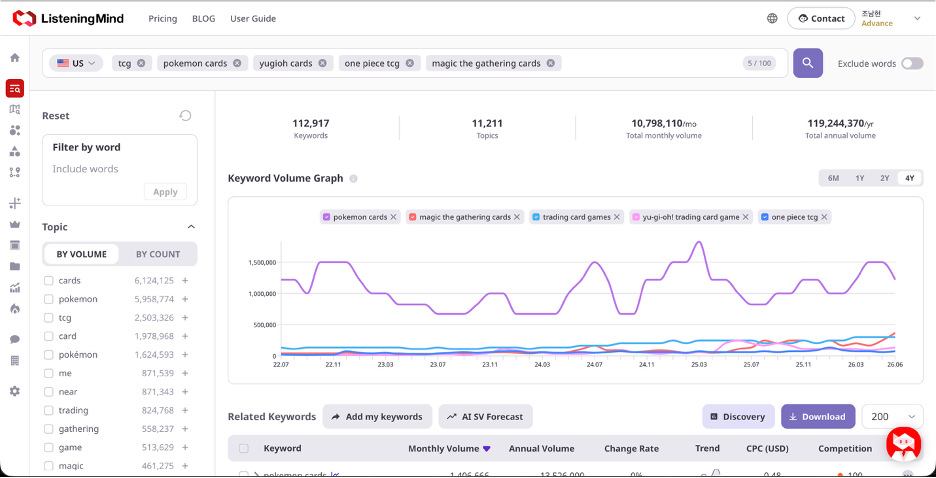
ListeningMind Keyword Info comparison from market trend view.
💡 The Digital Lane Is Big and Surprisingly Open
“Pokémon TCG Pocket” averages 50,166 monthly searches, while “Pokémon TCG Live” averages 44,033. Their paid search competition indexes are 8 and 1, compared with 100 for the broader term “Pokémon cards”. ListeningMind’s data suggests that paid search around Pokémon’s official digital products is far less crowded than search around physical cards.
Why This Matters?
Strong search demand can exist in a product area that advertisers and competitors have not yet treated as a distinct opportunity.
Where Is the One Piece TCG Product Gap?
If any IP has the fan power to challenge Pokémon’s lead, One Piece is one of the clearest candidates. It brings nearly 30 years of storytelling, a global anime and manga audience, and a fan base already used to following the franchise across formats. Its TCG search volume is still far below Pokémon, but the gap is not the only story.
Every great voyage needs a destination. One Piece fans are still searching for theirs.
The more interesting question is whether One Piece can give fans the same kind of connected journey. Pokémon already moves people from physical cards into official digital play. One Piece search behavior shows fans looking for online play, simulators and other ways to continue, but the analyzed paths do not show an equivalent official full game client.
That makes One Piece important not because it already matches Pokémon, but because it reveals where the next major product opportunity may be.
| Brand | Where searches move | Official destination | What it suggests |
| Pokémon | Physical collecting to official digital play | TCG Live and TCG Pocket | Pokémon owns the bridge |
| One Piece | Physical game to online play or simulator searches | No equivalent official full client in the analyzed paths | Interest can move to workarounds |
| Yu-Gi-Oh! | Physical TCG to digital play | Master Duel | The bridge exists, but digital demand is softening |
| Magic: The Gathering | Cards and sets to digital play | Arena and Magic Online | Core card demand is accelerating; a full path comparison is a useful next step |
| Digimon | Core TCG, deck and product interest | Limited comparable official digital continuation | Search demand shows prolonged weakness |
Interpretive comparison based on ListeningMind Path Finder and Keyword Info.
A Smaller Signal, but a Serious One 🛜
One Piece online demand does not match Pokémon. “One piece card game online” averages about 1,100 monthly searches. The more interesting clue is intent. The term has low paid search competition at 10 and a high cost per click of $5.68. It points to a smaller group, but one that appears ready to act and is actively looking for an online answer.
One Piece paths repeatedly move toward online play, OPTCG terms and simulator searches. Pokémon can send much of that interest to official products. In the analyzed paths, One Piece does not show an equivalent official full game client that absorbs the same online play need. The opportunity is not proven scale. It is a visible product gap and a group that keeps searching for a solution.
The crowd may still be small, but the ship has already left the harbor.
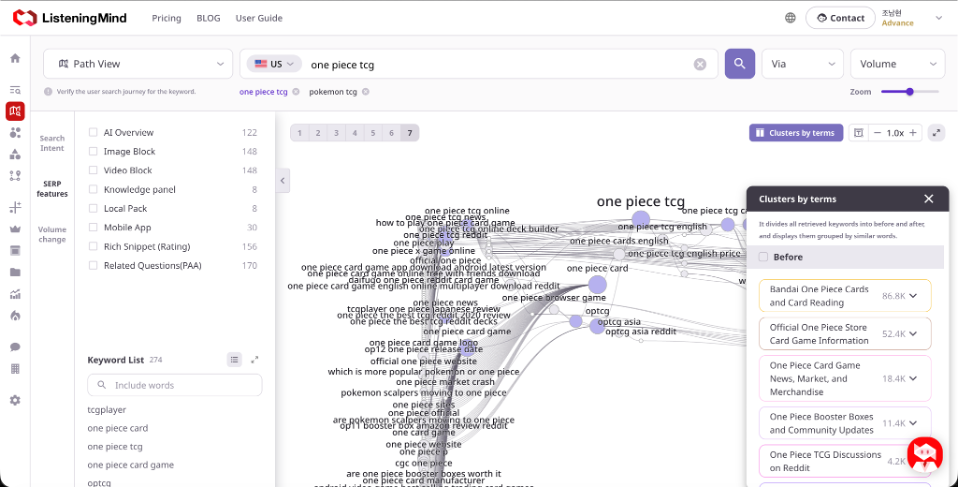
The Product Gap
Pokémon has turned movement from physical cards to digital play into official products. One Piece searches suggest a similar need without an equivalent official full client in the analyzed paths. Unofficial alternatives can be a clue that fans are trying to fill the gap. This is a product hypothesis, not a claim that the two digital markets are equal.
Which TCG Brands Are Gaining or Losing Search Demand?
Digital play is only one lane in this IP war. Core card interest, retail access, local stores, resale and accessories can all move in different directions. That is why the challengers need to be read one by one.
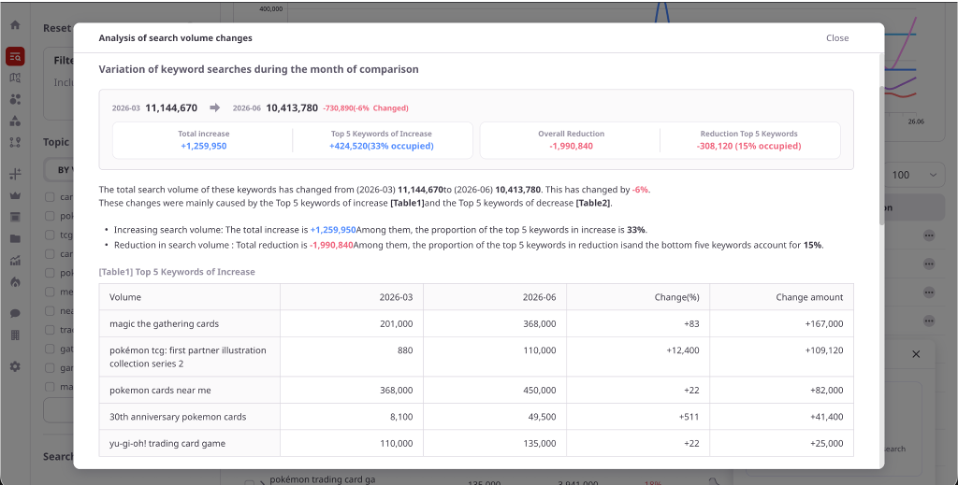
- Magic: The Gathering is making the strongest move among the established franchises in this analysis. “Magic the gathering cards” averages 259,666 monthly searches, rose 83% over the latest three months and reached 368,000 searches in June 2026. Magic just played its strongest growth card.
- Yu-Gi-Oh! remains large and its core TCG search is growing. The representative term averages 111,833 monthly searches, rose 22% over the latest three months and reached 135,000 in June. Yet “Master Duel” averages 19,466 and declined 18%. Its physical and digital lanes are not moving together. It is still time to duel, but not every arena is growing.
- One Piece TCG is steady rather than surging. It averages 69,500 monthly searches, was flat over the latest three months and reached 74,000 in June. That stability matters because the franchise has held attention beyond its launch period.
- Marvel is fighting from a smaller base, but its TCG specific signal is moving. “Marvel trading cards” averages 4,133 monthly searches and declined 18% over the latest three months. “Marvel TCG” averages 913, rose 80% and reached 1,300 searches in June 2026. The scale is still limited, but the contrast suggests that broader collectible interest may be shifting toward a more specific game format. A full Path Finder comparison remains a next step. Every new hero starts with a small origin story.
- Star Wars: Unlimited averages 29,100 monthly searches and declined 18% over the latest three months. Its launch spike has eased, making retention and organized play more important than launch awareness. The launch force was strong. Now comes the test of staying power.
- Digimon TCG averages 13,000 monthly searches and declined 18%. There are occasional monthly rebounds, so the fair reading is prolonged weakness, not an uninterrupted fall.
- Lorcana TCG rose 123% over the latest three months, but from a low base of 2,133 average monthly searches. A fast percentage increase and a large market are not the same thing. A little magic can start a story, but it still needs an audience.
An Interesting Pattern Around One Piece
One Piece may not be growing as quickly as Magic, but its search cluster reveals another important signal. Fans are not only searching for the cards themselves. A large part of the surrounding interest is tied to official stores, nearby locations and places to buy or play. This suggests that access and distribution remain major parts of the One Piece opportunity.
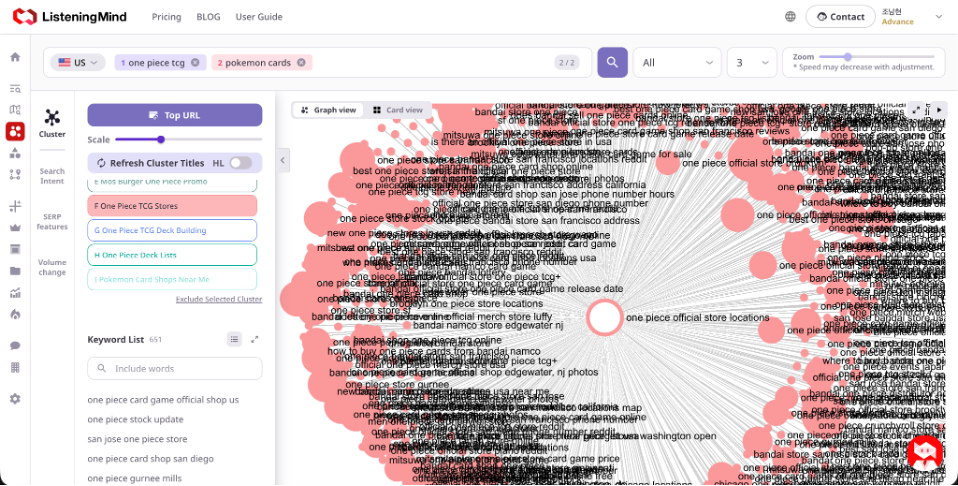
What to compare?
Look beyond total brand volume. Compare core cards, official digital products, retail discovery, local access, resale, value searches and accessories. The gaps show where a competitor owns attention and where it escapes.
A Quick Scoreboard Rule: Average and Current Are Not the Same 📊
Before naming a winner, the numbers need clear labels. In this analysis, monthly volume is the average over the latest three months. A value labeled June 2026 is the observed search volume for that month. Forecasts begin with the observed month and then look forward.
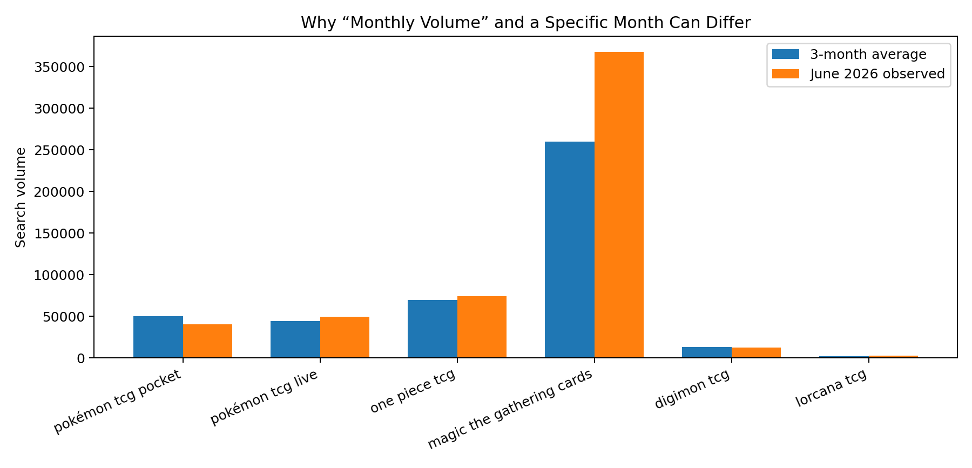
Taking Pokémon data as an example, “Pokémon TCG Pocket” averages 50,166 over three months, while its June 2026 volume was 40,500. “Pokémon TCG Live” averages 44,033 over three months, while its June volume was 49,500. Both numbers can be correct because they answer different questions.
Where Could TCG Search Demand Move Next?
Pokémon still dominates, but not every part of the brand is growing. Several Pokémon searches are returning to more normal levels rather than signaling a collapse. At the same time, Magic and Yu-Gi-Oh! are gaining momentum and One Piece is holding a stable base. The market is not moving as one block. Attention is being divided across brands, products, stores and ways to play.
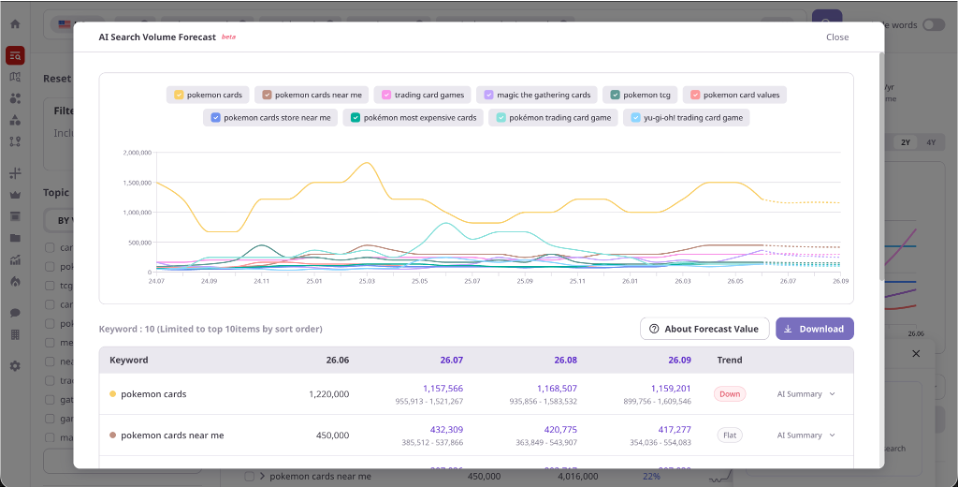
| Type of demand | Keyword | June 2026 | September forecast | Change | What it suggests |
| Digital product | Pokémon TCG Pocket | 40,500 | 40,324 | −0.4% | Steady after launch interest |
| Core franchise | One Piece TCG | 74,000 | 75,020 | +1.4% | Stable brand demand |
| Retail | Pokémon cards at Target | 74,000 | 99,247 | +34.1% | Growth tied to one channel |
| Retail | Pokémon cards in Walmart | 40,500 | 40,662 | +0.4% | Nearly flat in the same category |
| Accessory | Card binder Pokémon | 49,500 | 42,177 | −14.8% | Accessories can move differently |
ListeningMind AI Search Volume Forecast. Forecasts indicate direction. The range of possible outcomes widens over time, so the values should not be treated as exact budget commitments.
The forecast does not say that the whole category will rise. It shows different lanes moving at different speeds. Searches for Pokémon cards at Target are forecast to rise while Walmart stays nearly flat. One Piece brand demand can hold while binder demand falls. A digital product can remain useful after its launch buzz fades. The value is seeing where attention may shift, not forcing every brand into a simple up or down label.
Every franchise is playing with a different hand, and the next winning card may already be visible in search.
How Industry Teams Can Read the IP War
A useful competitor view does more than rank brand names. It shows why people enter a category, where they search next and whether the brand, a retailer, a community or an unofficial alternative answers the need.
The practical questions are simple: Why did the search begin? Where did it move next? Which needs does each brand own? Which needs are growing, fading or escaping to someone else?
The discoveries above come from different ListeningMind views. CEP Finder explains the moments that create demand. Path Finder shows recurring search connections. Cluster Finder groups the market into topics. Keyword Info compares size and recent movement. Forecast offers a near term directional view. Each tool answers a different part of the same competitive question.
Used together, they show what a competitor already owns, what is leaving its ecosystem, what is growing faster than the core category and what still has no clear official home.
For Publishers, IP Owners and Game Teams
For publishers, IP owners and game teams, the question is whether attention becomes continued engagement. A brand can lead in physical cards and still leave an opening in learning, digital play, local access or resale.
- Map where interest leaves the official ecosystem. Simulators, outside marketplaces, Reddit, local stores and grading sites can reveal needs that the brand does not fully serve.
- Treat products made by fans as clues. When unofficial simulators appear around a card game, they can suggest that players are trying to fill a digital play gap. Validate the size and durability of the search demand before treating that behavior as roadmap evidence.
- Compare physical, digital, retail and resale searches. A strong core brand can still offer a weak next step.
- Use entry moments, search paths and topic clusters before setting a roadmap. They show why fans arrive, what they seek next and which needs are large enough to become a real product opportunity.
For Retailers, Marketplaces and Event Organizers
Retailers, marketplaces and event organizers need to know where purchase and participation intent is forming. The same franchise can move differently by store, location, product format, stock level and local community.
- Read each channel separately. The Target and Walmart forecasts show that category growth does not spread evenly across sellers.
- Build pages around the decision fans are making, including nearby stock, release dates, set lists, value, authenticity, grading and beginner guidance.
- Look for searches with clear intent and low competition. Digital questions and solution searches can be less crowded than broad card terms.
- Use topic clusters to separate nearby stores, official stores, marketplaces, stock updates and price comparisons. Each group calls for a different retail, event or marketing response.
For Licensing, Investment, Distribution and Media Teams
Licensing, investment, distribution and media teams need to know more than which brand is famous. They need to see which IP answers the next fan need and which open space may support a product, partner, channel or story.
- Plan separately for players, collectors, investors, parents and local buyers instead of treating every TCG fan as one audience.
- Turn competitor gaps into editorial and partnership ideas, including play options, beginner guidance, code redemption, platform comparisons and purchase journeys.
- Measure whether content moves interest into an official destination, not only whether it earns a search impression.
- Balance audience size with strategic value. A smaller search group that is ready to buy, play or partner can matter more than a larger group showing general awareness.
A Simple ListeningMind Competitor Check
- Choose comparable category, brand and product searches.
- Use Keyword Info to compare size, recent movement, paid search competition and cost per click.
- Use CEP Finder to learn which moments create demand and what shapes the choice.
- Use Path Finder to compare where searches tend to move before and after each brand query.
- Use Cluster Finder to see which topics each brand owns and which are answered by retailers, communities or unofficial products.
- Use Forecast and volume change data to separate recent momentum from more durable demand.
- Turn the gaps into product, retail, event, licensing, distribution and media priorities.
The result is not another brand ranking. It is a map of what each IP captures, what escapes and which unanswered need may become the next growth opportunity.
So, Who Is Winning the Trading Card Game Market? 🏆
If winning means scale, Pokémon is far ahead. If it means recent momentum among established franchises, Magic is making the strongest move in this analysis. If it means connecting physical cards, digital play and official products, Pokémon owns the clearest ecosystem. If it means steady fan demand with a visible opening for a major new experience, One Piece may be the most interesting challenger. Marvel is not a scale leader, but its fast rising TCG specific search is worth watching.
ListeningMind sees more than one finish line. Rising brands may divide Pokémon’s audience, or one may build an ecosystem strong enough to weaken its lead. Search data helps publishers, IP owners, game teams, retailers, event organizers, licensing teams, investors, distributors and media teams decide what to build, stock, license, fund, distribute, schedule or cover next.
In an IP market, the next winner may appear in search before it appears in a sales report.
The opportunity is out there. Every search, every unmet need and every shift in fan interest leaves a clue.
You want the data? Then go find it. The journey starts with search!

Hi, I’m Nam Hyun Cho, part of the Growth team at ListeningMind.
If this content made you curious about what your own category looks like, let’s just look at it together — 15 minutes, your data, no slides.