Index
Creatine used to belong to athletes and bodybuilders. That’s no longer the case. Women, wellness-focused consumers, and buyers who scrutinize ingredient labels before purchasing are all entering this market. These are people who would never have reached for creatine before. Search data makes that shift impossible to ignore.
This article uses ListeningMind data to analyze the scale of the U.S. creatine market, search trends across three product formats, and what consumer search behavior reveals about where this market is heading.
The Creatine Market: Scale, Growth, and What’s Changing
According to ListeningMind, Americans are actively searching across 22,807 creatine-related keywords, generating 7,044,472 searches per month and 70,808,500 searches per year. These are not niche numbers.
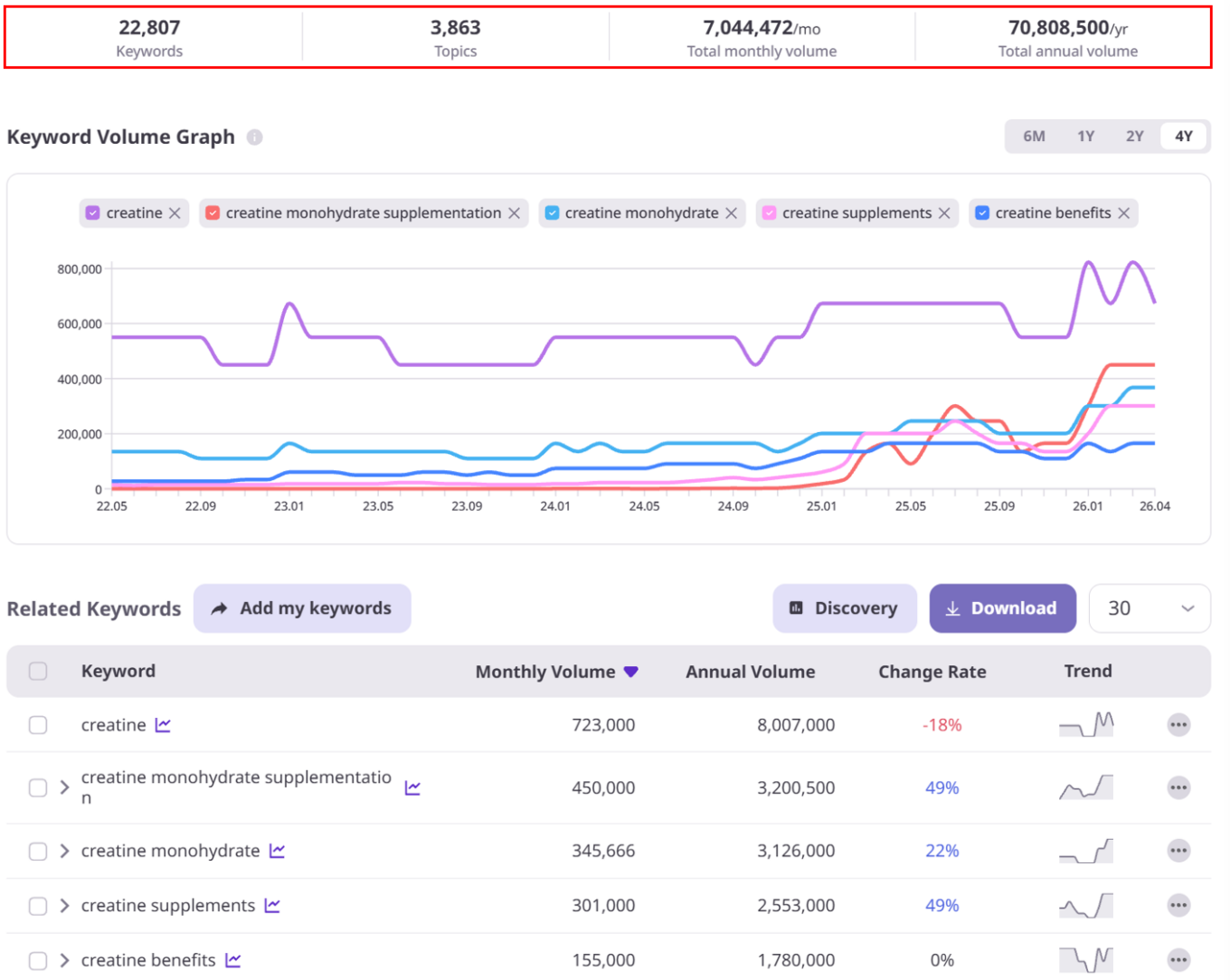
Searches for “creatine” alone, at 723,000 per month, have plateaued since 2025. Meanwhile, more specific queries are accelerating:
creatine monohydrate
,
creatine supplements
, and
creatine monohydrate supplementation
.
As more people become familiar with creatine, they stop searching at the category level and start searching with intent — by form, ingredient, or purpose. The market isn’t just growing in volume. It’s deepening.
How Each Format Is Growing — and Why It Matters
Breaking the creatine market down by product format reveals three distinct growth patterns.
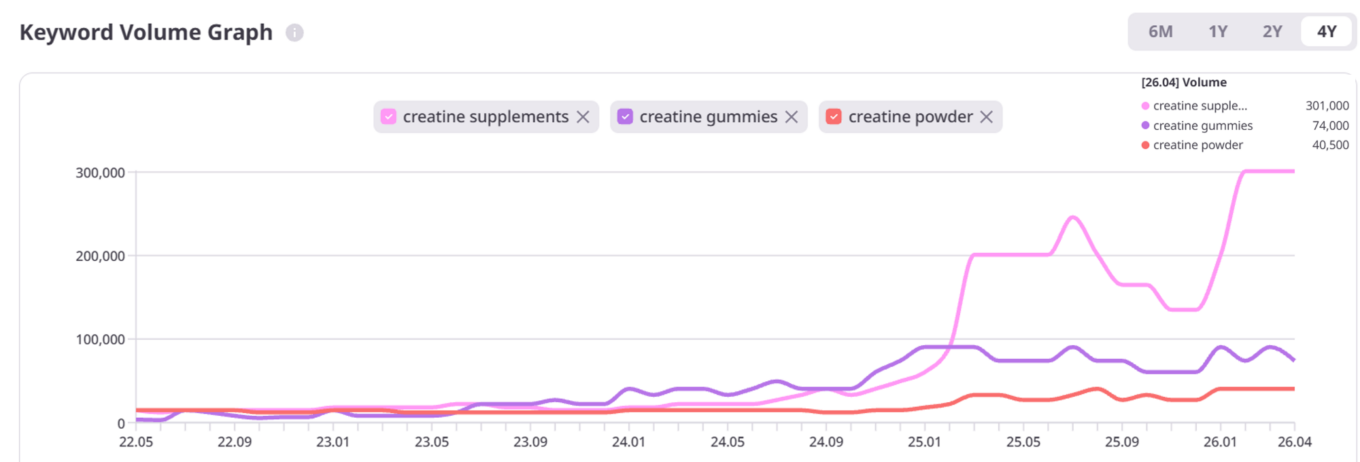
creatine powder (40,500/month) — Steady, structural growth
From 2022 through the end of 2024, search volume for creatine powder held flat at around 12,000–15,000 per month. Then, in January 2025, it jumped above 30,000 and has since stabilized in the 27,000–40,500 range. Rather than driving the market, powder search volume was lifted by it — a rising floor, not a spike.
creatine gummies (74,000/month) — Staircase growth
Starting from roughly 3,000–4,000 searches per month in May 2022, creatine gummies have climbed in clear, stepped surges: an initial jump in summer 2022, another step in late 2023, a push into the 40,000s in 2024, and then a leap above 80,000 in January 2025. That’s roughly 25x growth over four years — the most dramatic trajectory in the category.
creatine supplements (301,000/month) — Near-vertical surge
This is the most striking curve of the three. From 2022 through 2024, monthly searches for creatine supplements sat flat at 10,000–20,000. Then, in January 2025, volume shot up to 200,000, essentially overnight. It has continued climbing to 301,000 as of April 2026. The angle of ascent is nearly vertical. This pattern points to a surge in first-time buyers entering the market without a specific format or ingredient in mind, searching simply because they want to try creatine.
Worth noting: all three formats crossed a higher baseline in January 2025 simultaneously. This isn’t a format-specific trend — something shifted across the market as a whole.
What Search Topics Reveal About Each Format
Looking at the search topics associated with each format, a different consumer profile emerges for each.
creatine powder — Ingredient-first buyers
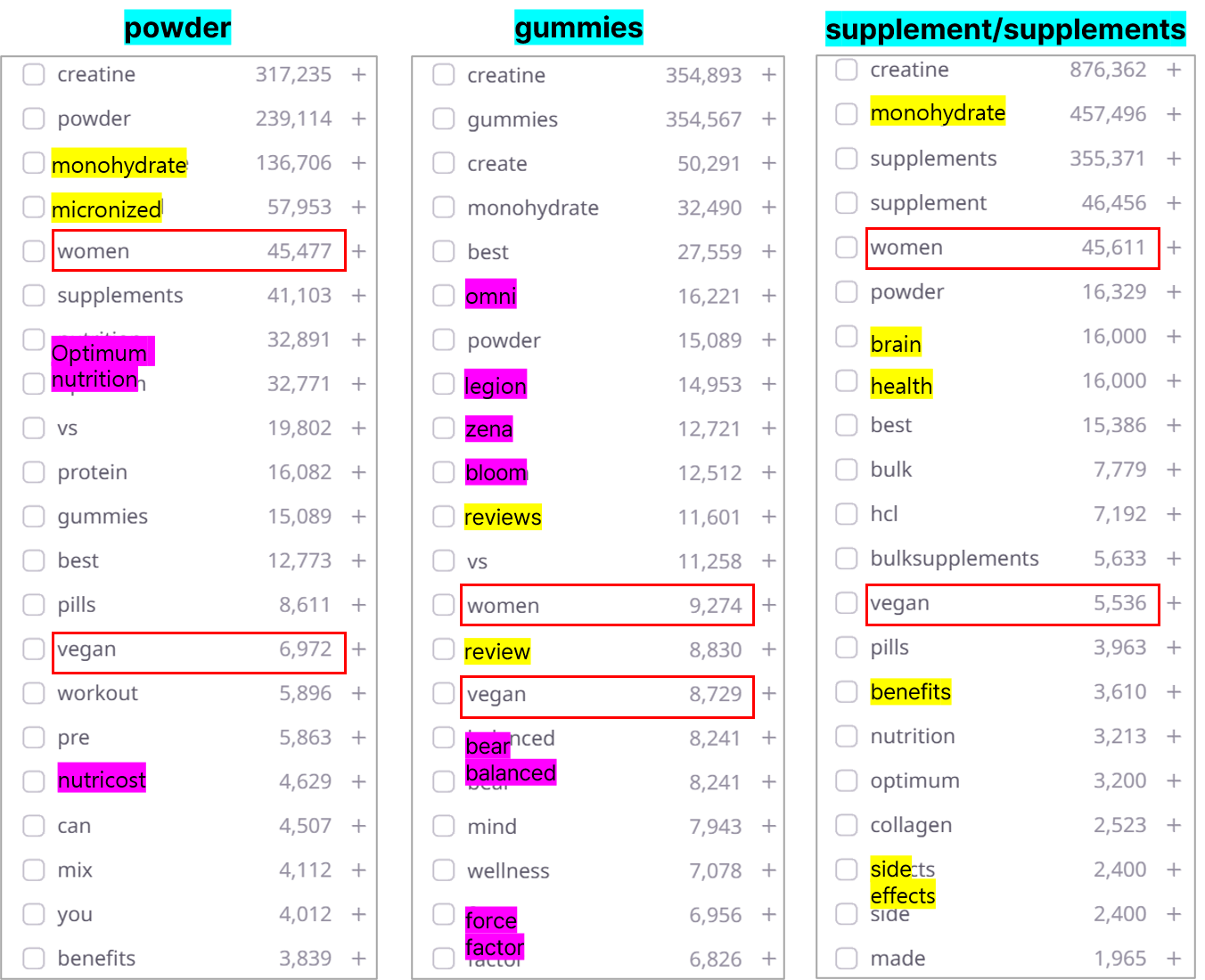
The top topics for creatine powder include
monohydrate
(136,706),
micronized
(57,953),
optimum
(32,771), and
nutricost
(4,629) — specific ingredient grades and established brand names. These are people who already know what they want.
creatine gummies — Brand comparison shoppers
The gummies topic list reads like a brand directory:
omni
,
legion
,
zena
,
bloom
,
bear balanced
,
force factor
— multiple brands competing for the same searches. High volumes for
reviews
(11,601),
review
(8,830) and
best
(27,549) confirm that comparison and validation are central to how people shop this format. The appearance of
wellness
(7,078) suggests buyers are approaching gummies as a lifestyle product, not just a workout supplement.
creatine supplements — Purpose-driven newcomers
Beyond
monohydrate
(457,496) in the second position, what stands out in this list is
brain
(16,000),
health
(16,000),
effects
and
side
(2,400 each). These are people asking: what does it do for my brain? Is it good for my health? What are the side effects? This is the entry-level consumer — someone drawn to creatine for general wellness reasons, still in the research phase, not yet committed to any format or brand.
Taken together, the three formats serve consumers at different depths of the market. Powder buyers select by ingredient. Gummies buyers compare by brand. Supplement searchers are still figuring out the basics.
One signal cuts across all three:
women
and
vegan
rank in the top topics for every format. Female interest and clean-ingredient concerns aren’t tied to any specific product type — they run through the entire market.
What Search Paths Reveal About Creatine Gummies
Search path data adds another dimension to this picture, showing not just what people search, but how their journeys are changing over time.
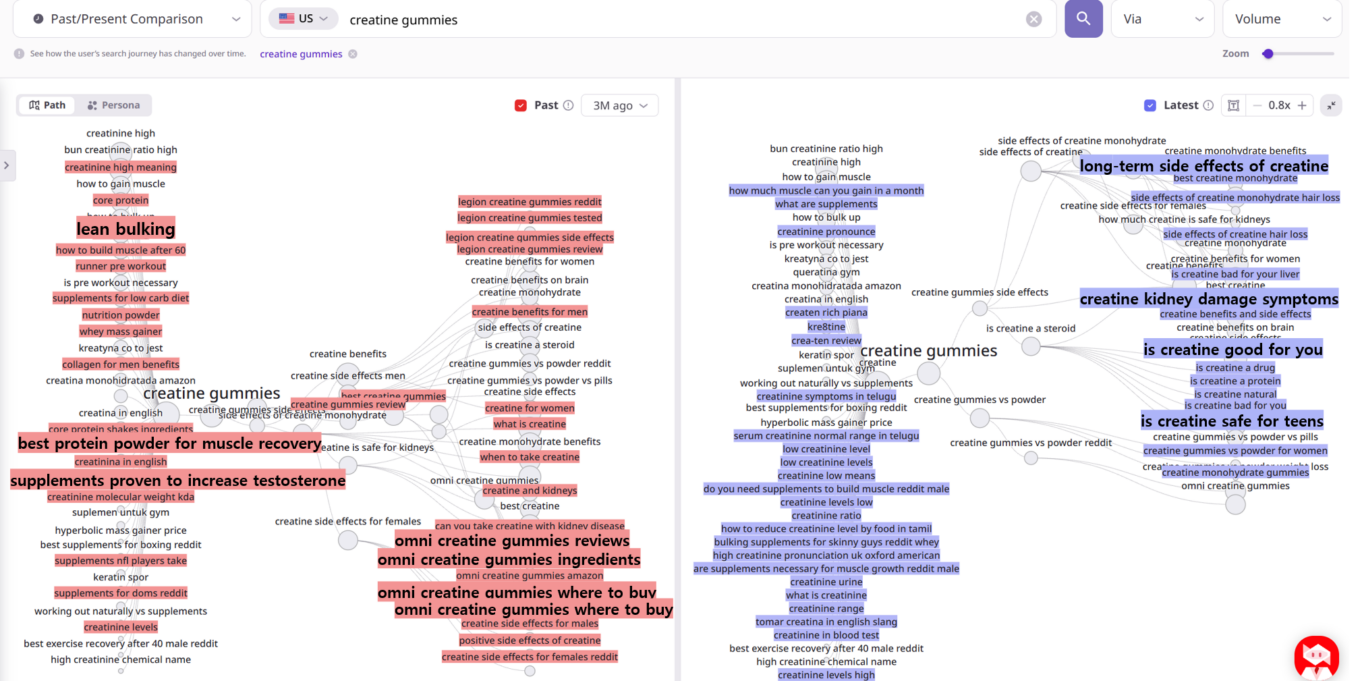
In this view, red indicates keywords that existed three months ago but have since disappeared. Blue indicates keywords that are new — present now but absent three months ago. Keywords with no color were present in both timeframes.
What disappeared (red) — The gym crowd moved on
Three months ago, searches like
'lean bulking
,
whey mass gainer
,
supplements proven to increase testosterone
‘ served as entry points into creatine gummies. The entire ‘
omni creatine gummies'
cluster (
reviews
,
ingredients
,
where to buy
,
amazon
), along with
legion creatine gummies
and its associated searches, has also disappeared. The era of specific brands driving the market is over; demand has diversified.
What appeared (blue) — First-timers and safety-focused buyers
The new entry points reflect consumers at the very start of their research. Searches like
'is creatine good for you, is creatine safe for teens
‘ signal people asking the most fundamental questions before committing to anything. Safety concerns have also become more medically specific: ‘
creatine kidney damage symptoms
,
long-term side effects of creatine
‘ now appear where they didn’t three months ago.
Three months ago, creatine gummies attracted gym-goers and were anchored by a few dominant brands. Today, the buyers arriving are asking whether creatine is safe, researching side effects in medical detail, and coming from far more varied starting points.
The product hasn’t changed. The consumer has — and so has the conversation around it.
See It for Yourself
The creatine market isn’t just bigger than it was. It’s structurally different. Powder search volume reflects a maturing base of informed buyers. Gummies have become the market’s growth engine, pulling in first-time users across a widening range of contexts. And searches for creatine supplements — broad, format-agnostic, purpose-driven — have surged almost vertically, powered by a wave of consumers who are new to the category entirely.
What search data makes visible is the shape of that change in real time: which formats are growing, who is entering the market, what questions they’re asking before they buy, and how those patterns are shifting month to month.
ListeningMind is a Search Intent Intelligence platform, built on real search behavior data. It maps market size, category trends, search journeys, brand visibility, and category entry points (CEPs) from a single keyword input. A free trial is available.
FAQ
Q1. How large is the U.S. creatine supplement market by search volume?
According to ListeningMind, the U.S. creatine market spans 22,807 active keywords, generating 7,044,472 searches per month and 70,808,500 searches per year. The keyword “creatine” alone accounts for over 8 million annual searches. But the bigger signal is that specific, intent-driven queries like creatine monohydrate and creatine supplements are growing fastest — a sign the market is both expanding and deepening.
Q2. What are consumers most focused on when they search for creatine gummies?
The most consistent question across time is whether gummies work as well as powder. Beyond that, searches cluster around side effects and safety concerns — particularly around kidneys — and brand comparisons. Comparing the path data from three months ago to today, muscle-building intent has largely disappeared from the entry points. It’s been replaced by first-time buyers asking the most basic question: is creatine even safe?
Q3. Why is search data useful for market analysis?
Search data reflects what consumers are actually thinking — in their own words, before they buy. Unlike surveys or sales data, it captures the questions, concerns, and comparisons that happen during the research phase. The three-month path comparison in this article shows how quickly consumer intent can shift, and how search data can surface those changes before they appear in sales figures.
Q4. What can you analyze with ListeningMind?
ListeningMind maps the full search landscape around any keyword or market. This includes total search volume, category-level trends, consumer search journeys, brand visibility, and category entry points (CEPs). It shows not just what people search, but how their searches connect, where they start, and where they end up.