
Index
For years, search worked in a predictable way. We typed keywords, and Google returned pages containing those words. The logic was simple, and brands optimized accordingly.
That era is ending.
A recent Google patent on Thematic Search makes the shift explicit: search is being rebuilt around topics and context, not keywords. For brands, this has profound implications for how content is designed, structured, and discovered.
From Keywords to Topics: What Thematic Search Actually Means
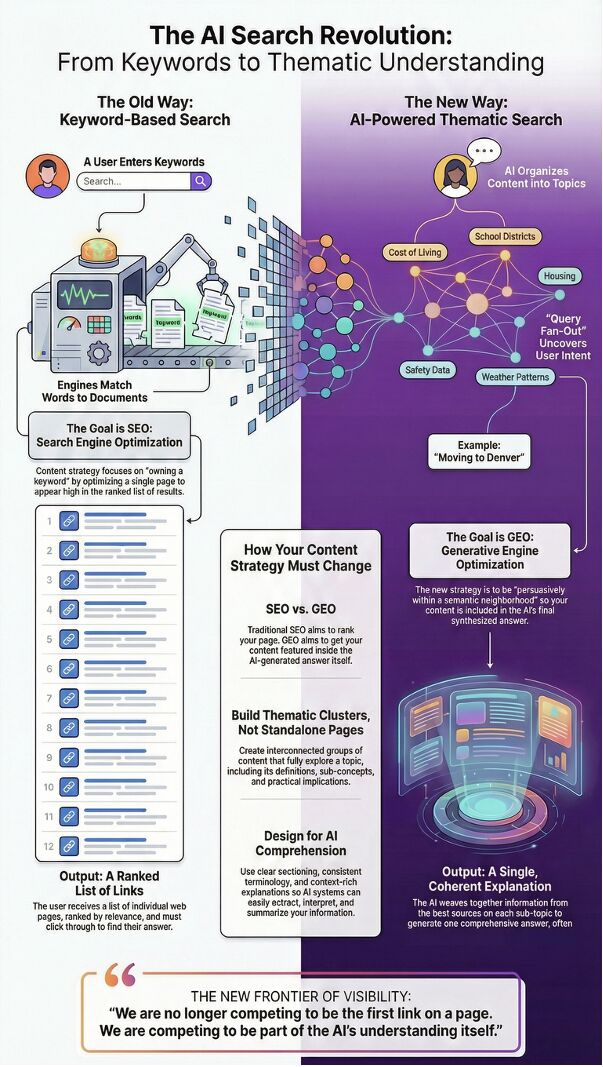
Thematic Search reorganizes information by clustering documents into meaningful topics before generating an answer.
Instead of ranking individual pages by keyword match, Google’s AI now prioritizes the broader themes those pages represent. What matters most is no longer whether your page contains the right phrase — it’s whether your content fits naturally into a topic the AI can recognize, understand, and summarize.
This is a fundamental change in what “optimization” means. Brands can no longer win by placing the right words in the right density. They win by owning a topic comprehensively.
Query Fan-Out: How One Question Becomes Many
A key mechanism in this new system is query fan-out. When a user enters a single question, the AI generates many related sub-questions on its own — and synthesizes answers across all of them.
A search like “moving to Denver” doesn’t just retrieve pages about Denver. It triggers an entire constellation of related queries: housing costs, neighborhoods, schools, safety ratings, job market conditions. The AI assembles all of these into a single, coherent answer.
The engine is not responding to a keyword. It’s responding to the full intent space behind that keyword.
This means a brand that answers only the surface question will be invisible. A brand that addresses the entire intent space — the questions behind the question — becomes the natural source AI turns to.
What This Means for Content Strategy
This transformation demands a fundamentally different approach to content.
Brands can no longer rely on isolated articles optimized for specific search terms. Instead, they must:
- Build structured topic clusters that address a theme from multiple angles
- Create context-rich explanations that go beyond surface-level answers
- Ensure content is easily extractable and summarizable by AI systems
In other words, content must be designed to participate in a topic — not compete for a phrase.
From SEO to GEO: The Visible Shift
This is precisely where the shift from SEO to GEO becomes visible in practice.
Success is no longer about ranking first for a keyword. It’s about being included as a trusted, authoritative source when AI assembles its answer. Search engines are now topic engines. That means brands must become topic architects — building the most comprehensive, credible, and contextually rich presence around the situations their customers care about.
The brands that understand this shift will be the ones AI chooses to represent the truth. The ones that don’t will find themselves absent from answers their customers are already receiving.