Index
For 25 years, search engines shaped how we discover brands. Today, AI agents are beginning to redefine that journey entirely.
Instead of opening endless tabs or comparing dozens of reviews, consumers will increasingly rely on AI assistants to filter the noise and present a curated shortlist. This shift transforms the rules of branding. The key question is no longer “How do we get seen?” It’s “How do we get chosen?”
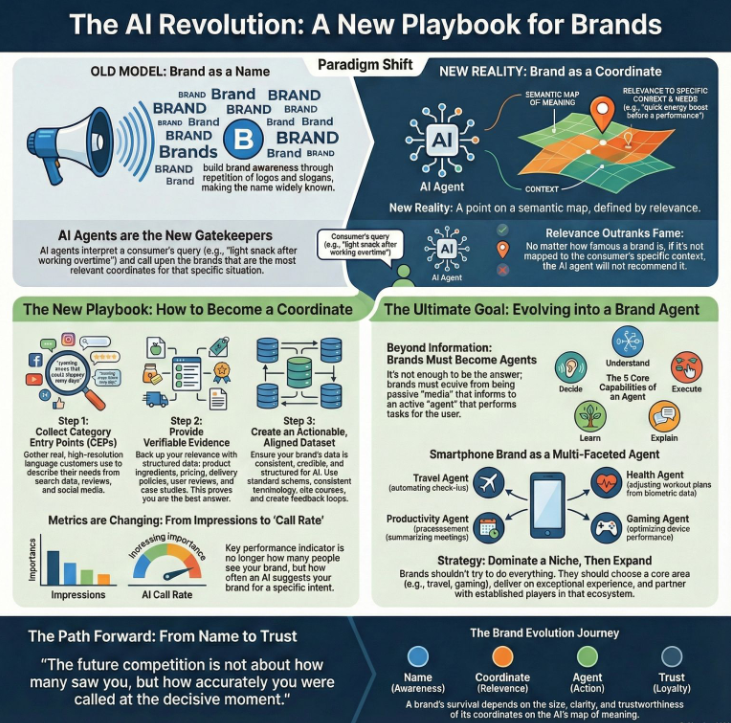
1. Brands Are Becoming Coordinates, Not Just Names
Traditional branding focused on logos, taglines, and recognition. In the AI era, brands live inside a semantic map — a structured space where meaning and context determine what gets recommended.
When someone asks an AI agent for “a light meal after working late,” the system doesn’t run a keyword search. It interprets the request as a coordinate and finds the brands positioned nearest to that context in its knowledge structure.
Success in this environment depends on owning many clear, well-defined points on this map — not just a memorable name.
2. AI Understands the Scene, Not Just the Need
AI evaluates high-resolution moments rather than broad demographic needs. These moments are what marketers call Category Entry Points.
Examples include “protein that’s gentle on an empty stomach” or “running shoes with grip on rainy days.” These are the real situations where decisions happen — specific, contextual, and emotionally loaded.
To be recommended by an AI agent, brands must define the specific moments they serve and demonstrate — through structured, consistent content — that they are the best answer for that scene.
3. Structured Data Matters More Than Creative Copy
AI agents don’t respond to catchy taglines. They rely on structured, consistent, and verifiable information.
Brands that want to appear in AI-generated recommendations need to:
- Organize information in standardized, machine-readable formats
- Use consistent language and terminology across all channels
- Keep content current and fill gaps in their knowledge base
- Build a content architecture that AI can navigate and cite confidently
In this world, a new performance metric is emerging: the call rate — how often a brand is recommended for a specific situation. It’s a more meaningful measure of brand health than impressions or clicks.
4. The Future Brand Acts Like an Agent
The most advanced brands will evolve beyond products and services into agents that execute tasks on behalf of the user.
They will understand context, make decisions, complete actions, explain their reasoning, and learn from outcomes. A phone brand that automatically checks you in for flights. A wellness brand that adjusts routines based on your recovery score. A productivity tool that prepares meeting summaries and flags action items before you ask.
This level of capability requires deep integrations, strategic partnerships, and a fundamental rethinking of what a brand is and does.
The New Rules of Brand Visibility
Brands are moving through three stages: from logos to coordinates to trusted agents.
In a world where attention is scarce and AI filters our choices before we even make them, the brands that win will be the ones that offer precision, reliability, and genuine utility — not just visibility.
As AI becomes the new gatekeeper of discovery, the question every brand must answer is simple: Have we given the machine enough reason to choose us?