
Index
SEO used to be driven by counting things — keywords, backlinks, anchor text. The more you had, the better you ranked. The logic was simple, and for a long time, it worked.
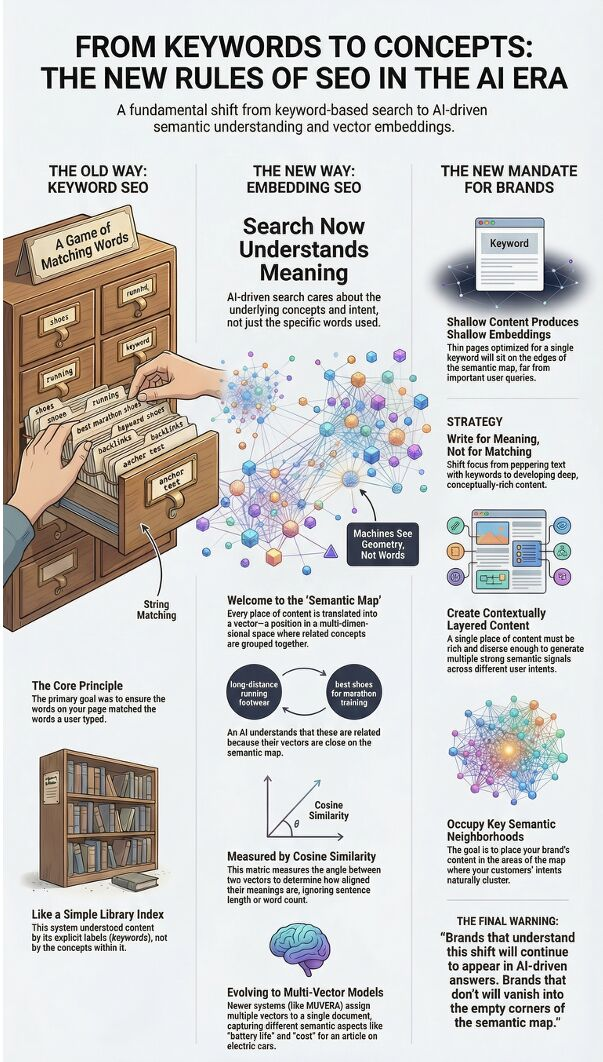
But AI-driven search no longer cares about matching strings of text. It cares about meaning. And meaning lives in vectors, not words.
Brands that don’t understand this shift won’t just rank lower. They simply won’t appear in AI-generated answers at all.
What Semantic Embeddings Actually Are
In embedding-based search systems, every piece of text is mapped into a multidimensional “semantic space” — a vast conceptual landscape where related ideas sit close together, regardless of how they are phrased.
This is why AI understands that “best shoes for marathon training” and “long-distance running footwear” express exactly the same intent. The words are different. The meaning is the same. And meaning is what the system retrieves.
Search engines no longer retrieve pages that match keywords. They retrieve concepts positioned near the user’s intent in semantic space.
Why Rich Content Generates Stronger Signals
This transformation becomes even more powerful with multi-vector models like MUVERA, which represent different aspects of the same document as separate vectors.
A single article about electric vehicles might generate distinct vectors for battery life, charging infrastructure, cost of ownership, and environmental impact — each one a semantic signal the AI can locate and retrieve independently.
Rich, structured content therefore generates stronger and more diverse semantic signals. Thin content, by contrast, produces weak embeddings — and weak embeddings push brands to the outer edges of the semantic map, where no meaningful queries live.
What This Means for Brand Content Strategy
For brands, the mandate is clear: write for intent, not for phrasing.
This means:
- Build content that explores a theme from multiple angles
- Use consistent terminology and contextual depth throughout
- Avoid thin, surface-level content that addresses only the obvious question
- Design content architecture so AI can extract, organize, and cite your ideas clearly
Embedding-based retrieval rewards clarity, richness, and topical diversity — not keyword density. A brand that writes one shallow article per keyword will lose to a brand that builds a comprehensive, interconnected content ecosystem around a topic.
The Age of Semantic SEO Has Begun
The age of keyword SEO is ending. The age of semantic SEO has begun.
Brands that understand how AI organizes meaning will appear in AI-driven answers. Those that don’t will disappear into the blank space between vectors — present on the web, but invisible to the systems that now shape what people find and believe.
The question is no longer “Are we ranking for the right keywords?” It’s “Does the AI understand what we mean, and does it place us where our customers are looking?”