
Index
For years, many marketers have treated Philip Kotler’s classic frameworks — segmentation, targeting, positioning, differentiation, customer lifetime value — as unquestionable truths. They form the backbone of marketing education and have guided brand strategy for decades.
But a growing body of empirical research, including work by Byron Sharp, Les Binet, and Peter Field, has challenged some of those assumptions and introduced a fundamentally different perspective on how brands actually grow.
Understanding both views — and where they diverge — is one of the most useful exercises a marketer can do today.
Kotler’s View: Segmentation and Loyalty
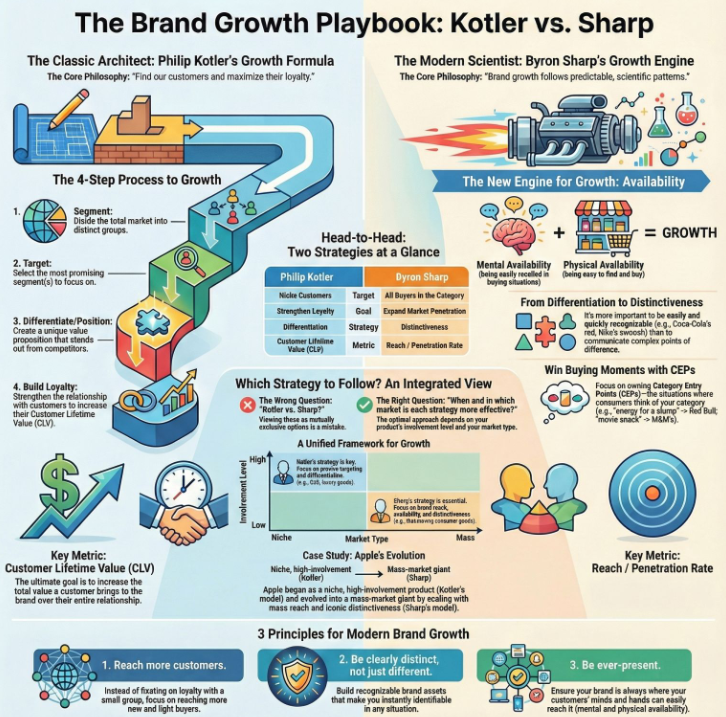
Kotler’s framework argues that brands grow by deeply understanding specific customer segments, delivering tailored value propositions, and building loyalty that maximizes customer lifetime value.
In this view, differentiation and precise positioning are essential. By identifying who your best customers are and serving them exceptionally well, brands build long-term relationships and stable growth within defined segments.
This approach places the loyal, high-value customer at the center of strategy.
Sharp’s View: Reach and Availability
Byron Sharp offers a counterargument grounded in large-scale empirical data. His research shows that real brand growth comes from three things: reaching as many consumers as possible, increasing mental availability (being easily recalled in relevant situations), and increasing physical availability (being easy to buy, anywhere).
Sharp’s data consistently shows that consumers buy multiple brands in a category rather than staying loyal to one. Light buyers and occasional purchasers — not loyal fans — make up the majority of most brands’ sales.
This leads to a different strategic conclusion: expanding reach, not deepening loyalty, is the primary driver of growth.
Sharp also emphasizes Category Entry Points (CEPs) — the mental cues and situational triggers that make consumers think of a brand. Red Bull owns “when you need energy.” M&M’s owns “movie-time snack.” Winning these moments, Sharp argues, matters more than hyper-detailed segmentation.
Key Differences at a Glance
| Kotler | Sharp | |
|---|---|---|
| Growth driver | Loyalty and lifetime value | Penetration and reach |
| Target | Core segments and best customers | Light buyers and non-customers |
| Strategy | Differentiation and tailored positioning | Consistent, distinctive branding at scale |
| Key metric | Customer retention and CLV | Mental and physical availability |
Why This Debate Matters Today
In today’s fragmented media environment — where consumers move constantly across online and offline channels — Sharp’s perspective becomes increasingly relevant.
Hyper-targeted strategies are expensive, complex, and often reach the people who were already going to buy. Broad reach combined with strong, consistent distinctiveness frequently delivers more predictable growth, particularly for mass-market and low-involvement categories.
That said, both perspectives have value. Premium, high-involvement categories — luxury goods, professional services, complex B2B products — may genuinely benefit from Kotler’s segmentation-driven approach. Fast-moving consumer goods and everyday categories tend to respond better to Sharp’s reach-based model.
A Practical Takeaway
Sharp’s arguments are refreshingly honest about what the data actually shows. Rather than romanticizing loyalty or retrofitting success stories into segmentation frameworks, his work encourages marketers to build broad mental presence and make their brand easy to find and easy to buy.
The most effective strategy often combines both perspectives. Start with strong differentiation to earn a clear identity. Then scale through mass reach and consistent, iconic distinctiveness — so that when the moment of need arrives, your brand is simply the one that comes to mind.