
Index
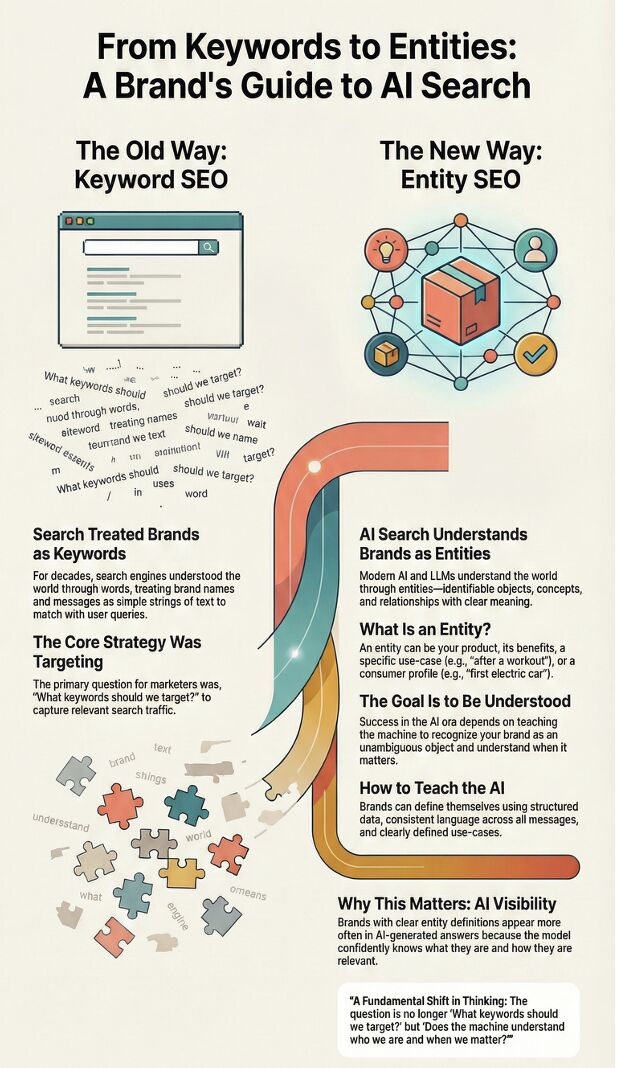
Modern AI search engines no longer understand the world through keywords. They understand it through entities — people, products, places, needs, situations, and concepts that exist as clear, identifiable units in a structured knowledge system.
For many marketers, the word “entity” sounds technical and abstract. In reality, the idea is straightforward. Every brand message already contains entities: products, features, consumer situations, benefits, use moments, emotions, and the problems consumers want to solve. Humans intuitively interpret these as meaningful units. AI systems simply formalize them.
What Counts as an Entity — and What Doesn’t
The distinction between an entity and a non-entity is not about complexity. It’s about specificity and context.
| ✅ Entity | ❌ Not an Entity |
|---|---|
| “Wireless earbuds for long commutes” | “Good wireless earbuds” |
| “First electric car buyer” | “People interested in EVs” |
| “After-workout snack moment” | “Healthy snack content” |
A clear entity has a defined context, a specific use case, and a recognizable semantic boundary. A non-entity is too broad or subjective for AI to place meaningfully in its knowledge structure.
The difference matters because AI retrieves entities, not keywords. If your brand content is full of broad, generic language, the AI simply has no clear unit to attach your brand to.
Why Entities Matter to AI
Large language models extract entities and the relationships between them to build their internal knowledge structures.
When a user asks about a product, a need, a scenario, or a brand, the model doesn’t retrieve keywords. It navigates its entity network — moving through objects, product types, use moments, problems, benefits, and the connections among them.
This means every use case you describe, every “when this happens” moment you map, every feature or benefit you articulate — these all become entities in the AI’s eyes. They are the units that determine whether your brand fits a question, a context, or a need state.
Why This Matters for Marketing
Brands with clear and consistent entity definitions appear more frequently in AI-generated answers. The model understands what they are, how they differ from competitors, and when they are the right answer.
Brands that communicate inconsistently — or rely solely on keyword tactics — fail to register in the model’s knowledge graph. They exist on the web, but they don’t exist as meaningful objects in the AI’s understanding of the world.
The Role of Entity SEO
Entity SEO makes this alignment possible. Through structured data, consistent language, and well-defined use cases, brands teach search engines and large language models to recognize them not as a string of text, but as a real object with meaning, context, and relevance.
The key question in the AI era is no longer: “What keywords should we target?”
It is: “Does the machine understand who we are and when we matter?”
To earn visibility in AI-generated answers, brands must show up not as loose terms, but as entities — clear, unambiguous, and impossible to confuse with anyone else.