Index
AI search doesn’t reward the brand with the most traffic. It rewards the brand that best fits the question being asked.
That’s the core shift behind GEO (Generative Engine Optimization)—and it changes how you need to think about brand visibility entirely.
This isn’t just a technology trend. It goes to the heart of how brands continue to exist—in consumers’ daily lives and within the decision-making structures of AI.
In this post, we break down what GEO is, why CEPs (Category Entry Points) are the new growth lever, and how to apply a three-step framework to get your brand consistently recommended by AI.
👉 Download the GEO Era Brand Survival Playbook
What GEO Means for Your Brand in 2026
GEO isn’t about ranking higher. It’s about being cited.
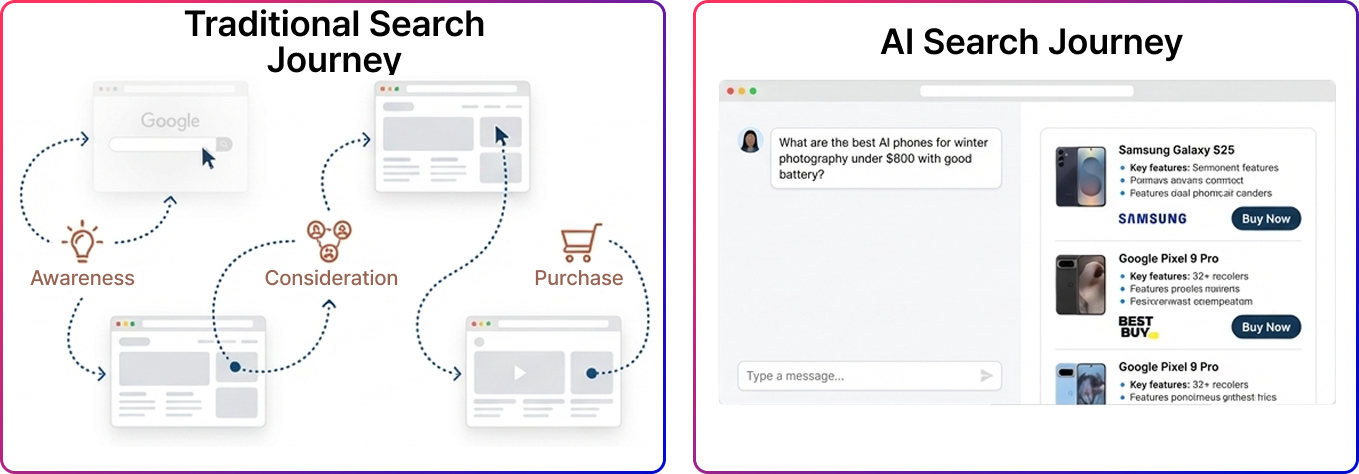
In AI-powered search, tools like ChatGPT, Perplexity, and Google AI Overviews don’t return a list of links. They generate a single answer—drawing from multiple sources, then presenting one synthesized response.
Your brand is either part of that answer, or it isn’t.
That’s a fundamentally different game from SEO. And it requires a fundamentally different strategy.
This article is based on ListeningMind’s GEO Era Brand Survival Playbook. It’s designed to help marketers understand how AI selects brands—and how to build a strategy around that selection process.
Why “Top of Mind” No Longer Drives AI Recommendations
For decades, brand strategy focused on one goal: become the first name consumers think of in your category.
That worked when humans were making the decision.
AI doesn’t think in those terms. It has no mind in the human sense—no brand memory, no emotional association, no instinct toward the familiar. What AI evaluates is the relationship between context and conditions—specifically:
- In what situations is this brand mentioned?
- What kinds of questions is it associated with?
- In what context does it consistently appear?
AI asks: “Which brand fits this situation best?”—not “Which brand is most famous?”
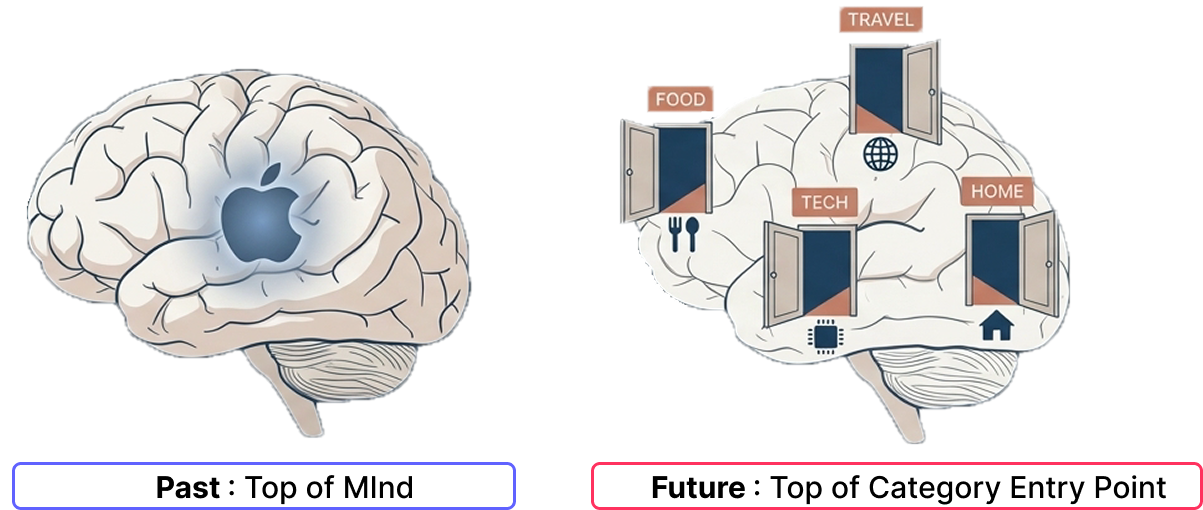
This is where CEPs (Category Entry Points) become the new competitive battleground.
A CEP is a specific situation or trigger that brings a consumer into a product category. Think “looking for a quick snack before a workout” or “traveling and need high-protein options.” Each of those is a distinct entry point—and AI processes them as distinct contexts.
Broad category awareness alone won’t get you cited. You need your brand associated with the specific CEPs where your audience is asking questions.
What Is GEO—and How Is It Different from SEO?
GEO (Generative Engine Optimization) is the practice of designing your brand to be cited in AI-generated responses.
SEO optimizes for ranking. GEO optimizes for relevance in context.
The shift looks like this:
- From keyword optimization → to meaning design at the CEP level
- From maximizing exposure → to maximizing contextual fit
- From “appearing in results” → to “being part of the answer”
The starting point of GEO isn’t keywords. It’s defining which CEPs your brand should own.
Once you know which situations your brand should appear in, you can build content and signals that make AI confident selecting you as the right answer.
The 3-Step GEO Framework for Brand Growth
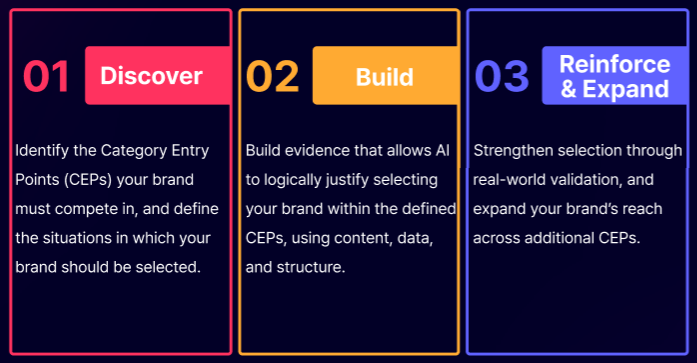
GEO isn’t a one-time fix. It’s an ongoing strategy—built around three repeating stages.
Each stage mirrors how AI actually processes brand relevance: discovery, evaluation, and selection.
Step1: Discover — Find the CEPs AI Should Associate with Your Brand
Before you can be cited, you need to know where you belong.
The key question in this step: “In what specific situations should our brand come up?”
That question can’t be answered by brainstorming around your brand name. It requires analyzing real search data—actual consumer questions, search paths, and purchase triggers.
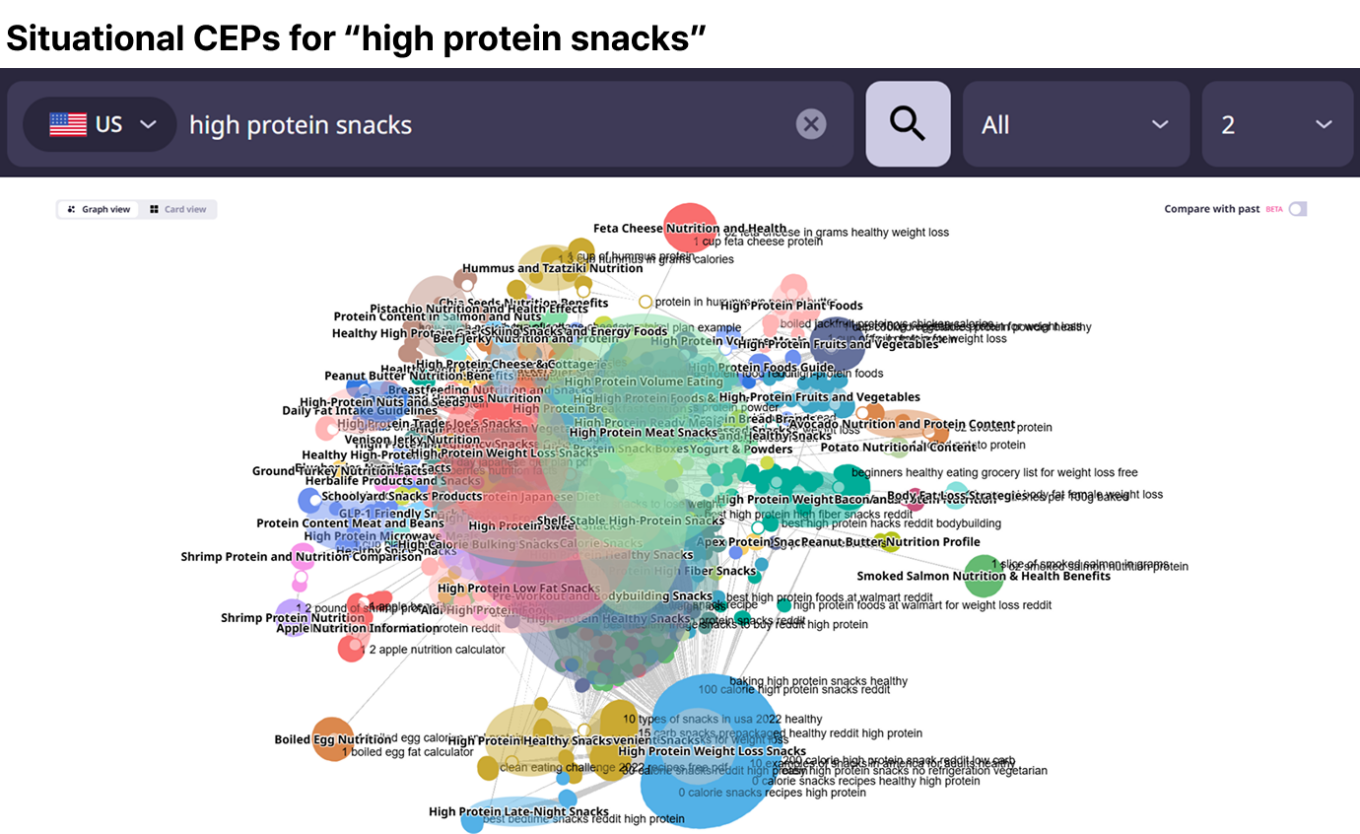
In GEO, CEPs must be expanded into prompt-ready question forms that brands can realistically answer. Only then can CEPs surface in real AI search environments.
In this example, the CEP “high protein snacks” connects to a broader strategy group—including “high protein gas station snacks”—and from there, we identify the high-probability prompts users are likely to ask AI. That’s the CEP-to-prompt pipeline that GEO runs on.
We walk through exactly how to do this with real search data in the GEO Era Brand Survival Playbook.
Step2: Build — Create Content Structures AI Can Actually Cite
Knowing your CEPs is only the first step. The next question is: “Can AI cite your brand when those questions come up?”
AI doesn’t copy-paste from your site. It decomposes questions, extracts relevant elements, and reconstructs a response. That means your content needs to be structured in a way that makes extraction easy.
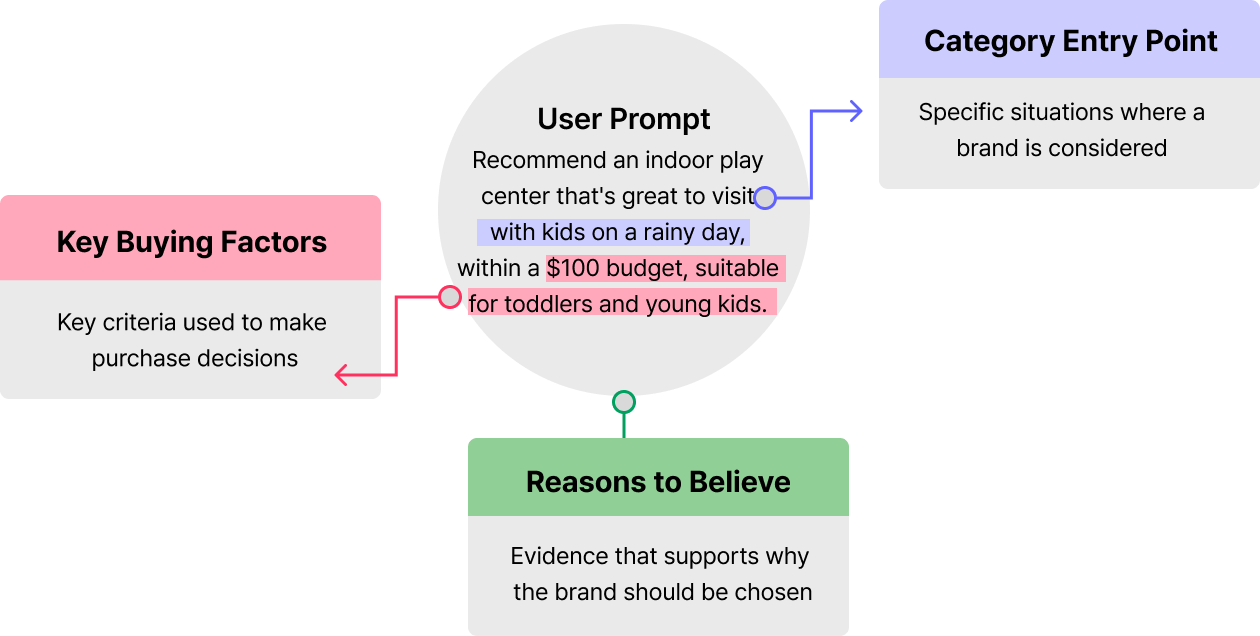
Content volume doesn’t matter here. Structure does.
Specifically, your content should have:
- Clear answers organized around individual questions (not topics)
- Context that’s immediately understandable without surrounding paragraphs
- Credible data and evidence tied to specific claims
This is also where E-E-A-T (Experience, Expertise, Authoritativeness, Trustworthiness) becomes a practical requirement—not just a quality signal. AI needs to be able to justify why your content is a credible source. Build your content so that justification is obvious.
Step3: Reinforce & Expand — Build the Signals That Keep AI Choosing You
Being cited once doesn’t mean you’ll be cited again.
AI selections shift over time. A brand that appears in responses today may not appear tomorrow—unless it consistently reinforces the signals that made it relevant in the first place.
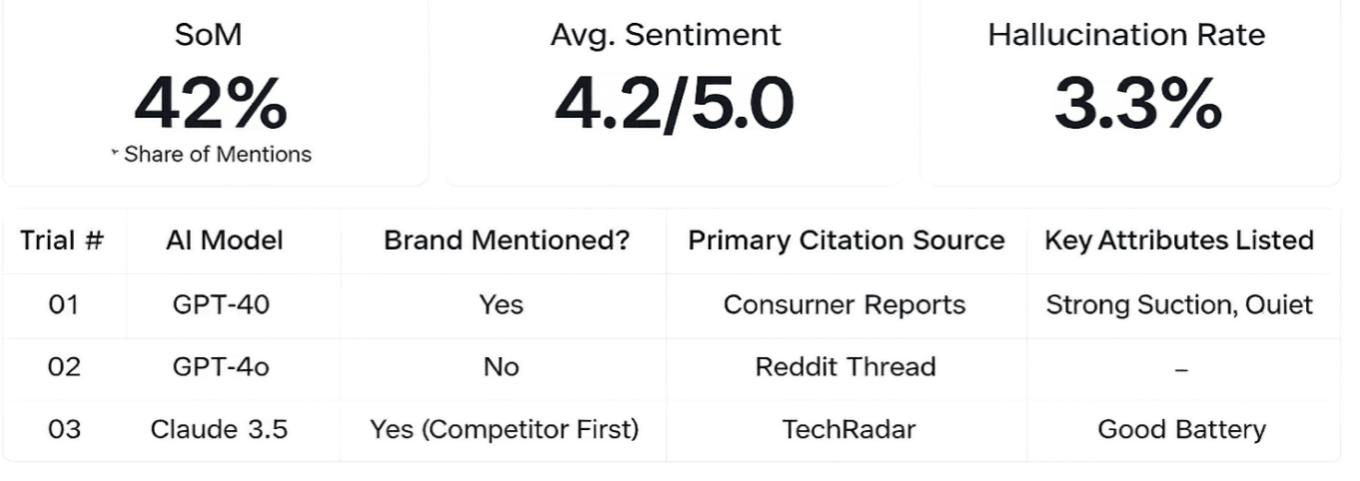
What creates consistency isn’t volume—it’s repeated, coherent signals across contexts.
That means:
- Consistent messaging tied to specific CEPs
- Ongoing mentions in authoritative external channels
- Connections with industry experts and credible media
Think of this stage as context expansion, not content distribution. Each new CEP you establish is a new entry point where AI can surface your brand. And every CEP you own makes the adjacent ones easier to claim.
Being selected for one CEP isn’t the goal—it’s the launching point for extending your brand’s meaning into the contexts that surround it. The broader your CEP footprint, the wider the range of questions where your brand becomes the right answer.
What This Means for Your Marketing Strategy
The brands that win in AI search aren’t the loudest. They’re the most contextually relevant.
That requires three things:
- Knowing which CEPs to target—based on real consumer intent data, not assumptions
- Building content that AI can decompose and cite—structured around questions, not topics
- Reinforcing those associations over time—through consistent signals across owned and earned channels
This is a strategic shift, not a tactical one. It won’t happen overnight. But the brands that start building CEP-based relevance now will have a significant advantage as AI search continues to grow.
Get the Full GEO Playbook
This post covers the framework. The full playbook goes deeper—with CEP discovery worksheets, prompt design methods, and a step-by-step execution guide.
Related reading: