Index
The non-alcoholic beverage market in the United States is changing fast. What was once a category pushed to the margins — a fallback for people who simply could not drink — is becoming one that consumers are actively and deliberately choosing. That shift is not just a feeling. It shows up clearly in the data.
In this article, we analyze the scale of the U.S. non-alcoholic beverage market, category-level search trends, and consumer search behavior using ListeningMind data.
The Non-Alcoholic Beverage Market: Scale, Growth, and What’s Changing
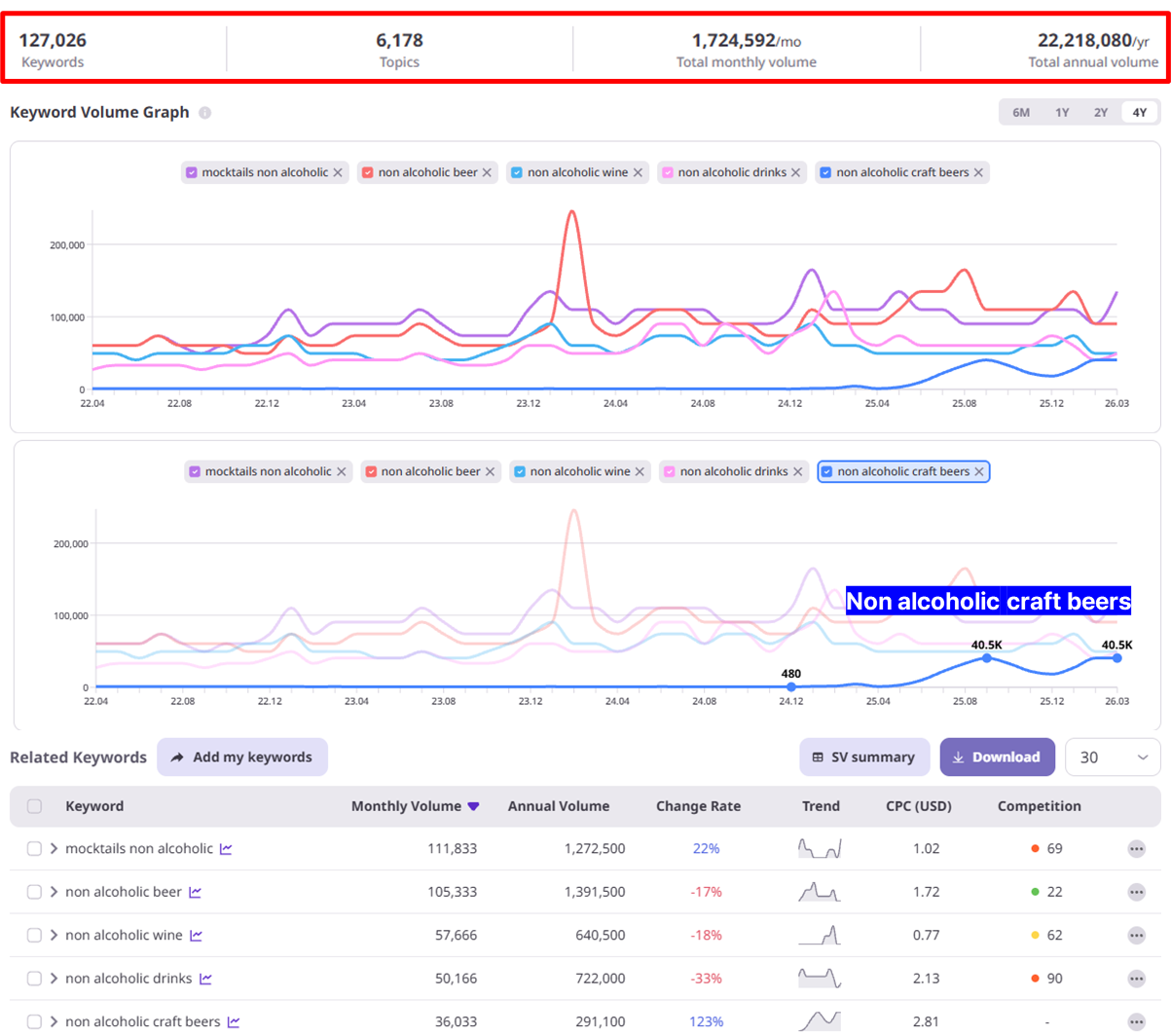
The non-alcoholic beverage market in the United States is at a genuine inflection point. According to ListeningMind data, there are now 127,000 keywords related to non-alcoholic beverages being actively searched in the U.S. — generating 1.72 million searches per month and over 22 million searches per year. These are not niche numbers. Non-alcoholic drinks have moved from the margins to the mainstream, shifting from a category people turned to out of necessity into one they are actively choosing.
How Each Category Is Growing — and Why It Matters
Breaking down the data by keyword reveals distinct patterns worth paying attention to.
Mocktails and non-alcoholic beer are the twin pillars of the market. Both categories have grown steadily year over year, with no signs of slowing. This is structural demand — not a trend spike — and it suggests a lasting shift in how Americans think about what they drink.
Non alcoholic wine is a seasonally dependent category that peaks every January, and meaningful growth outside of that window remains limited.
The most striking story, however, belongs to non alcoholic craft beers. From 2022 through 2024, monthly search volume hovered between 880 and 1,000 — barely registering on the chart. Then, in June 2025, something changed. Searches exploded. By August and September 2025, monthly volume had reached 33,000 to 40,000, and in both February and March 2026, the category held above 40,000 monthly searches. While every other category has plateaued or grown incrementally, non-alcoholic craft beer is the only one drawing a curve that looks unlike anything else in this market.
What Search Topics Reveal About Each Category
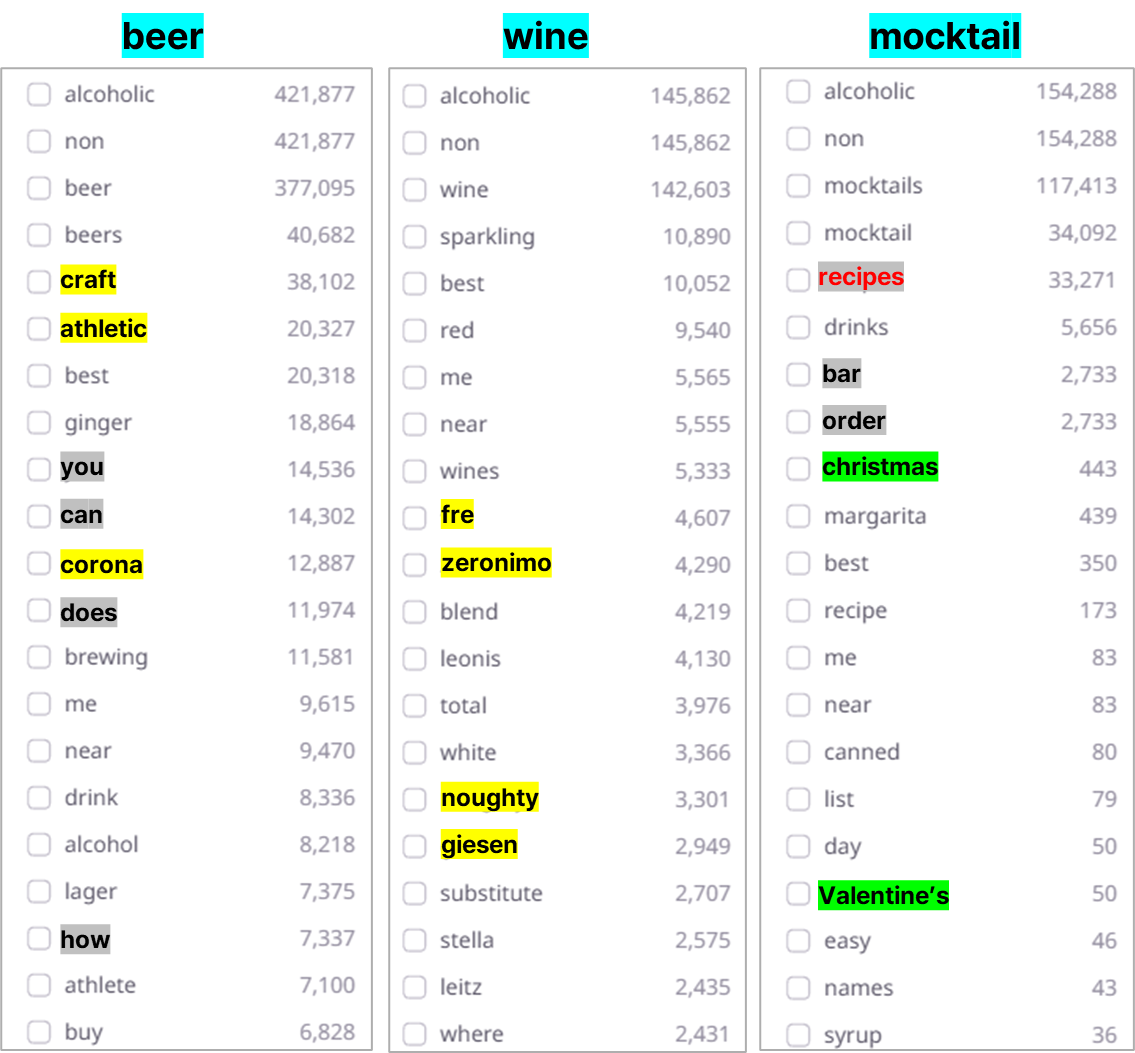
The differences between categories become even clearer when you examine how people enter each one.
Looking at the search topics surrounding non alcoholic beer, “athletic” (20,327) stands out near the top — a strong signal of brand-driven demand centered on Athletic Brewing. Even more telling is “craft” (38,102), which ranks above “athletic” by a significant margin, indicating that interest in craft as a quality standard and category in its own right is growing independently of any single brand. Beyond that, the data is filled with questioning and verification language: “you,” “can,” “does,” “how,” “bad.” Specifically, searches like “is non alcoholic beer bad for you” (4,133 searches/month), “does non alcoholic beer have alcohol” (3,633/month), and “is non alcoholic beer good for you” (1,600/month) all rank near the top.
What makes this particularly revealing are searches like “can pregnant women drink non alcoholic beer” (1,060/month) and “can you drive while drinking non alcoholic beer” (676/month). These are not expressions of general health anxiety — they are signals from consumers who actively want to drink non-alcoholic beer in specific situations where alcohol is off the table. Non-alcoholic beer is already widely known, but a layer of “is it really okay to drink?” sits between awareness and purchase. For brands and content creators, answering these questions directly is one of the clearest paths to conversion in this category.
Non alcoholic wine tells a different story. Brand names — “fre,” “zeronimo,” “giesen,” “noughty” — dominate the top search topics. This is a category where consumers already know what they want and are searching to find it. Brand recall is strong, and the intent skews toward named-product purchase rather than general exploration.
Mocktails are defined by a completely different kind of entry point. “Recipes” (33,271) ranks high, reflecting strong demand from consumers who want to make their own. “Bar” and “order” (2,733 each) also appear, pointing to a meaningful segment of people looking to order mocktails when dining or drinking out. Seasonal terms — “christmas,” “valentine’s,” — round out the picture. The question driving mocktail searches is not “what is a mocktail” but “what should I make or order for this occasion.” It is a textbook occasion-driven category, where demand is triggered by specific moments and settings rather than a general lifestyle shift.
What Search Paths Reveal About the Non-Alcoholic Craft Beer Market
Analyzing the search paths around “non alcoholic craft beers” reveals a clear picture of how this market is structured.

A segment of users arrives at “non alcoholic craft beers” through smaller craft brands — Surreal Brewing, Notch, and Go Brewing all appear as entry points in the search journey. But regardless of where users start, the paths consistently converge on one destination: Athletic Brewing.
Beyond that initial entry, the search journeys branching out from “non alcoholic craft beers” are dominated by keywords connected to Athletic Brewing. The brand has effectively become synonymous with the craft non alcoholic beer category itself — not just a player in the market, but the default answer to the question.
What stands out within those paths is the appearance of the search query “is all athletic beer non alcoholic?” This is the kind of question only someone unfamiliar with the brand would ask — and its frequency in the data suggests that the growth of this category is being driven not just by existing fans, but by a large wave of first-time discoverers entering the market.
The journeys ultimately land on purchase intent. Searches extend beyond “near me” to specific retailers — Costco and Total Wine — signaling that demand is anchored in physical retail rather than online channels. Craft NA beer is no longer something people hunt for online. It has become something they expect to find at their local store.
Try It for Yourself
What the ListeningMind data makes clear is that the non-alcoholic beverage market has undergone a fundamental shift — from a market of substitutes to a market of choices. Mocktails and non-alcoholic beer have established themselves as structural demand, and non-alcoholic craft beer entered an entirely new phase of growth in 2025.
Tracking shifts like these — in market structure, consumer intent, and search behavior — is where search data proves its value. With ListeningMind, you can analyze market structure, consumer intent, and behavior simply by entering a keyword.
ListeningMind offers a 7-day free trial. If you’re curious, sign up here.
FAQ
A. According to ListeningMind data, there are over 127,000 keywords related to non-alcoholic beverages being actively searched in the U.S., generating an average of 1.72 million searches per month and over 22 million searches per year.
A. Search data analysis shows that the majority of consumers who search for “non alcoholic craft beers” go on to explore keywords connected to Athletic Brewing. Three primary areas of interest emerge from the data: brand verification, finding where to buy, and health-related reassurance. The appearance of searches like “is all athletic beer non alcoholic?” signals that a large wave of first-time discoverers — not just existing fans — is entering the category. It is also notable that searches extend to specific retailers such as Costco and Total Wine, indicating that purchase intent is anchored in physical retail rather than online channels.
A. Search data reflects what consumers want to know and buy in real time. Unlike surveys or sales data, it captures the exact words people type of their own volition — making it particularly effective for uncovering latent needs and the questions or barriers that exist before a purchase is made. As shown in this article, a search like “can pregnant women drink non alcoholic beer” reveals precisely which consumer segments are seeking out non-alcoholic beer, and in what specific situations.
A. ListeningMind allows you to analyze market size, category-level trends, consumer search journeys, brand recall, and category entry points (CEPs) — simply by entering a keyword. As demonstrated in this article, it enables you to uncover which categories are growing, what questions consumers are asking before they buy, and what search behaviors lead to purchase — all without paid advertising data.