
Index
Overview
How do consumers search for supplements across ingredients, retailers, and use cases in the U.S. market? To examine this, we used ListeningMind Intent Finder to analyze supplement-related search behavior.
We began with a broad set of seed keywords representing common entry points into the category, including category-level terms (e.g., vitamins, supplements, multivitamins), ingredient-led terms (e.g., magnesium, probiotics, melatonin), and use-case terms (e.g., sleep aid). Intent Finder expanded these seeds into a comprehensive dataset of U.S. supplement searches.

This analysis identified 482,291 U.S. supplement-related keywords, grouped into 32,599 topics, across a four-year period (December 2021 to November 2025), representing approximately 68.6 million monthly searches. The keywords with the highest search volume were magnesium glycinate (823,000/mo), ashwagandha (673,000/mo),vitamin d supplement (632,000/mo), creatine (550,000/mo), and vitamin shoppe (550,000/mo), reflecting a mix of ingredient-driven, retailer-driven, and product-format searches.
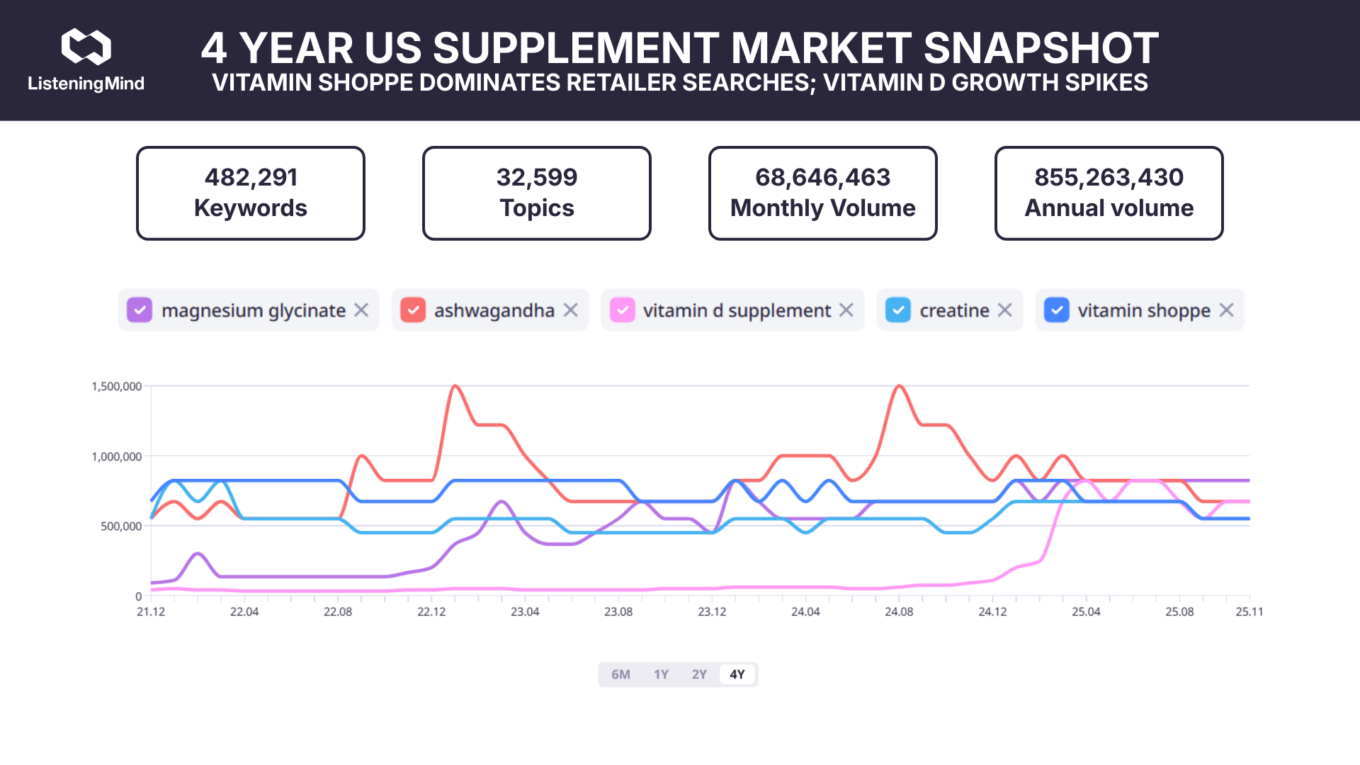
Vitamin shoppe (550,000/mo) dominates retailer searches, showing that retail discovery is concentrated and brand/retailer positioning matters. Second, vitamin d supplement (632,000/mo) experienced a clear, late-period growth spike: after a long low baseline the category accelerated sharply and reset at a much higher level, indicating a fast-moving adoption or media/seasonal effect. Third, ingredient behavior splits between the steady and the volatile: magnesium glycinate and creatine sit on high, steady baselines, while ashwagandha produces repeated large peaks (media/seasonal surges).
Fastest Growing Keywords
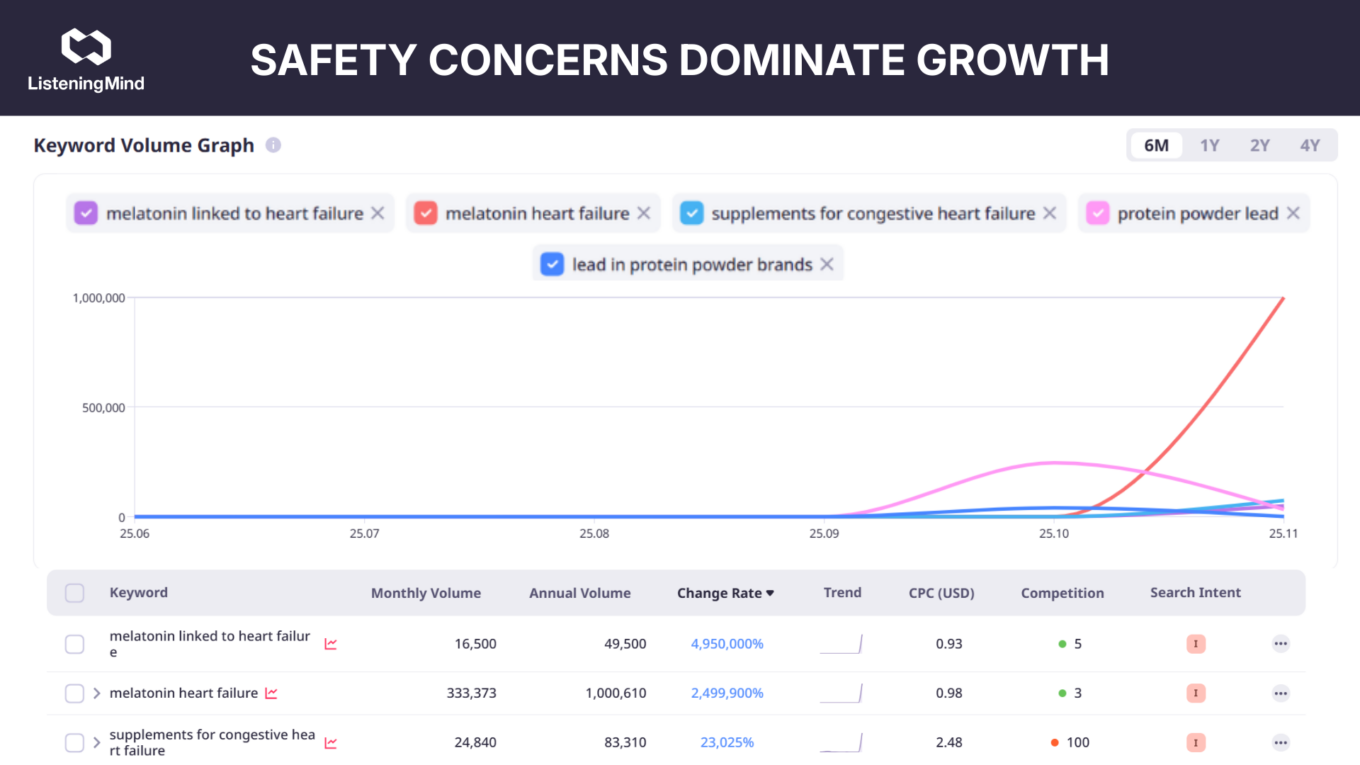
To search for trending keywords, we filtered out keywords with a search volume below 10,000 and then sorted by positive change rate over the past 6 months. Safety and risk queries, not benefit or “how to” searches, are driving the largest recent growth among big-volume supplement keywords. The data is not a scatter of random interest: it’s a concentrated pattern where safety-related topics (melatonin + cardiac risk; lead/heavy-metal concerns in protein) produce the largest absolute increases in search traffic.
What’s Wrong with Melatonin?
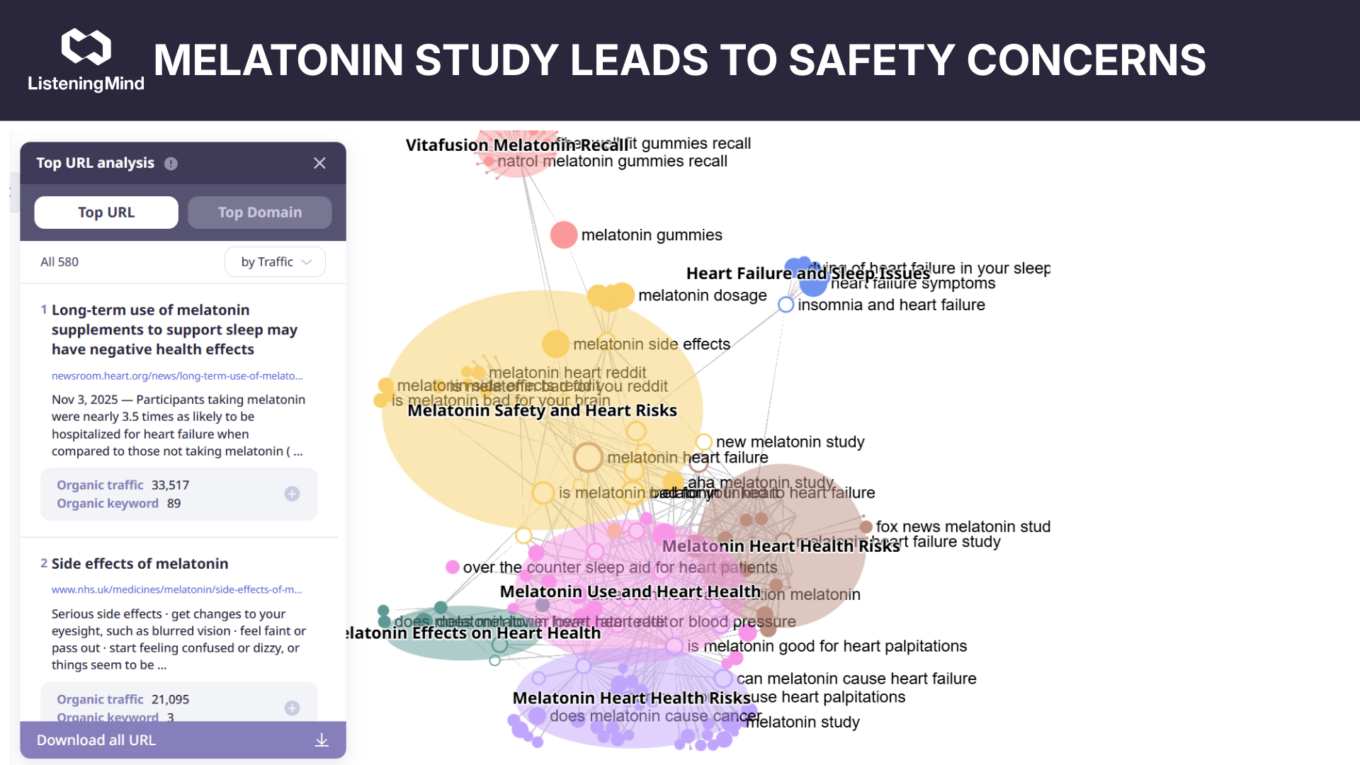
Melatonin emerged from this dataset as one of the fastest-growing safety-related topics, which is why we use it as a focused case study. Using Cluster Finder to search for topics around the keyword melatonin heart failure, we discover queries about cardiac risk, with clear secondary groups for dosing & side effects, news/study coverage, and clinical/symptom questions (palpitations, blood-pressure. Search intent is overwhelmingly informational (~98%), and the pages people land on are mainly news outlets and health authorities published around the time of the spike seen above.
We can look deeper into search paths to uncover more insight.
What this search journey shows
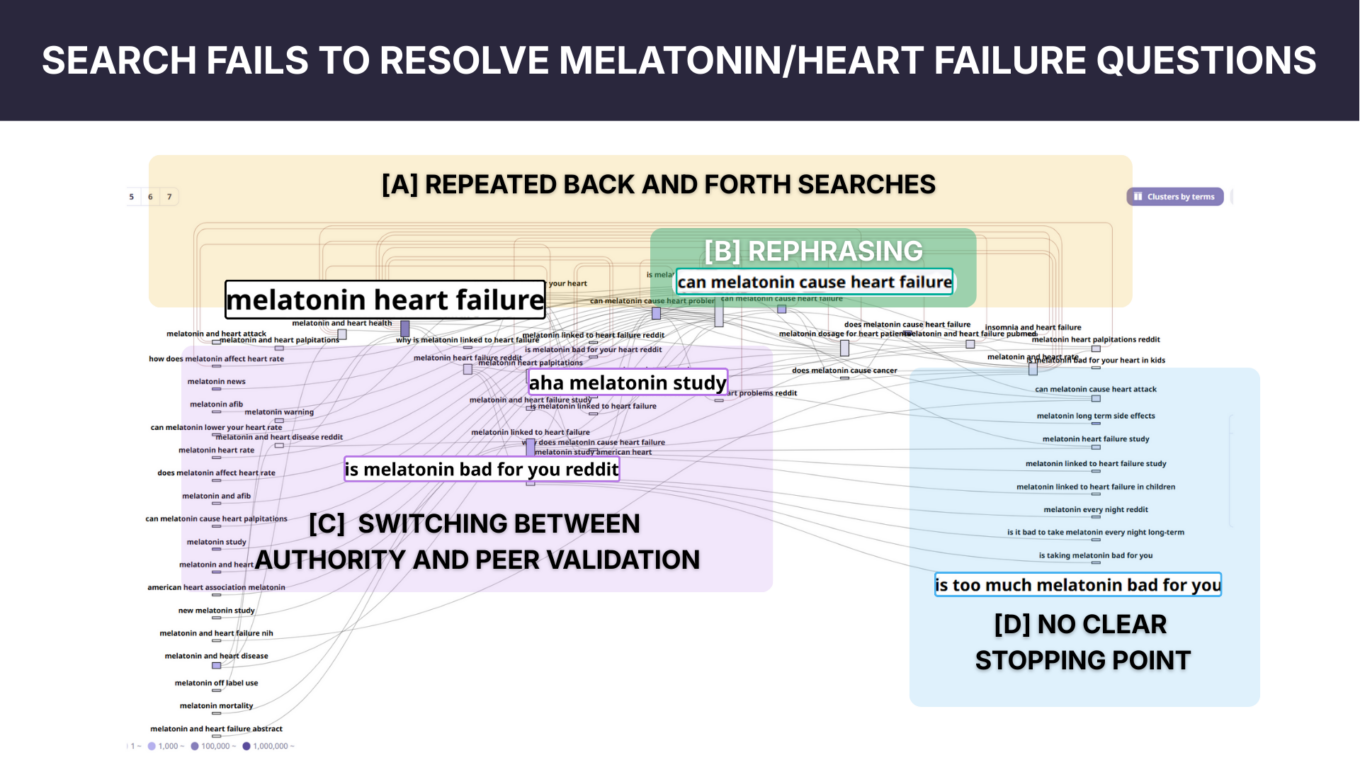
This visualization shows how users navigate uncertainty after encountering a high-risk health headline.
[A] Repeated back-and-forth searches
The dense looping lines indicate that users are revisiting the same topic multiple times. Instead of progressing toward an answer, they circle back, adjust wording, and try again. This pattern is a strong signal of unresolved intent: users are actively searching, but not finding an explanation they can settle on.
[B] Rephrasing the same concern
Users repeatedly reframe the question, shifting from “melatonin heart failure” to “can melatonin cause heart failure.” This rephrasing reflects a move from general awareness to causal concern. When users change wording but keep the same core question, it usually means existing content hasn’t clarified the issue.
[C] Switching between authority and peer validation
The path alternates between scientific or institutional sources (studies, AHA, PubMed) and peer discussions on Reddit. This switching shows a trust gap: authoritative sources provide data, but users still turn to peers to interpret what that data means for real people.
[D] No clear stopping point
Instead of converging on a final answer, the journey continues into adjacent questions about dosage, long-term use, and personal safety. The absence of a clear stopping point suggests that none of the available content fully resolves the original concern.
Why this matters
When users find clear answers, search paths narrow and end. When they don’t, paths loop, expand, and fragment. ListeningMind Path Finder makes this visible by showing not just what people search for, but how often they have to search again.
Leading Topics in the Supplement Category
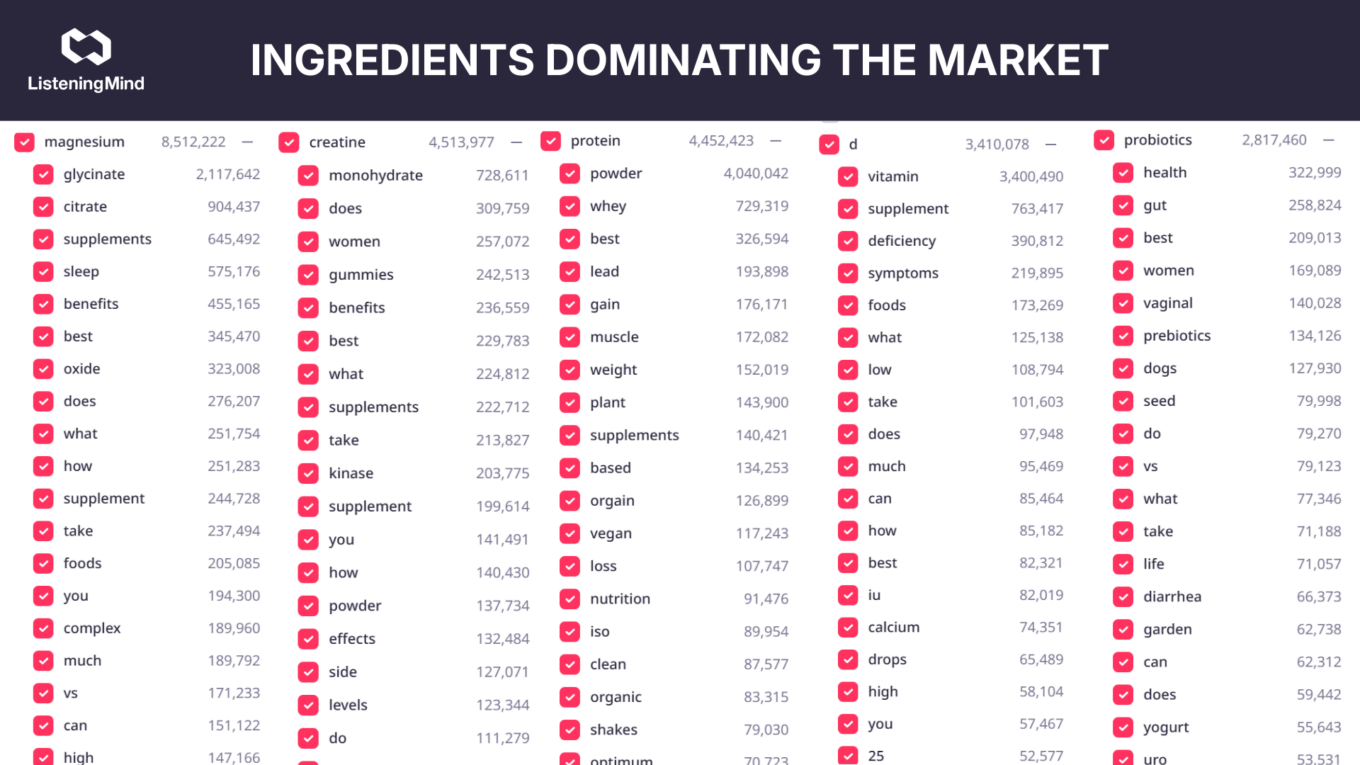
This snapshot shows the ingredient-first structure of the U.S. supplements market: consumers search by a core ingredient (magnesium, creatine, protein, vitamin D, probiotics) and then immediately add a purpose, form, or trust modifier. The result is a predictable set of intents stacked on top of each ingredient — and each intent requires a different product and content response.
Magnesium (8,512,222/mo)– searches center on forms and uses (glycinate, citrate, oxide), sleep and relaxation benefits, dosing (“how much”, “take”), and form comparisons. Intent-> To learn which magnesium to use and how to take it.
Creatine (4,513,977/mo)– queries focus on formats and performance (monohydrate, gummies, powder), dosing/usage, demographic interest (women), and “best”/brand comparisons. Intent-> To optimize performance and pick the right product format.
Protein (4,452,423/mo)– people search for product and purchase information (powder, whey, best, brand names) alongside safety and trust modifiers (lead, recalls) and outcome terms (muscle, weight, gain) Intent-> To find a high-performing, safe protein product.
Vitamin D (3,410,078/mo)– searches are largely diagnostic and dosing (deficiency, symptoms, what it does, IU), plus format and source queries (foods, D3, D3+K2) Intent-> To assess need and choose the right dose/format.
Probiotics (2,817,460/mo)– queries are condition- and strain-driven (gut, vaginal, prebiotics, best for women) with an important pet substream (dogs) Intent->To find the right strain or product for a specific health need.
Conclusions
The data shows a consistent structure in how consumers search for supplements in the U.S. market. Searches typically begin with a core ingredient or category and are refined through modifiers related to use case, format, comparison, and safety. High-volume ingredients such as magnesium, creatine, protein, vitamin D, and probiotics function as clusters of related subtopics rather than single, uniform categories.
Trend analysis indicates that recent growth among large-volume supplement keywords is concentrated in safety- and risk-related queries. The melatonin case study illustrates how these concerns surface in search behavior, producing dense topic clusters and extended search paths as users seek clarification.
By analyzing search behavior at the category, topic, and journey level, it becomes possible to identify where attention is increasing, how users frame their questions, and where existing information does not fully resolve those questions. This approach provides a data-based view of consumer intent that can be applied across ingredients, products, and use cases within the supplement market.
Explore real U.S. intent data across brands, ingredients, and use cases with ListeningMind, and move beyond assumptions to evidence-backed decisions. Sign up for a free 1-week ListeningMind Trial.