
Index
Introduction
Korean food is no longer unfamiliar to American consumers. Yet, search data reveals more than popularity, it shows who is searching, when, and why. In this article, we use ListeningMind’s Intent Finder, Path Finder, and Cluster Finder to analyze the moments when U.S. consumers search for Korean food and the intent and opportunities behind those searches.
What’s the most-searched Korean food?
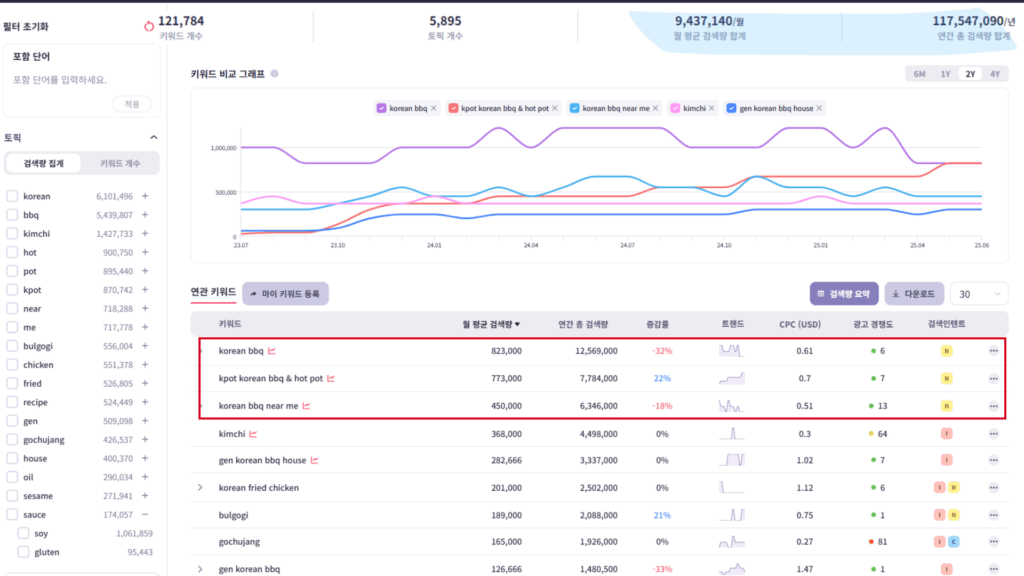
Using 100 Korean food seed keywords in ListeningMind Intent Finder (as of July 15, 2025), we found that U.S. searches related to Korean food average 9.4 million per month. The single most-searched term is “korean bbq” with 823,000 monthly searches, followed closely by “kpot korean bbq & hot pot” (773,000/mo) and “korean bbq near me” (450,000/mo). Notably, these top queries are all navigational intents—users are aware of the category or brand and are likely moving toward concrete actions such as finding a location, checking menus, or planning a visit.
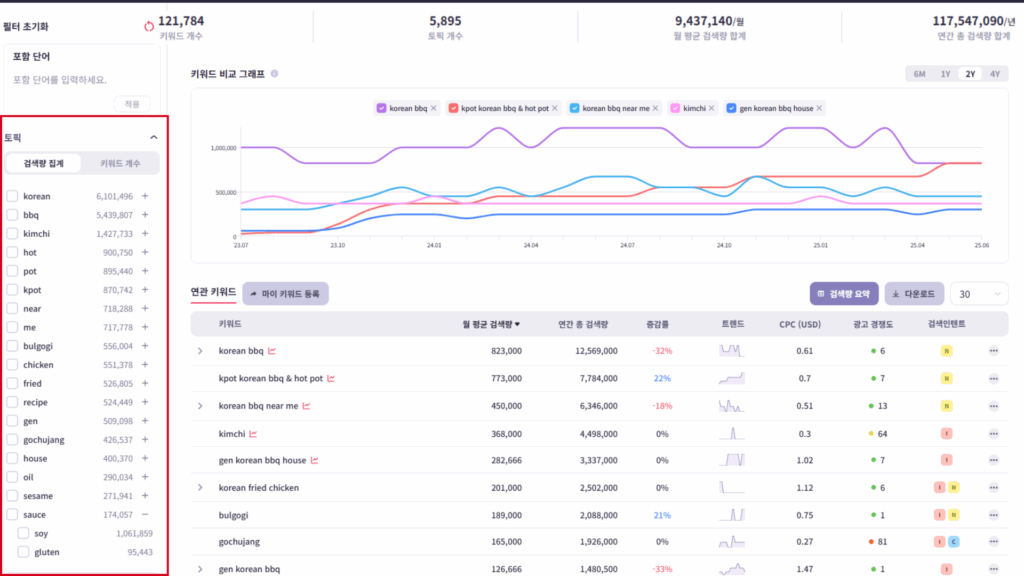
Beyond individual keywords, topic-level data shows the strongest interest in:
- BBQ (approx. 5.4 mil/mo)
- Kimchi (approx. 1.4 mil/mo)
- Hot Pot (approx. 5.4 mil/mo)
Which dishes dominate Korean food searches?
At the topic level, Korean BBQ clearly dominates with about 5.5 million monthly searches, far ahead of others like kimchi (approx. 1.4M/month), bulgogi (approx. 556K/month), and Korean fried chicken (approx. 456K/month)—showing broad interest across both traditional and street foods.
For recipes, the top searches are:
- Kimchi (approx. 170K/month)
- Bulgogi (approx. 93K/month)
- Bibimbap (approx. 50K/month)
- Tteokbokki (approx. 37K/month)
This indicates steady at-home cooking interest alongside dining out.
Brand-based searches are also significant, with Kpot (approx. 874K/month) and Gen Korean BBQ House (approx. 509K/month) leading. Interestingly, Kpot is run by a U.S.-based hospitality group, does not seem to be Korean-owned, while Gen Korean BBQ House was founded by Korean immigrants.
Location-based searches concentrate heavily in major cities such as New York, Las Vegas, and Los Angeles, confirming that Korean food interest is most active in urban markets.
How is Korean BBQ searched and consumed?
Path Finder shows how “korean bbq” searches evolve into queries about locations, brands, prices, hours, and reviews—mirroring the real consumer journey.
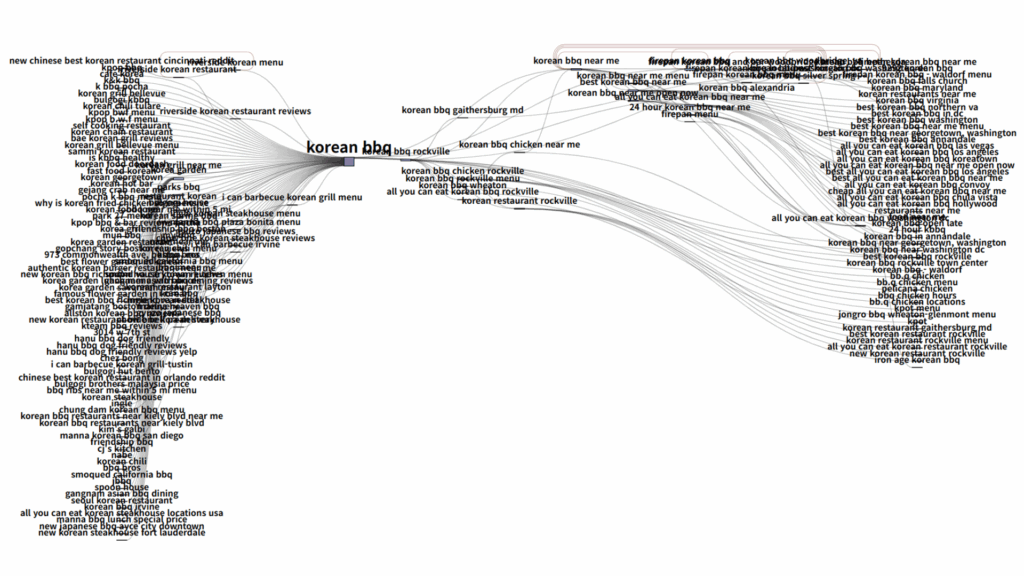
Korean BBQ 인사이트
Key Insights
1. All-you-can-eat as the default format
Searches for “all you can eat / AYCE Korean BBQ” remain strong, showing that unlimited dining is the baseline expectation. Brands like Kpot, Firepan, 9292, and bb.q Chicken often appear first, followed by menu, reviews, and hours—clear signs of consumers in the decision phase.
2. Strong late-night demand
Queries like “24 hour korean bbq near me”, “late night korean bbq”, and “open now” appear frequently in cities, positioning Korean BBQ as a flexible, late-night dining option.
3. DMV as the epicenter
The Washington D.C.–Maryland–Virginia (DMV) area dominates searches, with suburbs like Rockville, Annandale, Arlington, and Alexandria showing particularly high demand. Here, Korean BBQ is part of everyday dining culture, not just a special outing.
4. Rising wellness interest
Searches such as “is korean bbq healthy” are emerging. While still small in volume, they signal a growing consumer lens on health and nutrition.
When do U.S. consumers think of Korean BBQ?
ListeningMind’s Cluster Finder view groups related keywords into themes, visualizing the different contexts in which people look for Korean BBQ. These “entry themes” highlight not just the food itself, but the situations and needs that trigger searches.
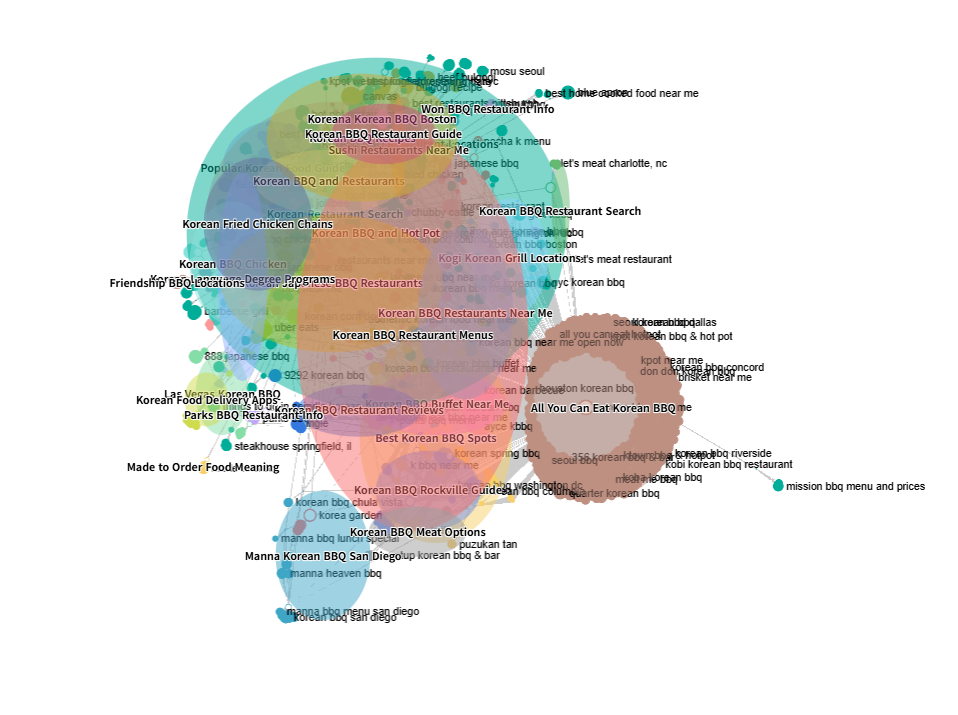
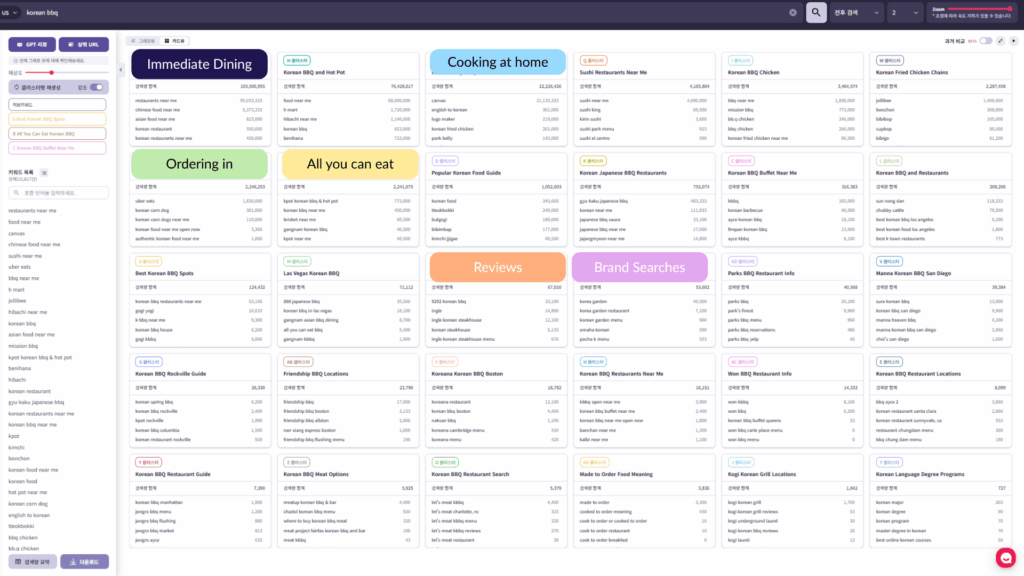
- Immediate Dining– Queries like near me, Korean restaurant open now, or best Korean BBQ near Georgetown show a strong, in-the-moment dining intent. Localized searches are especially high in the DMV area (Rockville, Annandale, Alexandria).
- Ordering In– Keywords such as Uber Eats, delivery Korean food, or Korean corn dog near me reveal demand for convenient at-home options.
- All You Can Eat– All you can eat Korean BBQ, AYCE Korean BBQ, and buffet near me capture value-driven and group dining intent. Brands like Kpot, Gen, and 9292 appear frequently, showing direct brand recall.
- Cooking at Home– Bulgogi recipe or how to make Korean fried chicken represent at-home cooking motivations instead of dining out.
- Review Checking– Searches combining restaurant names with reviews or ratings reflect careful decision-making right before a visit or purchase.
- Brand Searches– Direct searches for Kpot, Gen, 9292, bb.q Chicken highlight brands with established mental availability.
Conclusion
Korean BBQ is firmly mainstream in the U.S., with search data reflecting clear consumer pathways—from curiosity to dining out, ordering delivery, cooking at home, or choosing by brand.
High-intent queries like “near me,” “open now,” “all you can eat,” and brand names show strong purchase intent, while recipe searches reveal parallel at-home engagement.
For brands, aligning with these entry points and ensuring accurate, up-to-date information on menus, hours, pricing, and reviews can directly impact conversions. Meanwhile, urban and DMV markets, late-night demand, and emerging health concerns represent key opportunities for positioning and growth.