
Index
This guide is designed for marketing and strategy agencies preparing competitive proposals (PTs), market analysis decks, and positioning, messaging, and journey frameworks complex or fast-changing markets.
It shows how agencies can use search intent data to explain market change, justify strategy, and support recommendations using the U.S. supplement market as a concrete example.
How to use this in a proposal
- Market context: Use Sections 1–3 to explain why the market is shifting and why safety signals matter.
- Method justification: Use Section 2 to show scale and structure without leaning on survey-only logic.
- Proof and journey logic: Use Sections 4–5 to demonstrate how uncertainty shows up in real behavior.
- Strategy implications: Use Section 6 to justify ingredient-specific positioning and messaging.
Why Agencies Need a Different Market Lens in Supplements
Agency Insight: Search intent is a defensible input for early-stage strategy, especially when client decisions need to be justified with observable behavior.
In regulated categories like supplements, traditional research methods have limits:
- Surveys capture stated opinions after decisions form
- Panels and CRM data overrepresent existing customers
- Early safety concerns are underreported or filtered out
Search behavior fills this gap. Search queries capture pre-brand, pre-purchase, and often pre-diagnosis moments—when consumers are trying to understand risk, safety, and need, not yet choosing products.
What the U.S. Supplement Market Looks Like Through Search
Agency Insight: Categories are not uniform. Each ingredient functions as its own demand ecosystem with distinct intents and risks.
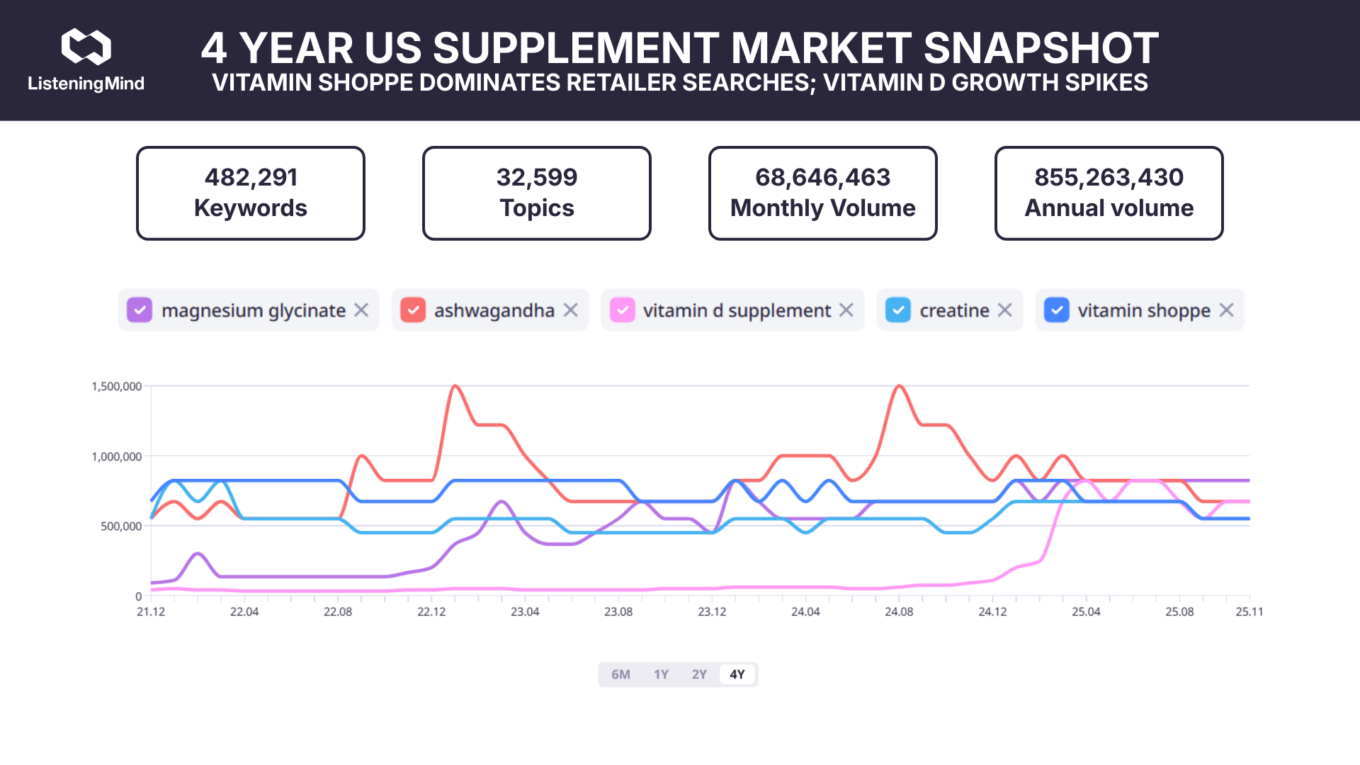
Using ListeningMind Intent Finder (Dec 2021–Nov 2025), U.S. supplement search behavior shows a clear structure:
- 482,291 keywords grouped into 32,599 topics
- ~68.6M monthly searches (~855M annually)
- Discovery is led by ingredients first, not brands
High-volume entry points include magnesium, creatine, protein, vitamin D, probiotics, alongside retailer-driven searches (e.g., Vitamin Shoppe).
Growth Is Being Driven by Safety, Not Benefits
Agency insight: Safety-led growth signals a shift in what the market needs. Instead of leading with product benefits, agencies should first prioritize clarity, reassurance, and credible explanation. Conversion paths can then be built once uncertainty has been resolved.
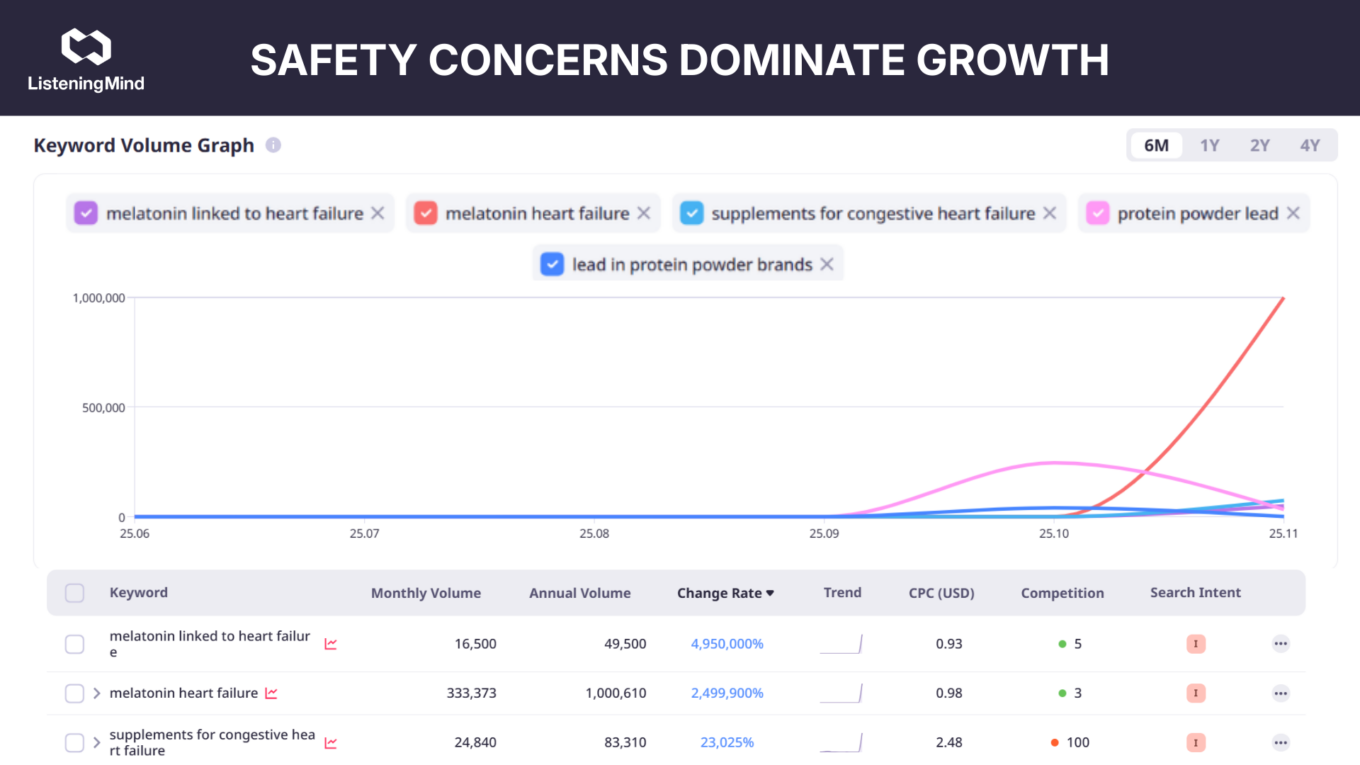
When filtering for fast-growing, high-volume keywords, a clear pattern emerges: recent growth is concentrated in safety- and risk-related queries, not in benefit-led or “how to use” searches.
Case Study: Melatonin and Cardiac Risk
Agency insight: This is not product shopping behavior, it’s risk assessment behavior.
Why Melatonin Matters
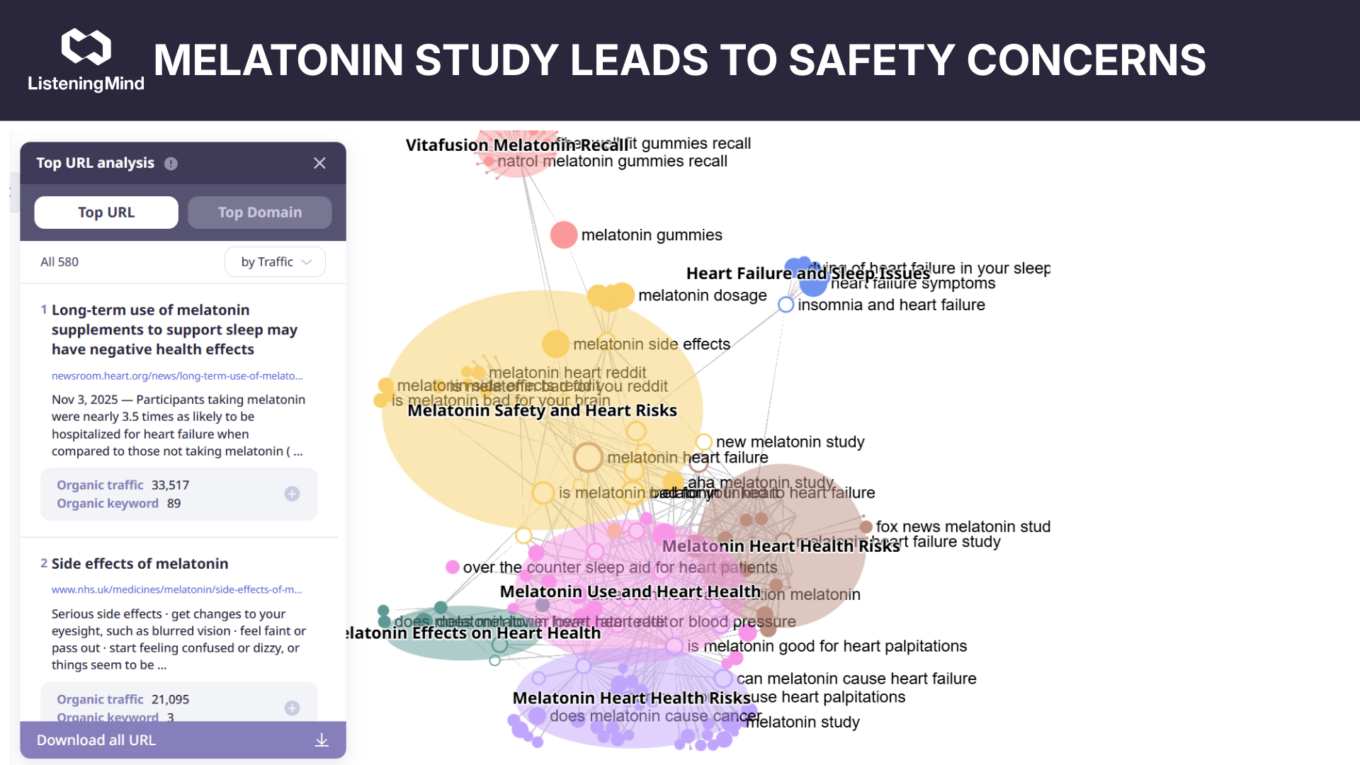
Melatonin emerged as one of the fastest-growing safety-related topics in the dataset. Rather than treating it as a single keyword, ListeningMind was used to examine:
- Topic clusters (what people associate with the risk)
- Search paths (how people try to resolve uncertainty)
What the Clusters show
Around queries like “melatonin heart failure”, clusters form around cardiac risk and side effects, dosing and long-term use, news and study coverage, and clinical/symptom questions (palpitations, blood pressure). Search intent is overwhelmingly informational, and landing pages are dominated by news outlets and health authorities.
How Uncertainty Appears in Search Journeys
Agency Insight: When journeys loop instead of narrowing, the issue is not awareness it’s explanation. This informs content strategy, authority use, and message sequencing.
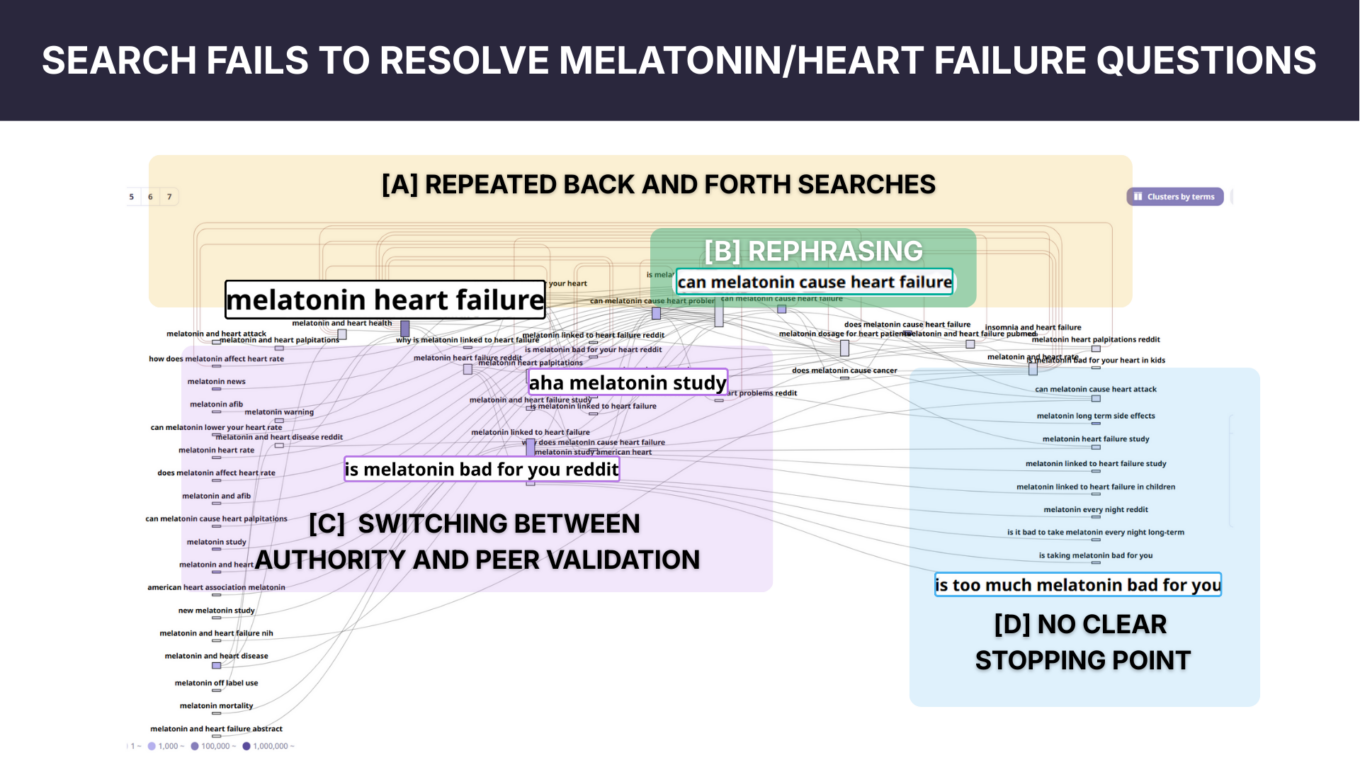
Using ListeningMind Path Finder, melatonin-related searches reveal distinct patterns:
[A] Repeated back-and-forth searches
Users loop through the same topic multiple times, signaling unresolved intent.
[B] Rephrasing the same concern
Queries shift from general to causal, reflecting escalation from awareness to concern.
[C] Switching between authority and peer validation
Users alternate between institutional sources and peer discussion, indicating a trust gap.
[D] No clear stopping point
Journeys expand into dosage, duration, and personal safety questions—without converging on a final answer.
Ingredient-Led Demand Structures (What Agencies Can Act On)
Agency insight: Ingredient-led demand requires ingredient-led strategy. Agencies that plan at the ingredient level—rather than the category level—are better equipped to address the specific questions, concerns, and decision criteria shaping each mini-market.
This snapshot shows the ingredient-first structure of the U.S. supplements market: consumers search by a core ingredient and then add purpose, form, comparison, or trust modifiers.
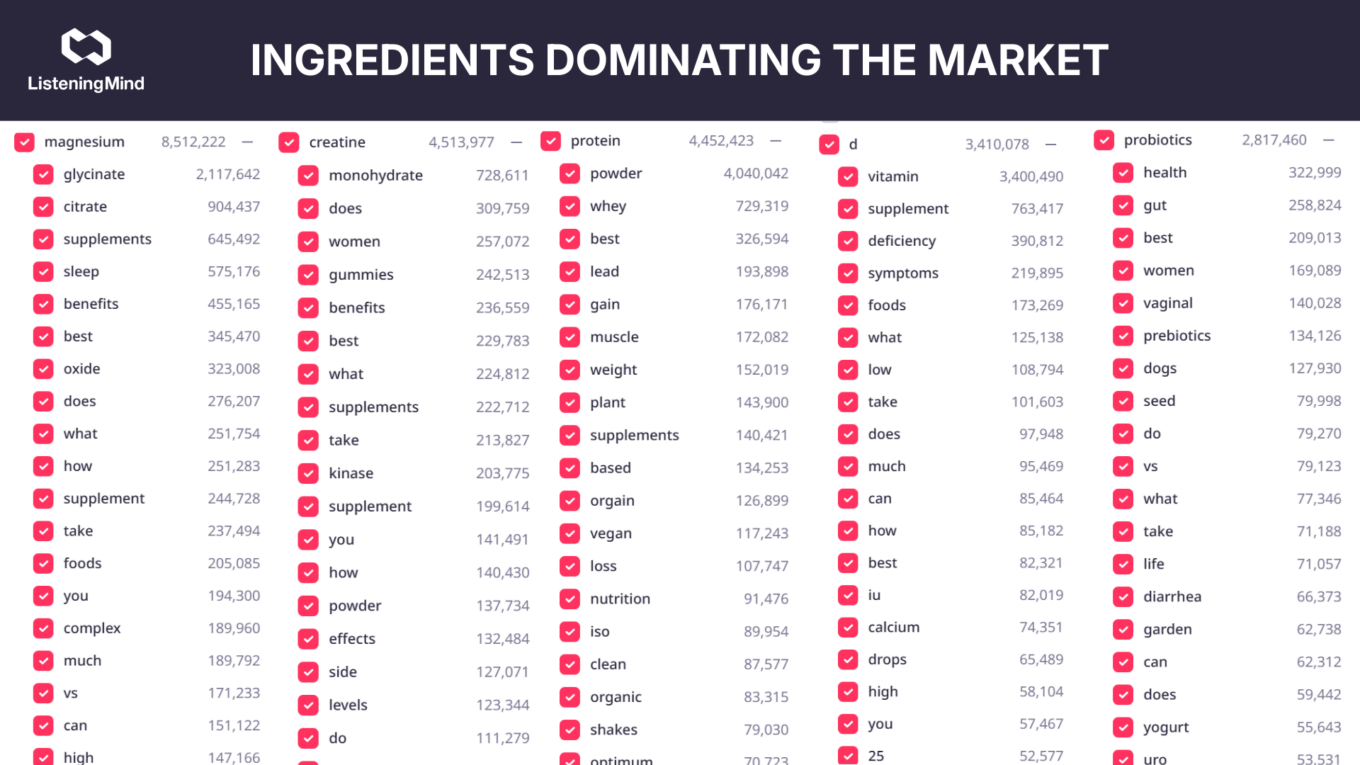
Across the supplement category, each core ingredient behaves like its own mini-market, with a predictable stack of intents layered on top. Agencies need to plan strategy at the ingredient level, not the category level.
Insight by Ingredient
Magnesium
How people search
Users start with the ingredient, then quickly narrow by form (glycinate, citrate, oxide), use case (sleep, relaxation), and dosing questions (“how much,” “when to take”).
What’s driving demand
Confusion around forms and effectiveness, not lack of awareness.
Primary intent
Choose the right type of magnesium and understand how to take it correctly.
Agency implication
Messaging must clarify differences, not restate benefits. Education beats promotion.
Creatine
How people search
Searches cluster around formats (monohydrate, gummies, powder), performance outcomes, and usage guidance, with a notable rise in women-specific queries.
What’s driving demand
Format innovation and broader audience adoption beyond core fitness users.
Primary intent
Optimize performance and select the most suitable format.
Agency implication
Positioning should evolve from “gym supplement” to use-case-led performance support.
Click “+” below for more ingredient insights
How people search
High-volume purchase and comparison queries sit alongside safety modifiers (lead, recalls) and outcome goals (muscle, weight, gain).
What’s driving demand
Trust and safety concerns layered on top of commoditized products.
Primary intent
Find a protein product that is both high-performing and safe.
Agency implication
Differentiation comes from trust signals, not functional claims alone.
How people search
Searches are largely diagnostic (deficiency, symptoms) and dose-focused (IU), followed by format questions (D3, D3+K2).
What’s driving demand
Self-assessment of need before product selection.
Primary intent
Assess deficiency risk and choose the appropriate dose and format.
Agency implication
Content must support decision confidence, not just product awareness.
How people search
Queries are condition- and strain-specific (gut health, vaginal health, prebiotics), with distinct sub-streams for women and pets.
What’s driving demand
Personalized health needs rather than generic “gut health” interest.
Primary intent
Match the right strain or product to a specific health context.
Agency implication
One-size-fits-all messaging fails; segmentation is essential.
How Agencies Use This in Proposals
- Market context: Show where growth is coming from (safety, not benefits)
- Strategy justification: Explain why intent-based research complements surveys
- Journey mapping: Demonstrate non-linear, trust-driven decision paths
- Positioning & messaging: Identify where explanation gaps exist
Agencies can confidently say demand forms around ingredients before brands, safety concerns reshape demand quickly, search reveals these shifts earlier than sales or tracking data.
Why ListeningMind Fits Agency Workflows
- Analyze pre-brand, pre-purchase intent at scale
- Map real search journeys without PII
- Support strategy with observable behavior
- Translate data into proposal-ready narratives
ListeningMind does not replace surveys or brand studies. It fills the gap where those tools cannot see.
Closing
In regulated categories like supplements, growth is driven as much by concern and uncertainty as by benefits. Search intent makes that uncertainty visible. For agencies, this provides a defensible, early signal to guide market analysis, strategy development, and client recommendations. Before brands are chosen and before demand fully materializes.