Index
In today’s fragmented attention economy, brand discovery doesn’t guarantee brand adoption. In the game industry, consumer insight reveals how curiosity evolves into confidence.
For example, millions of players begin their journey with casual curiosity, searching “Poki games” to find quick, free fun. Yet, what ListeningMind’s Path Finder data shows is that many of them don’t stay there. Instead, they move on to broader searches like “free games” or “online games,” and eventually land on trusted platforms such as Steam or Epic Games, where their attention turns into engagement and loyalty.
Ultimately, this isn’t just a gaming insight.
It’s a brand truth
“The real competition isn’t for awareness- it’s for the moment curiosity becomes confidence.”
Keyword Discovery: The Journey to “Poki Games”
ListeningMind’s Cluster Finder first identified “Poki Games” as the highest-volume commercial intent keyword in the mobile gaming category at the time of analysis. This finding matters because while users were searching for free or casual games, their intent already carried commercial potential- they were open to discovering new platforms or brands.
In other words, Poki was not just a site for casual play; it was a gateway into the broader gaming ecosystem.
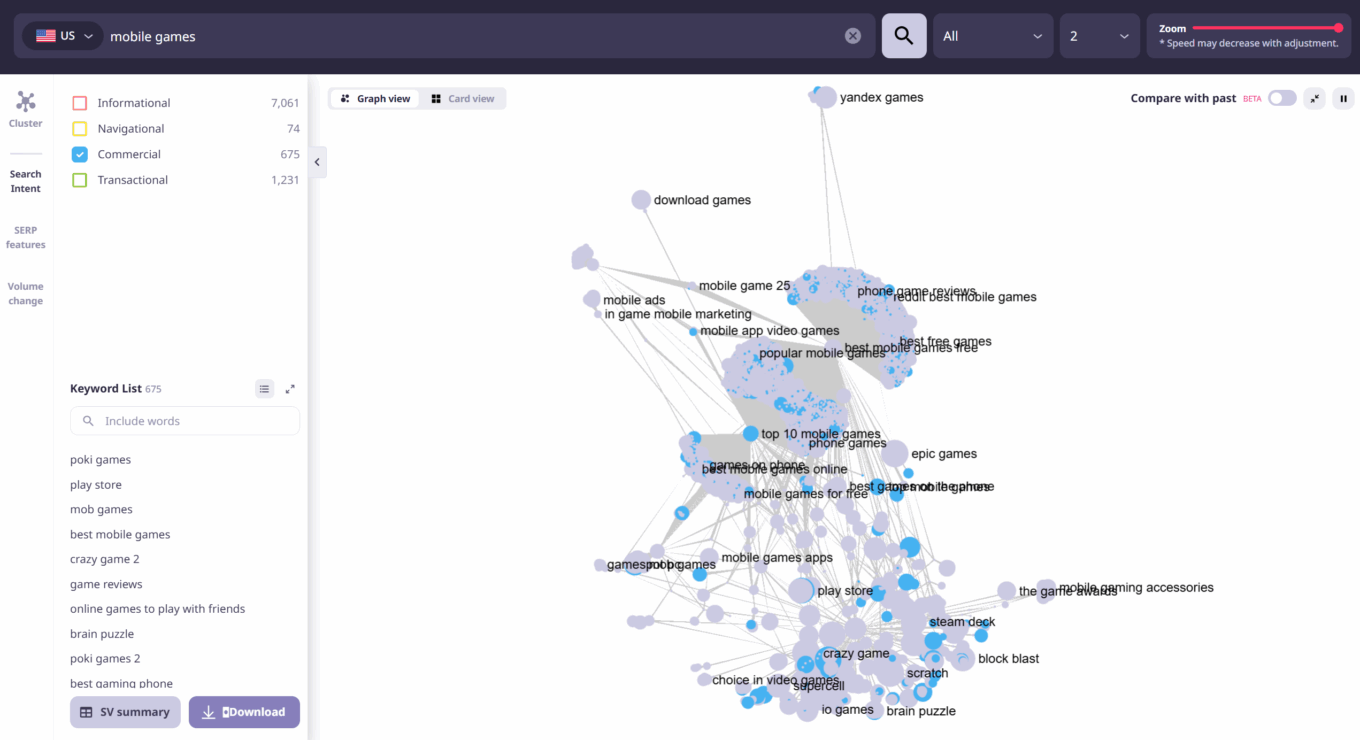
Path Finder: What are users searching for after “Poki Games”?
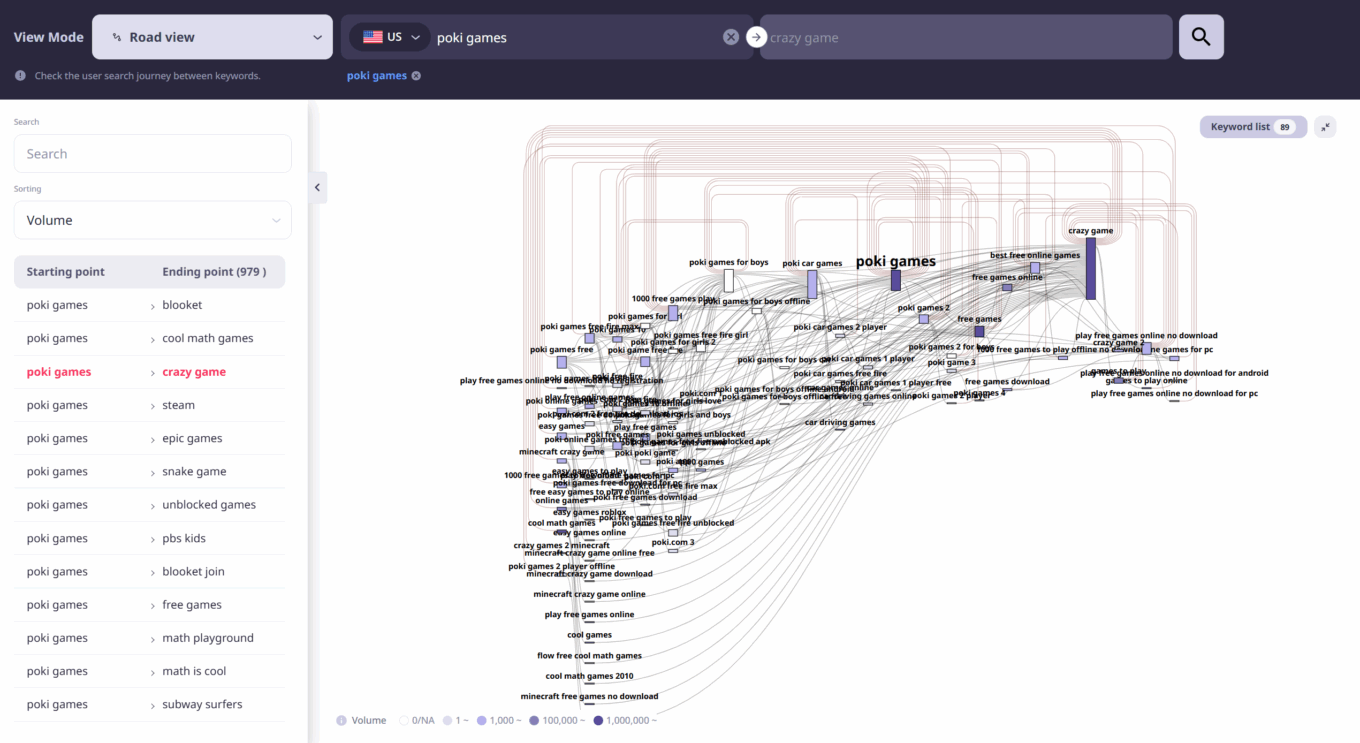
After identifying “Poki Games” as the top commercial-intent keyword, we used ListeningMind’s Path Finder to trace what users search for after discovering Poki. At first glance, the resulting map looked chaotic- and that chaos tells an important story.
Rather than staying within Poki’s ecosystem, users quickly branch out into hundreds of different searches such as “free games online,” “crazy games,” “Minecraft,” and “free games to play.” In doing so, they reveal a journey that begins with curiosity but often ends in distraction or redirection.
This pattern shows that Poki captures massive top-of-funnel attention, but struggles to convert that attention into lasting engagement or loyalty. In other words, Poki acts more as a discovery engine than a destination — and this gap creates a valuable opportunity for other platforms to intercept users while they are still exploring.
Ultimately, this insight highlights how small shifts in search intent can signal larger behavioral transitions. By understanding where curiosity disperses, brands can position themselves at the emotional moment where exploration turns into commitment.

The more tangled the path, the weaker the brand gravity.
Poki’s audience branches rapidly- a sign of high curiosity but low commitment.
Road View: Four Emotional Roads from Curiosity to Confidence
After we simplified the tangled map, four clear behavioral archetypes emerged. Each represents a different emotional logic in the player’s journey from curiosity to confidence:
| Road | Emotional Transition | Description | Example Destinations |
|---|---|---|---|
| Edutainment | Curiosity → Learning | From open play to learning games (safe, parent-approved) | Bloocket, PBS Kids |
| Structured Play | Chaos → Control | From chaotic exploration to logical, skill-based games | Cool Math Games |
| Exploration | Curiosity → Distraction | Endless sampling with no loyalty | Crazy Games |
| Platform Trust | Exploration → Confidence | Migration to major ecosystems with trust | Steam, Epic Games |
Edutainment Road: Poki Games → Bloocket
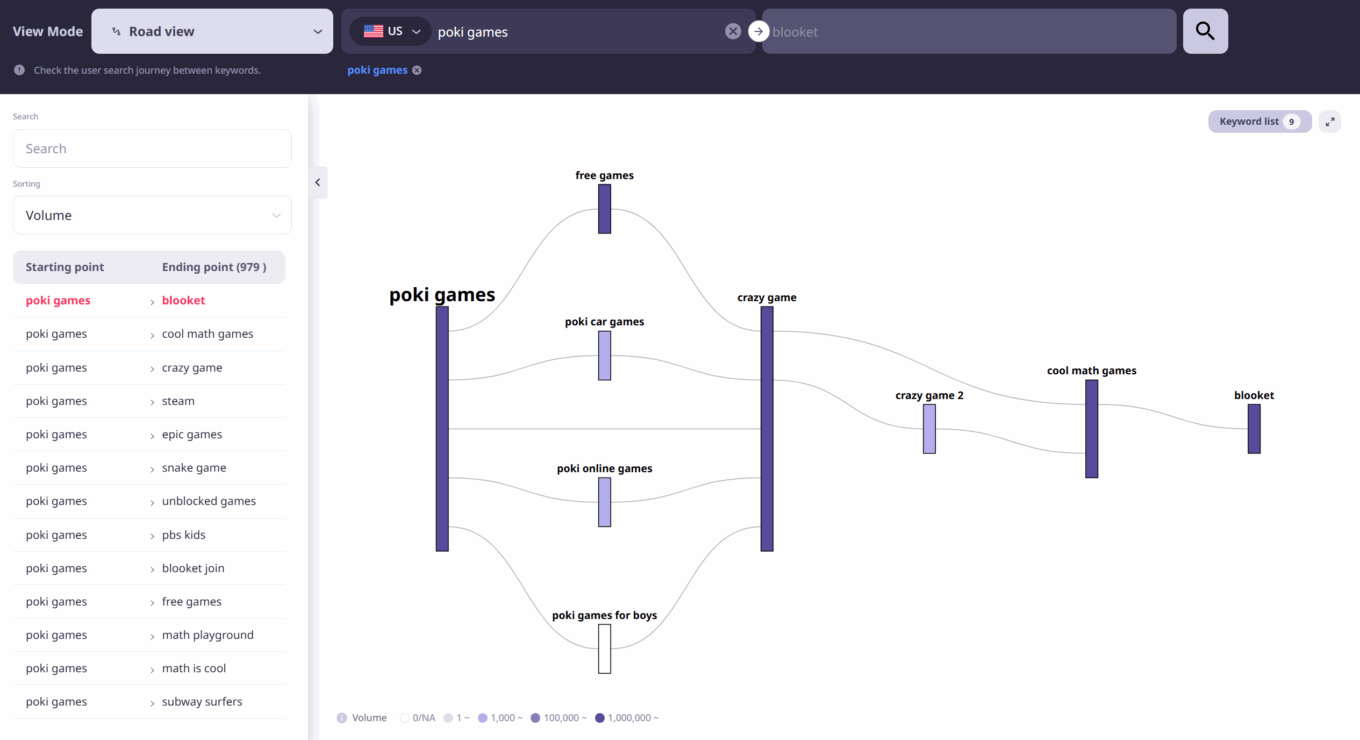
ListeningMind Path Finder shows a cluster of users transitioning from Poki Games to Bloocket and other educational or classroom-based gaming sites. This path reveals an audience seeking “safe play with learning value.”
Structured Play Road: Poki Games → Cool Math Games
Players moving from Poki Games to Cool Math Games indicate a behavioral shift from spontaneous exploration to structured, skill-driven engagement- a sign of growing desire for control and purposeful play.

Exploration Road: Poki Games → Crazy Games
The largest and most chaotic user flow. Players leaving Poki for Crazy Games display curiosity without loyalty- an endless loop of free, no-download options that rarely convert to brand affinity.
Platform Trust Road: Poki Games -> Steam
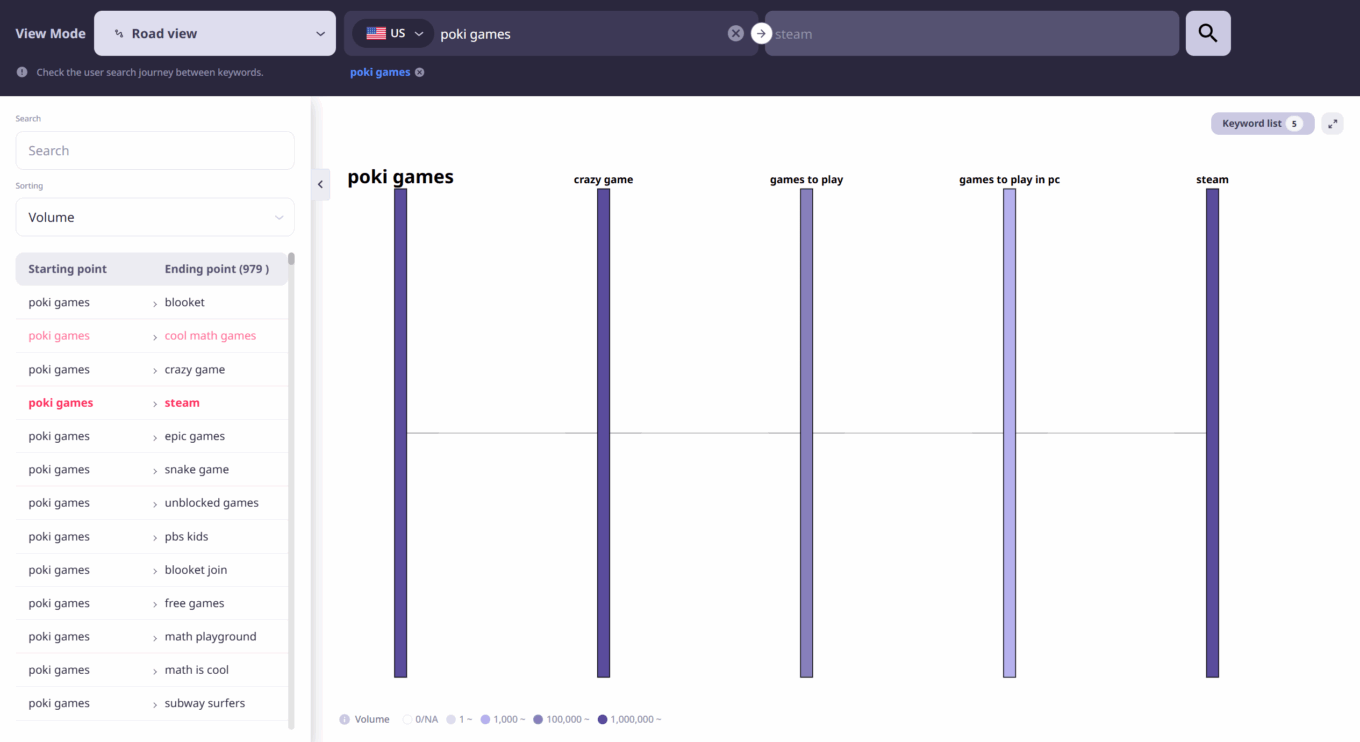
In the ListeningMind Path Finder maps, a small but clear segment of users shift from broad exploration terms such as “free games” or “online games” toward specific gaming platforms. This stage represents a movement from searching to settling- the moment curiosity stabilizes into trust. These destinations differ by brand but share a common function: they signal confidence and reliability rather than discovery.
Interpretation
- Poki captures exploration intent- the spontaneous, top-of-funnel audience.
- The middle zone (“free games”) is the interception window- the emotional shift point between curiosity and confidence.
- Trusted platforms capture decision intent- where curiosity becomes commitment.
The Strategic Implication: Position Your Brand Between Curiosity and Confidence
A. Identify Intercept Keywords
Keywords like “Free games”, “online games”, “free PC games”, and “games to play online” may sound generic, but they’re actually mid-funnel intent triggers- the phrases people use when they’re moving from curiosity to decision.
At this stage, players aren’t loyal to any brand. They’re exploring options, open to persuasion, and emotionally primed for reassurance. These searches carry feelings of freedom, immediacy, and accessibility- emotional cues that make users more receptive to discovery and trust-building messages.
Action:
Use these keywords across your SEO, ads, and creative- not to imitate Poki, but to intercept the audience that’s leaving Poki’s orbit and guide them toward your brand.
B. Match the Emotional Transition
Every player’s search reflects an emotional state. As they move from curiosity to confidence, their motivations shift- from seeking fun and freedom to seeking trust and belonging.
Your messaging should evolve along that same path. Speak to what they’re feeling at each stage, not just what they’re typing.
| Emotional Stage | What They Feel | Strategic Message |
|---|---|---|
| Curiosity | “I just want to play.” | Instant play, zero friction. |
| Exploration | “I want something better.” | Free play that actually grows with you. |
| Confidence | “I trust this brand.” | Your world, your story, your progression. |
Action:
Craft creative and copy that mirrors these emotional transitions. When users feel seen and understood- not just targeted- they move naturally from curiosity to commitment.
C. Anchor in Storytelling Confidence
In ListeningMind’s ClusterFinder data (for “game storytelling,” “immersion,” “choice”), users associate brand trust with authenticity, freedom, and emotional continuity.
That means:
→ Don’t sell “free.” Sell “freedom.”
→ Don’t sell “fun.” Sell “meaningful play.”
→ Don’t sell “games.” Sell “stories you control.”
Action:
Use storytelling as your trust architecture. Align every message- from ad copy to gameplay narrative- around the emotions of ownership, creativity, and progression. When the story feels personal, confidence follows naturally.
The Payoff: Confidence Through Clarity
Marketers often talk about “owning the funnel,” but ListeningMind data shows a more powerful goal: own the emotional transition that happens between curiosity and confidence.
That’s where discovery becomes trust- and where intent turns into identity. When players move from sampling to settling, they’re not just choosing a game; they’re choosing a brand that feels reliable, rewarding, and real.
The brands that thrive are those that recognize this moment not as a conversion event, but as an emotional alignment. They understand that confidence isn’t built through reach or repetition- it’s built through clarity.
Clarity of value, tone, and experience.
Because in every category, confidence is what keeps people from drifting- and clarity is what keeps them coming back.
ListeningMind turns that transition into something measurable- revealing where emotion, intent, and opportunity intersect so brands can turn curiosity into confidence with precision.