
Index
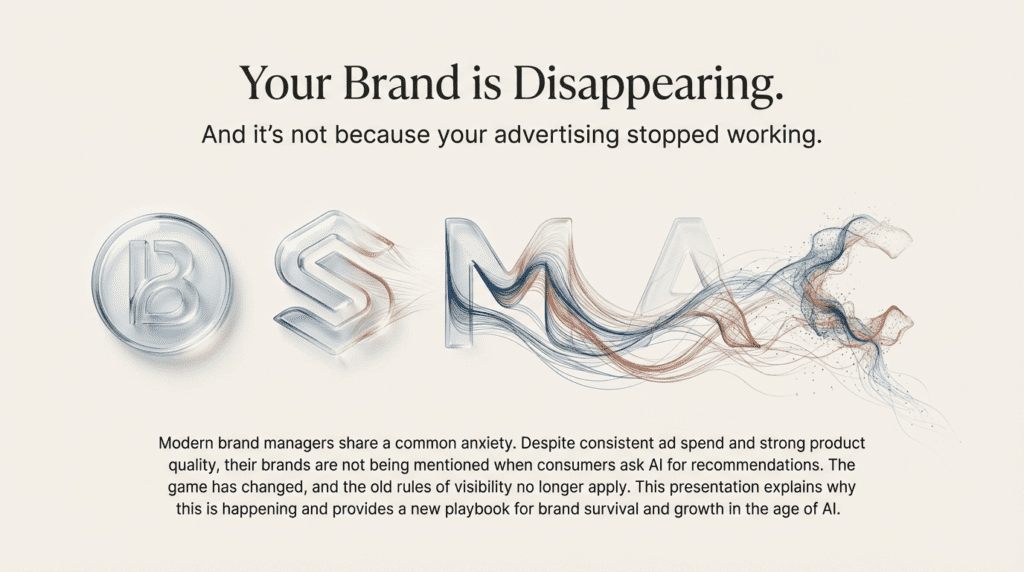
For many brands, something unsettling is happening. Despite steady advertising investment and strong products, they are no longer appearing when consumers ask AI for recommendations. This disappearance is often misattributed to creative fatigue, media inefficiency, or algorithm changes. In reality, it signals a deeper structural shift in how decisions are made.
The rules that once governed visibility no longer apply. Branding is no longer competing solely for attention in human memory. It is now competing inside AI systems that synthesize answers on behalf of consumers. To understand what this means for brand growth, we must first understand how the nature of consumer questions has changed.
Why Brands Are Disappearing in the Age of AI.
Many brand leaders are facing an unfamiliar problem. Despite steady advertising investment and unchanged product quality, their brands no longer appear when consumers ask AI for recommendations.
At first, this looks like a visibility issue. But it isn’t. In most cases, nothing about the brand’s execution has deteriorated. What has changed is the environment in which decisions are made.
Consumers are increasingly delegating decisions to AI. Rather than searching, comparing, and choosing themselves, they describe their situation and let an AI system generate the answer. The decision moment is no longer spread across multiple touchpoints. It is compressed into a single response.
In this environment, brands do not gradually enter consideration. They either appear as part of the answer or they do not appear at all.
This is why brands can seem to “disappear” even while performing well by traditional standards. The problem is not messaging, media, or awareness. It is that brands built to compete for attention are now operating inside systems designed to synthesize meaning.
What is disappearing is not the brand itself, but its ability to be surfaced by AI at the moment a decision is made.
The Nature of the Question Has Changed
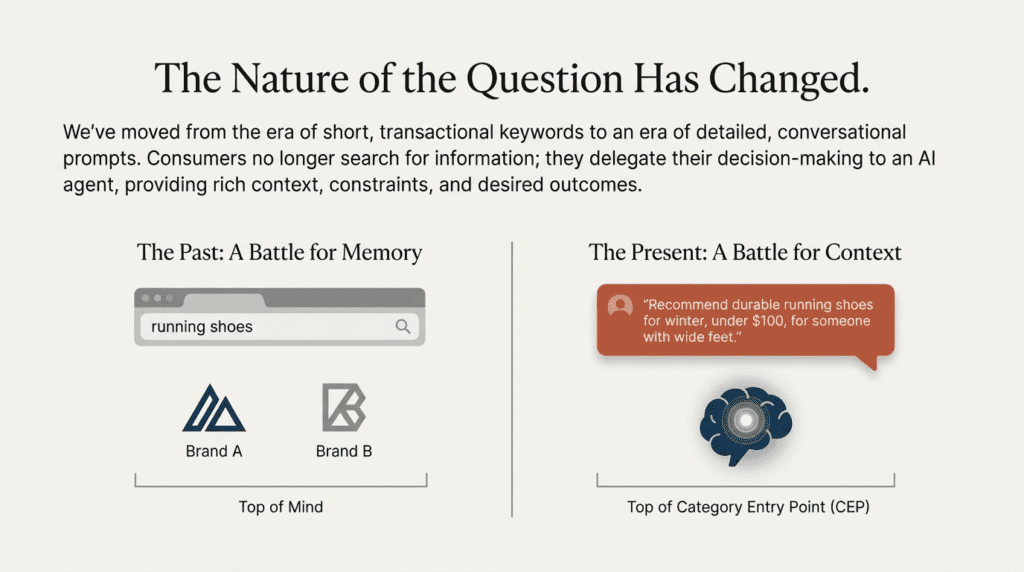
For years, marketing operated in a world of short, transactional keywords. Brands competed to be remembered when a category was searched.
That logic no longer applies.
Consumers are no longer searching for information. They are describing their situation to an AI and delegating the decision itself. Context, constraints, and desired outcomes are now part of the question.
This shift is most visible not in search volume, but in the length and structure of queries. What used to be a keyword has become a detailed prompt.
As questions gain resolution, branding shifts with them. The goal moves from being Top of Mind to being Top of Category Entry Point, the most relevant answer for a specific situation.
AI Thinks in Conditions, Not Slogans
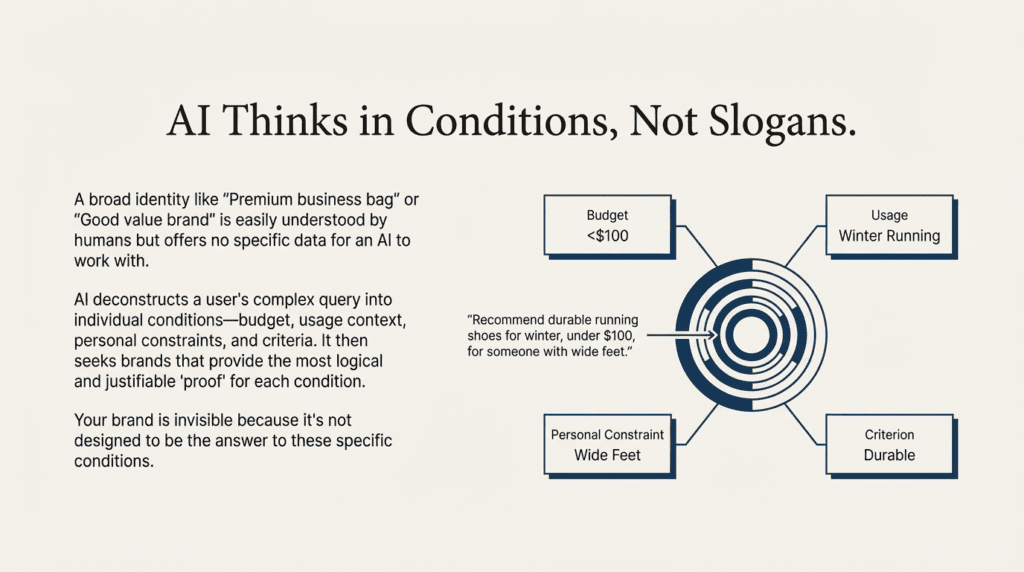
Brands often describe themselves in broad terms: “premium,” “trusted,” or “good value.” Humans understand these signals intuitively. AI does not. To an AI system, these statements contain no actionable data.
When an AI processes a complex question, it breaks it down into discrete conditions: budget, usage context, personal constraints, and evaluation criteria. It then searches for brands that can provide the most logical and defensible evidence for each condition.
In this process, brand messaging carries far less weight than condition-level signals. What matters is not what a brand claims to be, but whether it is structured as a valid answer to the question being asked.
This is why many brands become invisible inside AI-generated recommendations. Not because they are weak, but because they were never designed to satisfy the specific conditions AI is evaluating. Competing in this environment requires moving beyond slogans and toward data, structure, and proof that align with how AI makes decisions.
From Search to Summoning
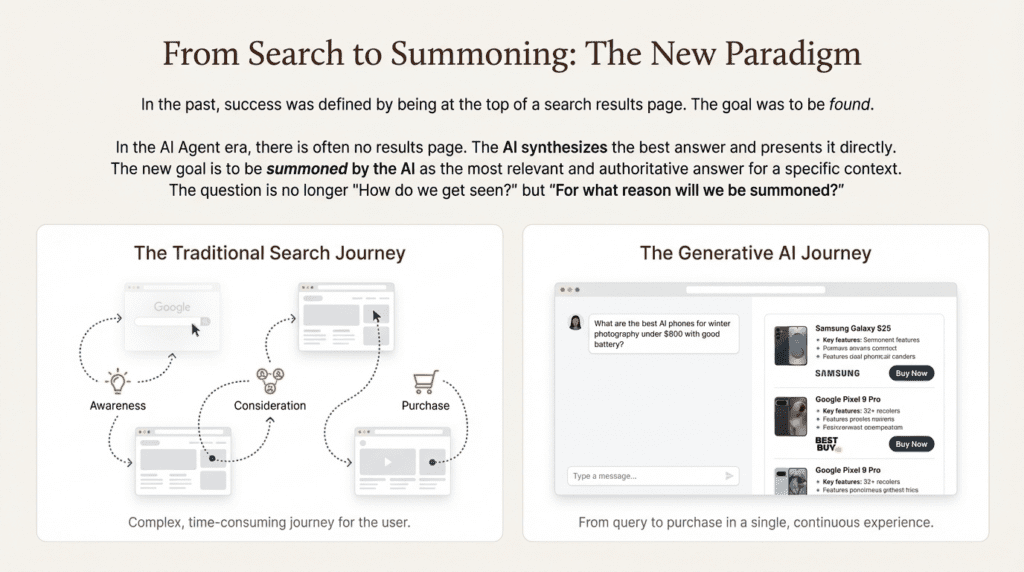
In the past, success in marketing was defined by visibility. Brands competed to appear at the top of a search results page, where they could be discovered and compared.
That model is breaking down.
In the AI agent era, there is often no results page at all. AI systems synthesize information and present a single answer directly to the consumer. The role of the brand shifts accordingly. The goal is no longer to be found, but to be selected by the AI as the most relevant and authoritative answer for a specific situation.
This changes the central marketing question. It is no longer “How do we get seen?” but “For what reason will AI choose us?”
This is not a theoretical shift. It reflects an ongoing change in user experience. The journey from question to purchase is increasingly compressed into a single, continuous interaction inside the AI itself. When that happens, brands either appear as part of the answer, or they disappear entirely.
The End of Top-of-Mind Dominance
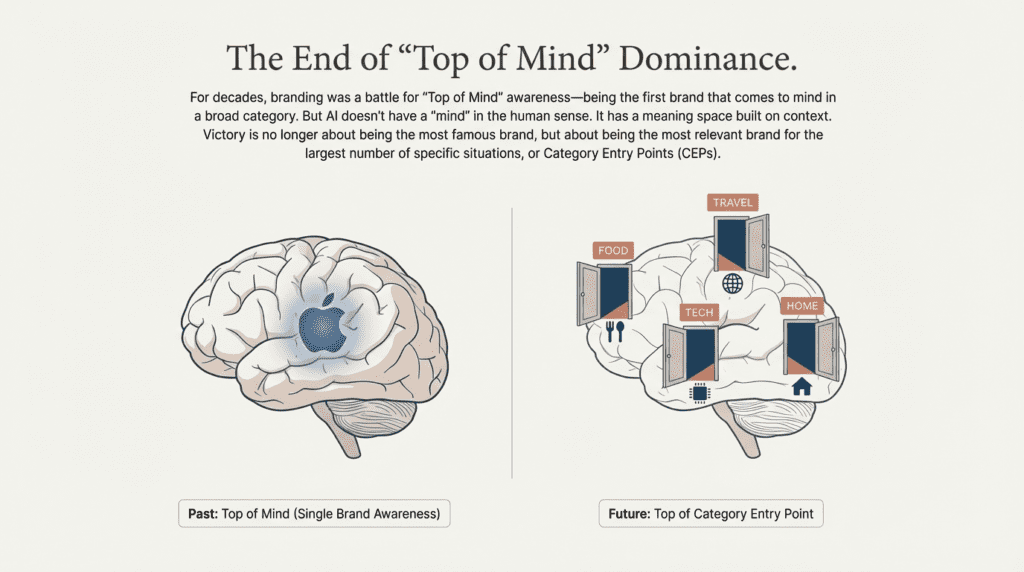
For decades, branding was a battle for awareness. Success meant becoming the first brand that came to mind when a category was mentioned.
AI does not operate this way. It does not have a “mind” in the human sense. Instead, it works within a meaning space built on context and relevance.
In this environment, victory no longer goes to the most famous brand. It goes to the brand recognized as the most relevant across the greatest number of specific situations, or Category Entry Points.
Where branding once focused on representing an entire category with a single mental association, future growth depends on being called upon in many distinct moments within a consumer’s life. The ability to appear across these fragmented, situational contexts matters more than dominating awareness in the abstract.
The Engine of Growth Is CEP Expansion
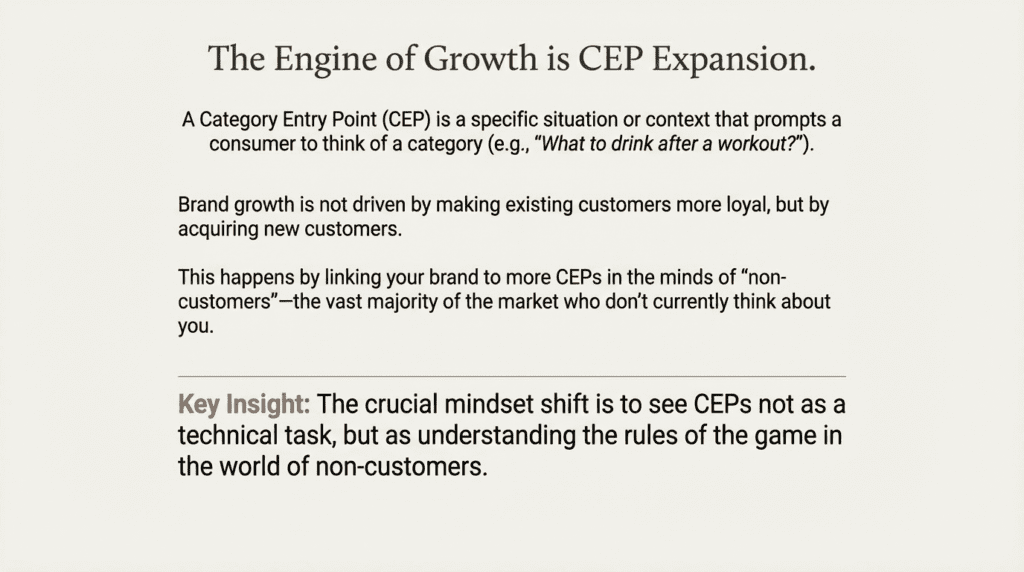
True brand growth comes not from increasing the loyalty of existing customers, but from acquiring new ones. These new customers live in the world of people who do not currently think about your brand at all.
Growth happens when a brand becomes connected to more of the situations that trigger category consideration. These situations, known as Category Entry Points, are the moments when a consumer’s context makes a category relevant.
When a brand expands beyond a single situation into new, adjacent contexts, growth accelerates. A product once associated only with one use case can grow rapidly when it becomes relevant in many parts of a consumer’s life. What matters is not the message used to create these connections, but whether they work in real consumption contexts.
The crucial shift is to stop treating CEPs as a technical marketing concept and start understanding them as the rules that govern how non-customers experience and make decisions in daily life.
The Difference Between Stagnant and Growing Brands
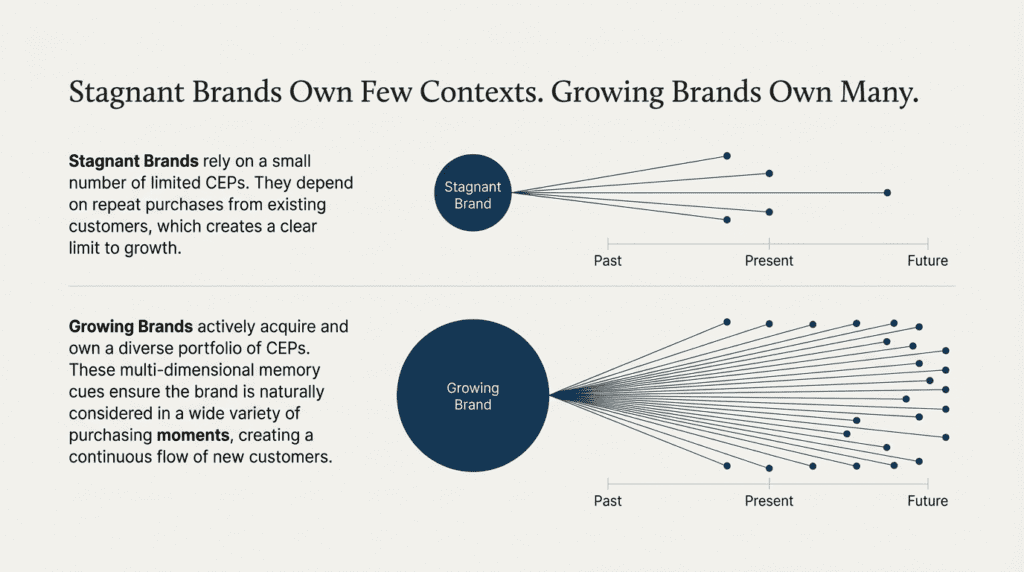
Brands that fail to grow tend to rely on a small and limited set of Category Entry Points. Their performance depends largely on repeat purchases from existing customers, which places a clear ceiling on growth.
Growing brands behave differently. They actively build and expand a diverse portfolio of CEPs, connecting themselves to many situations in which consumers consider the category. These multiple connections increase the likelihood that the brand is naturally considered across a wide range of moments.
The distinction is not about short-term tactics, but about long-term orientation. Brands that prepare for the future do not rely on past success formulas. They continuously extend their presence into new life contexts, expanding the territory in which they can be called upon.
Brands Must Now Win in a Dual Space
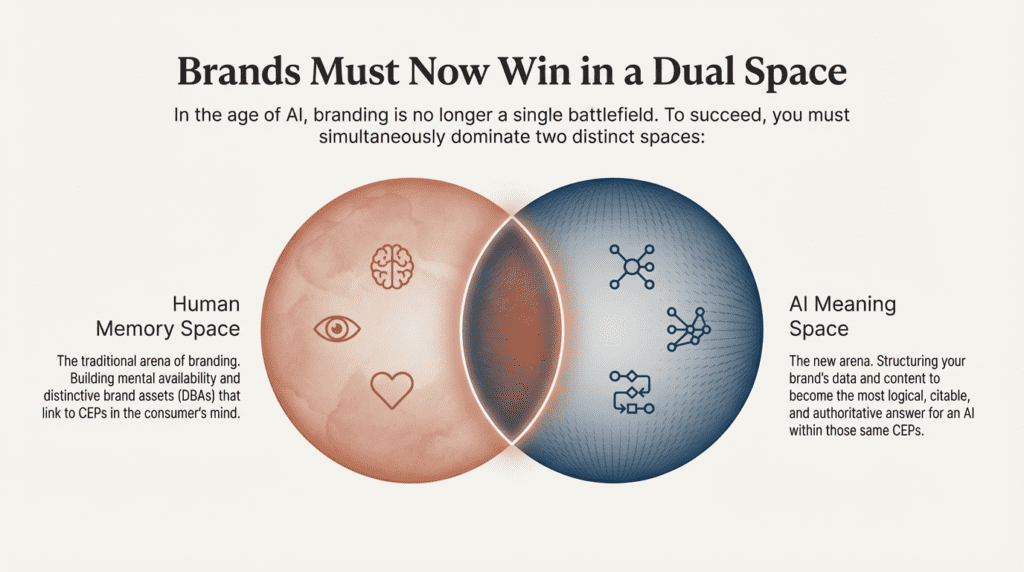
In the age of AI, branding is no longer fought on a single battlefield. Success now depends on winning in two distinct but interconnected spaces at the same time.
The first is the human memory space. This is the traditional domain of branding, where mental availability is built through distinctive brand assets and emotional resonance. It determines whether a brand feels familiar, trusted, and easy to recall.
The second is the AI meaning space. Here, brands compete through structure, data, and contextual relevance. Content and signals must be organized so that AI systems recognize the brand as the most logical and authoritative answer within specific Category Entry Points.
These two spaces do not operate independently. Failure in one is quickly exposed in the other. A brand that is emotionally strong but structurally weak will not be surfaced by AI. A brand that is technically optimized but absent from human memory will struggle to convert relevance into demand.
Sustainable growth now requires dominance in both spaces simultaneously. Occupying only one is no longer enough.
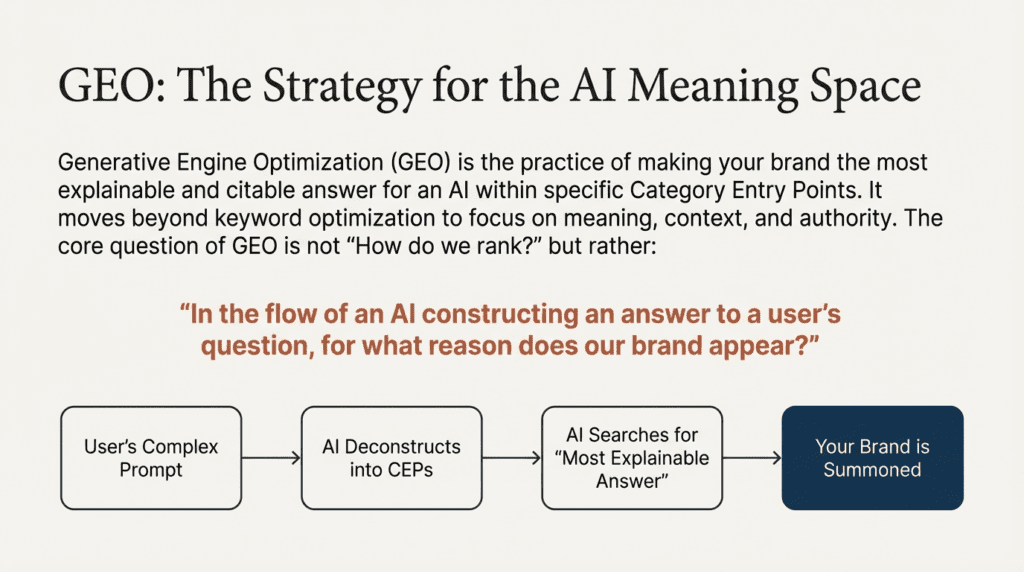
GEO: The Strategy for the AI Meaning Space
This shift gives rise to a new strategic discipline: Generative Engine Optimization, or GEO.
GEO is not about improving search rankings. It is about making a brand the most explainable and citable answer within a specific Category Entry Point. Rather than optimizing for keywords, GEO focuses on meaning, context, and authority.
Many teams confuse GEO with SEO, but the logic is fundamentally different. SEO asks how to appear higher in results. GEO asks why a brand appears at all when an AI constructs an answer.
When an AI processes a complex prompt, it decomposes the question into underlying conditions and searches for the most defensible explanation for each. GEO is the practice of deliberately structuring brand signals so that, within this flow, the brand naturally emerges as the answer.
The central question of GEO is no longer “How do we rank?” but “For what reason does our brand belong in the answer?”
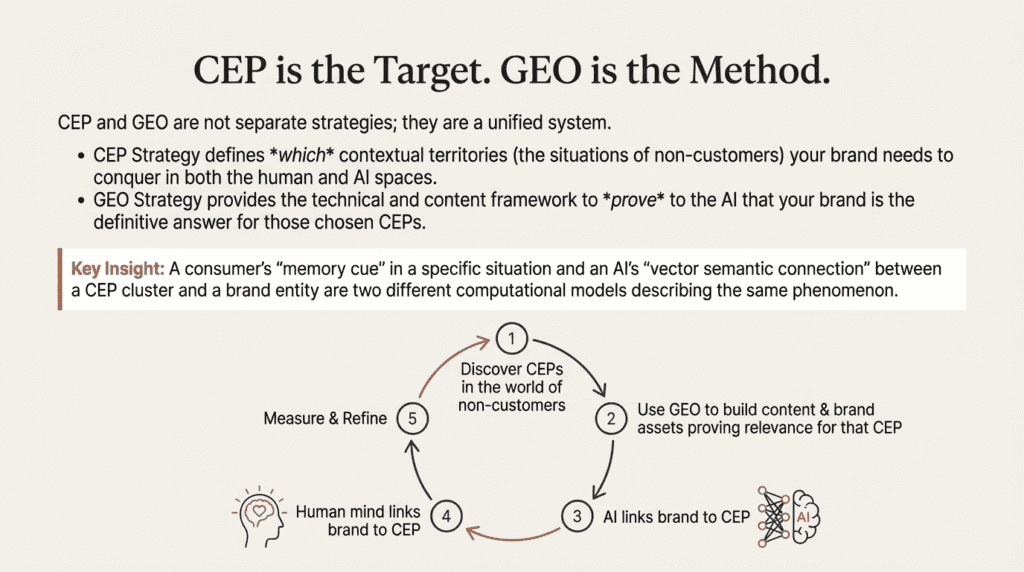
CEP Is the Target. GEO Is the Method.
CEP and GEO are not separate strategies. They operate as a single, integrated system.
CEP strategy defines where a brand needs to compete. It identifies the contextual territories, the real situations in which non-customers begin to consider a category. These are the moments a brand must own in both human memory and AI decision-making.
GEO defines how a brand proves it belongs in those moments. It provides the structural, content, and data framework that allows AI systems to recognize the brand as the most relevant and defensible answer within each chosen CEP.
At a deeper level, CEPs and GEO describe the same phenomenon through different lenses. What appears to a consumer as a memory cue in a specific situation appears to an AI as a semantic connection between a context and a brand entity. The goal of this system is alignment: ensuring that both humans and machines arrive at the same answer, for the same reason.
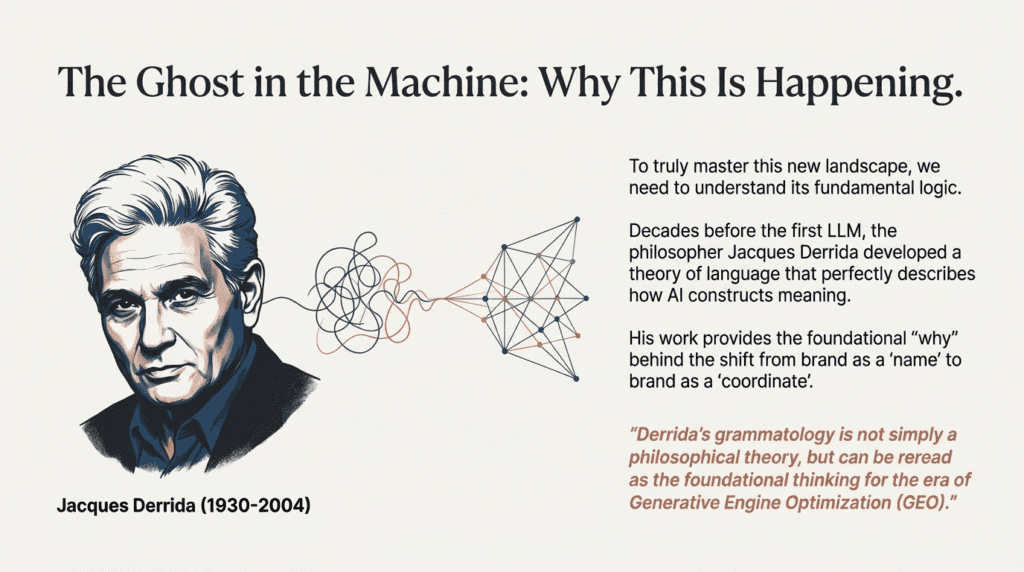
Why Derrida’s Insight Matters Now
To understand what is changing in branding today, we need to understand how meaning itself is being constructed. Long before AI existed, Jacques Derrida argued that meaning is not fixed or inherent, but created through context, relationships, and difference. That logic now closely mirrors how AI systems operate.
Large language models do not “understand” brands as names or identities. They calculate meaning by analyzing how a brand appears across situations, conditions, and associations. In this environment, a brand is no longer a label. It becomes a coordinate within a network of contexts.
This is why the shift from brand as a name to brand as a coordinate is not theoretical. It reflects how AI evaluates relevance. What matters is not what a brand claims to be, but how consistently it appears as the most logical and defensible answer in specific situations.
Seen this way, Derrida’s thinking becomes directly relevant to GEO. Generative Engine Optimization is not about persuasion or slogans. It is about shaping the conditions and signals through which AI computes meaning. AI does not replace branding. It makes its underlying mechanics visible.
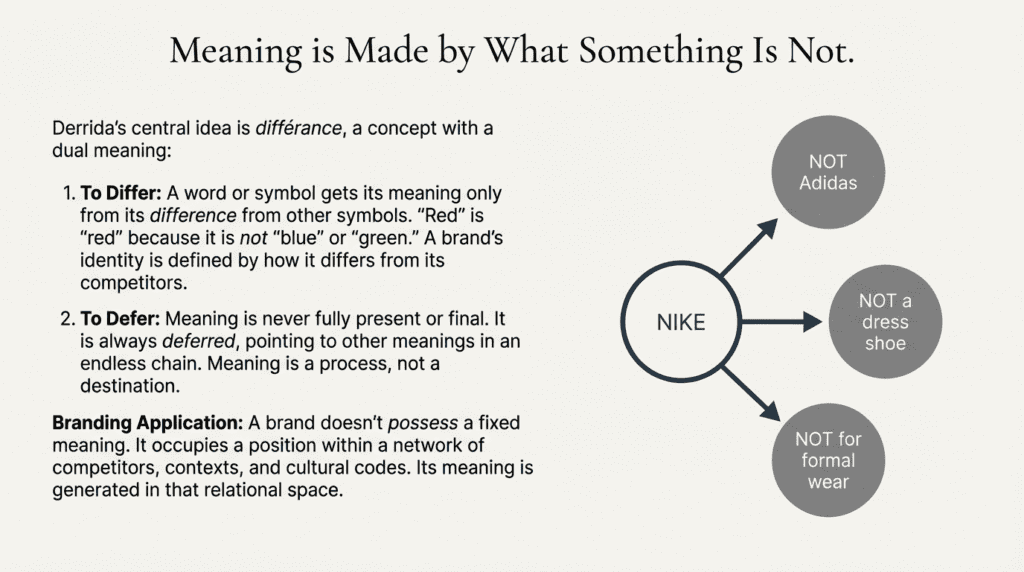
Meaning Is Created Through Difference and Deferral
Derrida’s core concept of différance carries two intertwined ideas. First, meaning is produced through difference. A brand is not defined in isolation, but through how it differs from competitors and alternatives. What a brand is becomes clear by what it is not.
Second, meaning is never complete or final. It is continuously deferred. A brand’s meaning does not crystallize at the moment a company declares it. Instead, it is repeatedly reinterpreted and reshaped each time consumers encounter the brand in a new situation, or Category Entry Point (CEP).
This reframes brand management as an ongoing operation rather than a one-time statement. A brand is not a fixed entity, but a flexible position within a broader network of competitors, contexts, and cultural codes. Each new situation a brand enters is not a risk to control, but an opportunity to expand and strengthen its position.
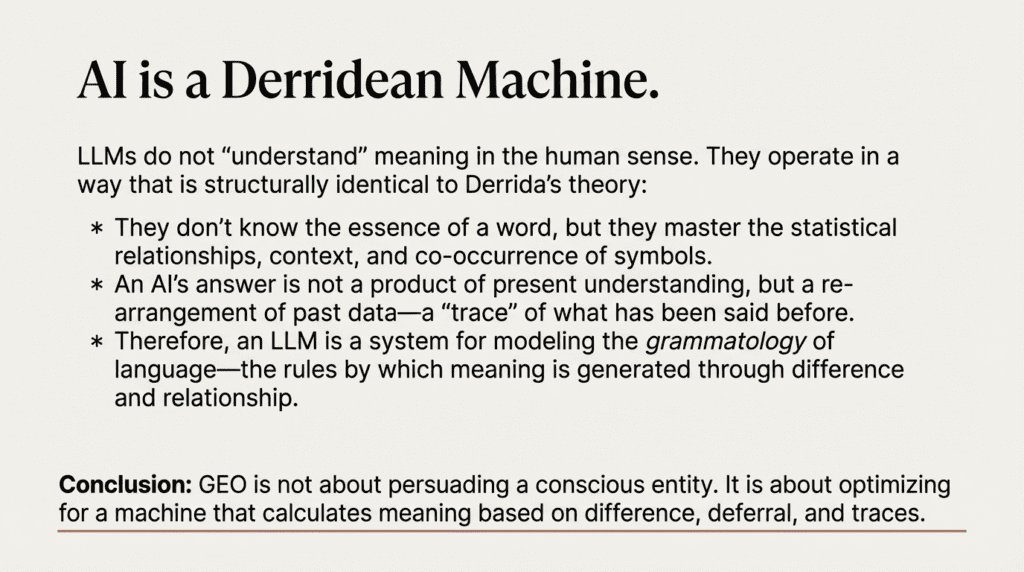
AI Is a Derridean Machine
Large language models do not understand meaning in a human sense. They do not grasp the essence of words. Instead, they operate by modeling statistical relationships between symbols: patterns of co-occurrence, context, and probability.
An AI’s response is not a moment of insight. It is a rearrangement of what has already been said before. Past data leaves traces, and the model recombines those traces to produce the most plausible answer for the present question. In this sense, an LLM does not define meaning; it calculates it.
This makes AI structurally aligned with Derrida’s view of language. Meaning emerges not from fixed definitions, but from difference and relationship within a system. GEO, therefore, is not about persuading a conscious mind. It is about positioning a brand correctly inside a machine that generates meaning by comparing, deferring, and relating signals.
Your Brand Is Not a Presence, but a Trace
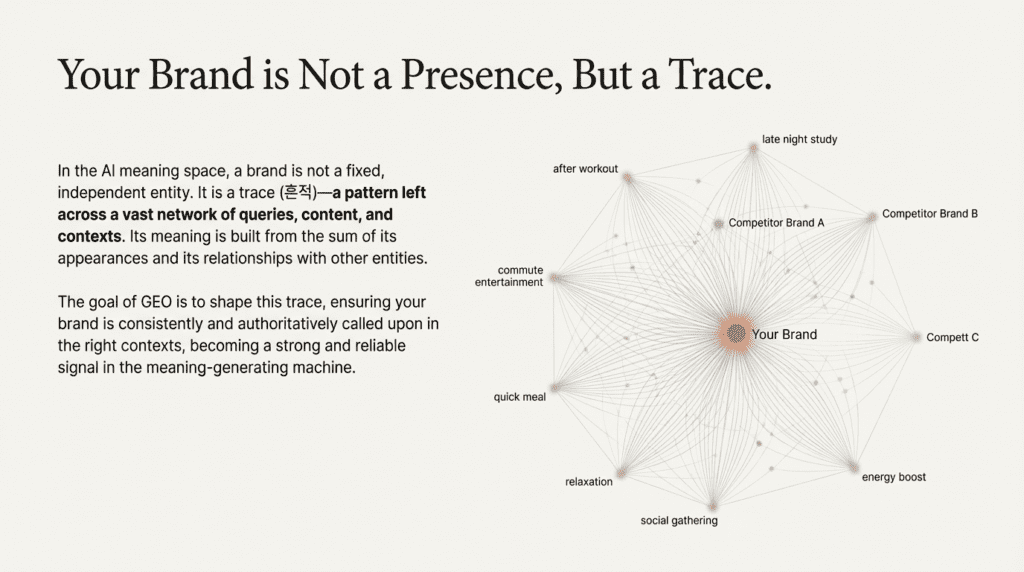
In the AI meaning space, a brand does not exist as a fixed or independent entity. It exists as a trace: a pattern left across a vast network of queries, content, and contexts. A brand’s meaning is not something it “has,” but something that is continuously formed by how often it appears, where it appears, and what it is connected to.
This means brand meaning is constructed in real time. It emerges from relationships: between topics, situations, competitors, and use cases. In this environment, a brand is no longer a message you control, but a signal you must manage.
The purpose of GEO is to deliberately shape these traces. By strengthening how and where a brand appears in relevant contexts, GEO ensures the brand is repeatedly and authoritatively summoned by the AI’s meaning-generation process. The stronger and more consistent the trace, the stronger the brand signal becomes.
A Three-Step Execution Framework for Growth
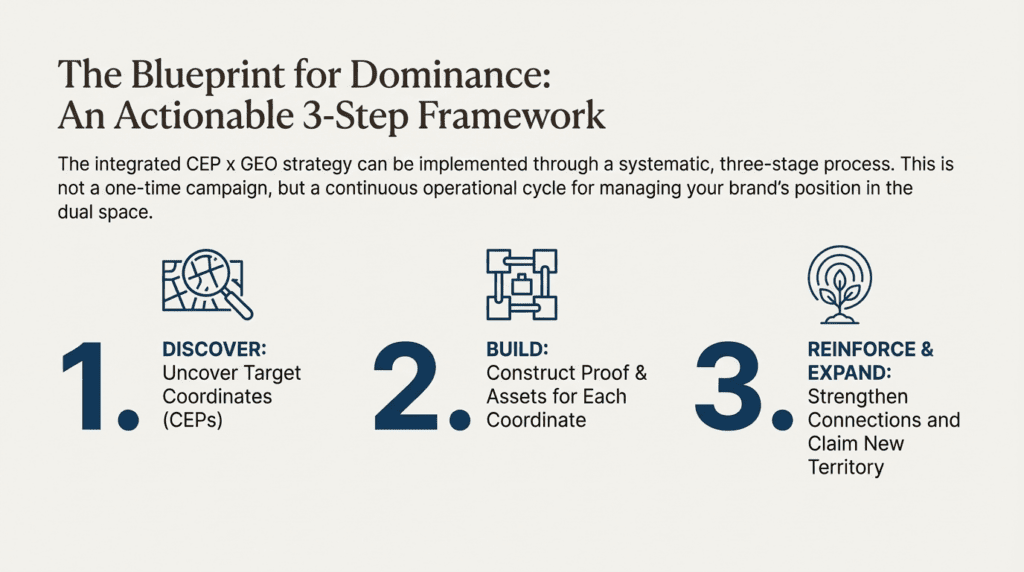
From these philosophical insights and technical realities, a clear execution framework emerges. This is not a one-time campaign, but a continuous operational cycle for managing and improving a brand’s position across the dual space of human memory and AI meaning.
The process begins by identifying the coordinates that truly matter: the Category Entry Points where non-customers start to consider the category. These CEPs define where growth is possible and where a brand must compete.
The second step is to build proof at those coordinates. This means constructing content, data structures, and brand assets that demonstrate clear authority and relevance within each chosen context. The goal is not visibility, but credibility—becoming the most defensible answer for that situation.
Finally, those connections must be continuously reinforced and expanded. As the brand strengthens its position in one context, it can move into adjacent CEPs, gradually extending its territory. Growth, in this model, is not linear. It is the cumulative result of owning more meaningful coordinates over time. Read on for more details on each step.
Step One: Discover Your Coordinates in the World of Non-Customers
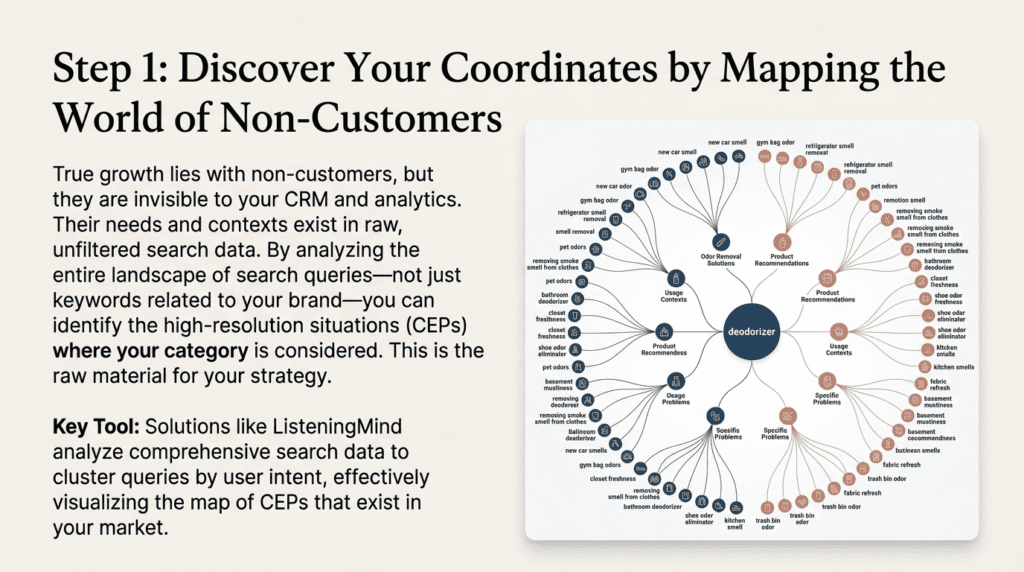
The greatest opportunities for growth are not found among existing customers, but among non-customers—people who do not yet think about your brand at all. These audiences rarely appear in CRM data or performance dashboards. Their real needs and tensions live in unfiltered search behavior.
To uncover them, brands must move beyond brand-related keywords and analyze the full landscape of queries where the category is being considered. Every question, hesitation, and comparison represents a potential Category Entry Point. When mapped at scale, these queries reveal clusters of intent that show how people actually enter the category.
Tools like ListeningMind make this possible by analyzing comprehensive search data and grouping queries by intent. The result is a high-resolution map of CEPs across the market. This map is not insight for insight’s sake—it is the raw material from which strategy is built.
Step Two: Build Proof for Each Coordinate
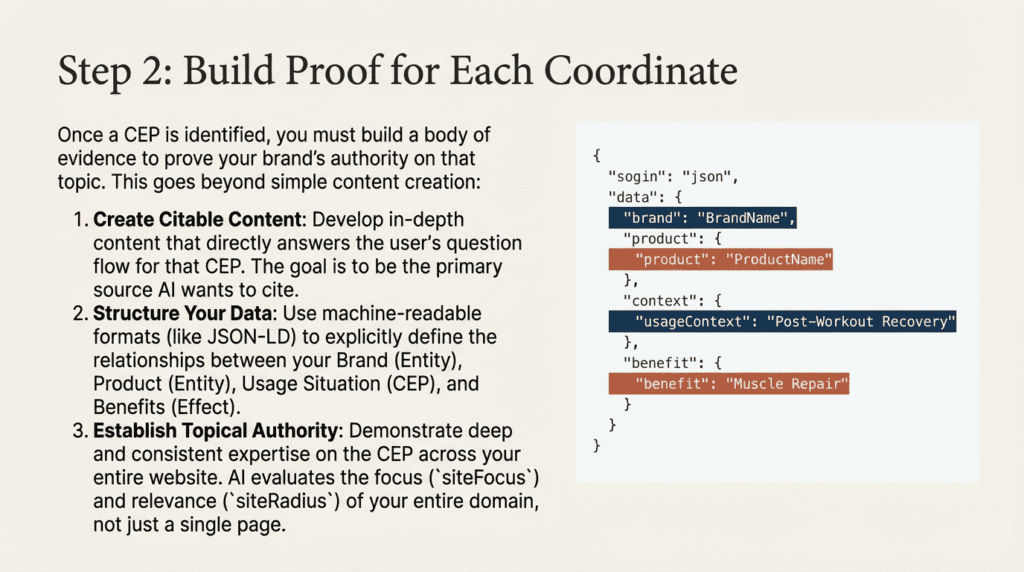
Once a target Category Entry Point (CEP) is defined, the next task is to prove that your brand deserves authority within that context. This goes far beyond producing large volumes of content. What matters is whether your content provides clear, direct, and citable answers that an AI can confidently rely on when constructing a response.
This requires depth, not breadth. Brands must develop content that fully resolves the user’s question within a specific situation, in a way that is logically structured and easy to reference. At the same time, technical structure matters. Using machine-readable formats such as JSON-LD allows you to explicitly define the relationships between your brand, products, usage situations, and benefits, making those connections legible to AI systems.
Most importantly, this is a cumulative effort. AI does not evaluate authority at the page level alone, but across the entire domain. Consistent focus, clarity, and relevance across your site signal expertise over time. In the AI era, proof is not claimed—it is demonstrated, repeatedly and coherently.
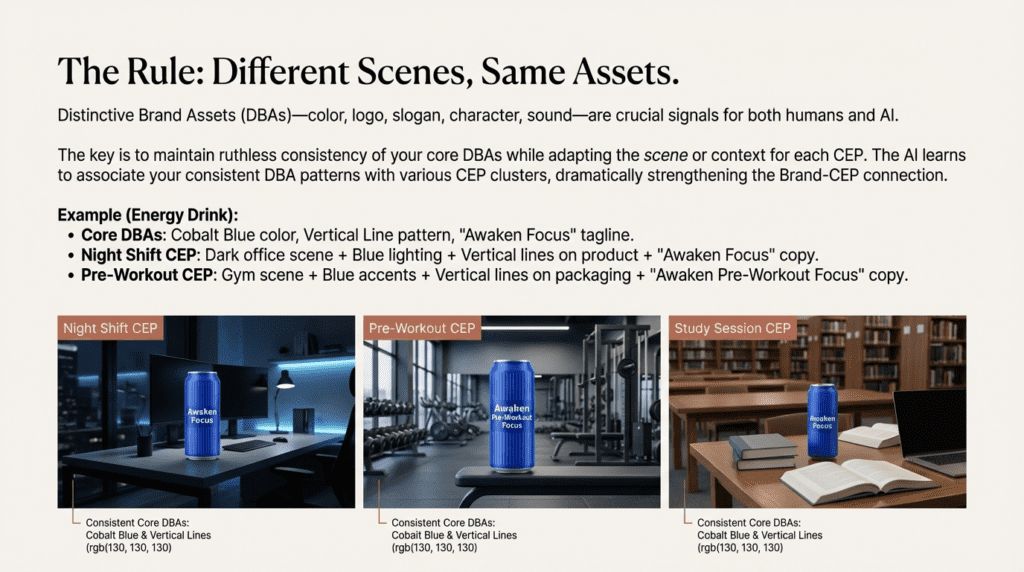
Principle: Different Situations, Consistent Signals
Branding fundamentals do not change, even as situations do. While the scene may shift from one context to another, the core signals a brand sends must remain consistent. Distinctive Brand Assets (DBAs) such as color, logo, slogan, and visual patterns are critical signals for both humans and AI.
The goal is not to repeat the same execution everywhere, but to preserve the same core assets across different Category Entry Points (CEPs). Whether the context is late-night work, pre-workout preparation, or focused study, the underlying brand patterns should remain unmistakable. This consistency gives AI a stable reference point, allowing it to learn strong and reliable connections between your brand and multiple CEP clusters.
Consistency does not limit creativity. Instead, it anchors recognition. By flexibly adapting the scene while rigorously protecting the brand core, you enable both humans and AI to recognize your brand instantly, regardless of context. In the AI era, adaptability wins only when it is built on ruthless consistency.
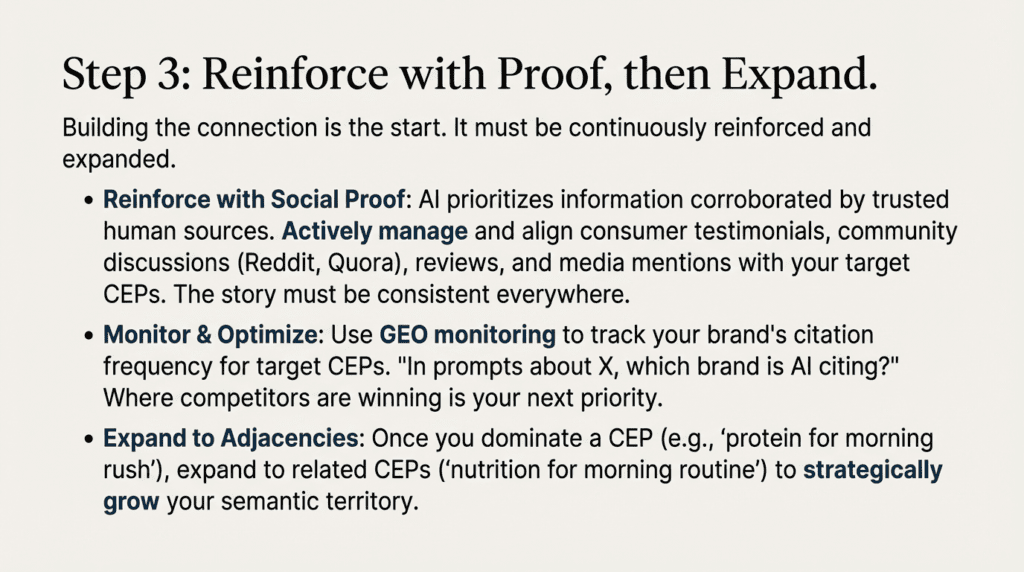
Step 3: Reinforce with Proof, Then Expand Your Territory
Creating the connection is only the beginning. That connection must be continuously reinforced. AI prioritizes information that is validated by credible human sources, which means social proof matters more than ever. Community discussions, media mentions, expert references, and real customer reviews should consistently align with your target CEPs. The story your brand tells must be the same wherever it appears.
Once reinforcement is in place, performance needs to be monitored. GEO is not static. You must track where your brand is cited, in which prompts, and for which situations. When competitors appear as the preferred answer in certain contexts, those gaps signal your next priorities.
Finally, growth comes from expansion. After securing authority in one CEP, the next move is to extend into adjacent contexts. If a brand becomes dominant in a situation like “busy morning breakfast,” it should naturally expand into nearby territory such as “nutrition for morning routines.” This is how brands systematically grow their semantic territory and remain visible as consumer situations evolve.
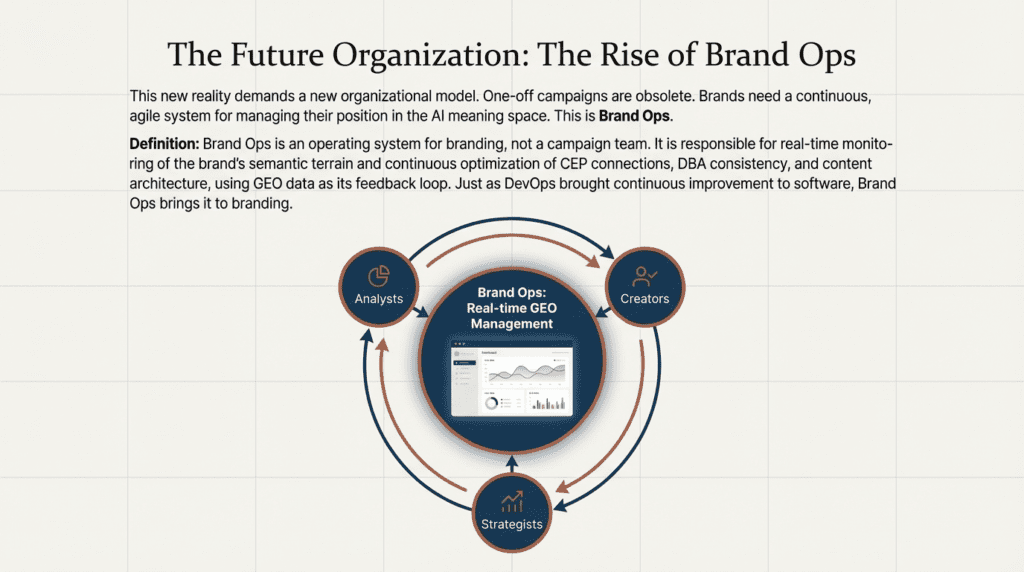
The Future Operating Model: Brand Ops
This shift does not only change strategy. It changes how marketing teams operate. The era of one-off campaigns is over. Brands now need a continuous system to monitor, manage, and optimize their semantic territory in real time. That system is Brand Ops.
Brand Ops is not a campaign function. It is an operating model for branding. Just as DevOps transformed software development by enabling continuous improvement, Brand Ops brings the same discipline to brand management. Analysts, strategists, and creators work together in a closed loop, using GEO data as ongoing feedback rather than post-campaign evaluation.
The goal is constant adjustment. Brand signals, CEP coverage, content structure, and authority are continuously measured and refined as AI behavior and consumer contexts evolve. In an AI-mediated market, brand success is no longer about launching campaigns. It is about running a living system that keeps your brand correctly positioned, day after day, inside the AI meaning space.
Conclusion: The Dual Space Is the New Marketplace
The nature of brand competition has fundamentally changed. The arena has shifted from names to coordinates, from awareness to context, and from being found to being summoned. What determines success is no longer how loudly a brand speaks, but how precisely it is positioned.
A brand’s future is no longer shaped by the strength or creativity of its messaging alone. It is shaped by how clearly it occupies meaningful coordinates across two spaces at once: human memory and AI’s meaning space. In this dual space, brands win not by broadcasting, but by becoming the most reliable answer in the moments that matter.
The integrated CEP and GEO framework outlined here is not a trend or a tactic. It is a blueprint for navigating this new marketplace. Brands that learn to operate within it will not simply adapt to change. They will define the next stage of competitive advantage.
Disclaimer: Notes for Readers
If parts of this essay felt uncomfortable or provocative, that reaction is worth addressing directly.
1. Top of Mind is not dead.
When this essay refers to “the end of Top of Mind dominance,” it does not mean that brand awareness in human memory no longer matters. Quite the opposite. Mental availability remains essential.
The point is that Top of Mind alone is no longer sufficient. In the AI era, it now has a counterpart: Top of Category Entry Point (CEP). Human memory and AI meaning space operate together. Branding must now succeed in both.
2. Brands are not disappearing.
Statements like “brands are disappearing” are intentionally provocative, but not literal. What is fading is the old mode of discovery, being found through search result pages.
As AI increasingly delivers direct answers, the interface has changed, not the value of brands. In fact, the role of branding becomes more demanding: brands must now be precise, explainable, and trustworthy enough to be cited by AI, not merely visible on a page.
Brands are not weakening. The requirements for relevance are becoming stricter.
3. Derrida is a metaphor, not a proof.
Connecting Derrida’s concept of différance to LLMs is not a philosophical claim of equivalence. Derrida did not anticipate AI, and this essay does not argue that LLMs “are” Derridean in a rigorous academic sense.
The comparison is used as a conceptual lens, a way to help marketers intuitively grasp how meaning is generated in AI systems: not as fixed essence, but through difference, relation, and accumulation over time.
The goal is practical insight, not philosophical precision.
4. Finally, this is not a finished answer.
CEP and GEO are still evolving frameworks. This essay is not a universal manual, but a directional map. How these ideas are applied will differ by category, market, and brand maturity.
If this piece helps you rethink how your brand competes in a world shaped by both human memory and AI meaning systems, then it has done its job.
Thank you for reading.
🚀 Understand how customers move from prompts to decisions. Explore ListeningMind with a free 7-day trial.