Index
There has been a wide range of skepticism about the usefulness of personas in marketing, product planning, and software design. Recently, as interest in the Jobs To Be Done (JTBD) framework has grown, these two approaches are often compared by those trying to clearly define and describe their target customers. However, neither framework is a complete replacement for the other, nor is it easy to do so. In practice, the wisest approach is to understand the strengths and limitations of each and use them appropriately, or even combine them when needed.
The Persona Framework
As we all know, the persona framework has been used for quite some time. While personas are often seen as stereotypical representations of consumers within a target segment (and are sometimes mistaken as originating from marketing and advertising), the concept actually began in 1988 with Alan Cooper at Microsoft. Cooper proposed personas as a way for software designers to better understand the goals of real system users by creating prototypes focused on usage objectives.
Like any tool, personas can be used well or misused. Since Alan Cooper’s time, many designers have failed to use personas properly, focusing only on demographic factors rather than needs, behaviors, and context. On the other hand, some companies have commissioned deep field research from social science-driven research firms to define personas based on solid insight. However, most product teams can’t wait for the results of such research and move forward with development anyway, so these reports rarely impact actual product or design decisions.
Typical Persona Template:
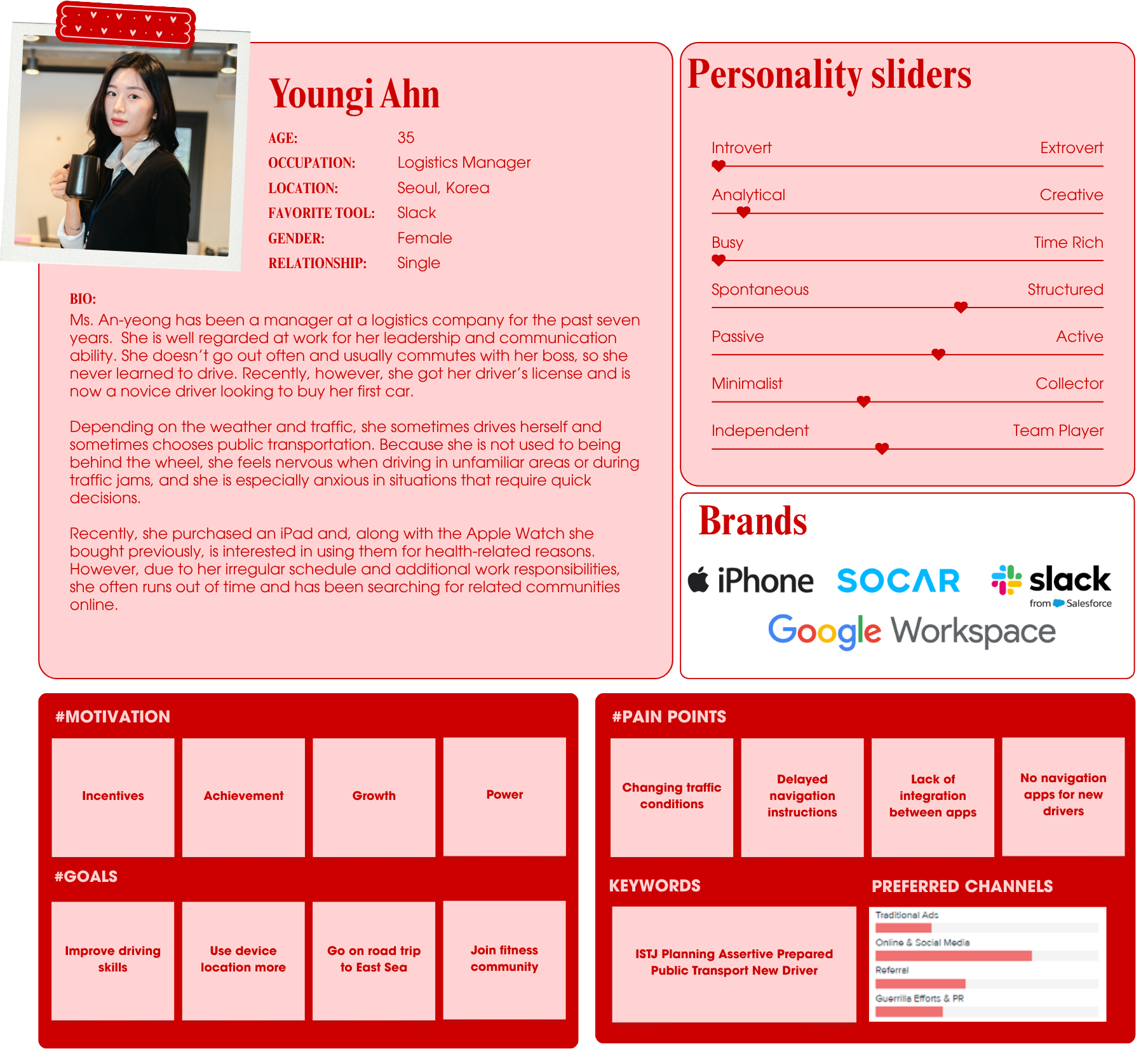
Five Limitations of the Persona Framework:
- Over-Simplification:
Personas often oversimplify the complex behaviors and needs of customers, missing the diversity of real-world patterns and contexts. - Irrelevant Data:
They tend to include unnecessary or irrelevant information that does little to guide actual product development or marketing strategy. - Abstract Needs and Behaviors:
Personas express customer needs and behaviors abstractly, making it difficult for teams to derive actionable insights. - Limited Practical Use:
Because personas don’t always reflect real customer needs and actions, they are often ignored within organizations. - Inconsistency Across Teams:
Different departments and projects may each create their own personas, leading to inconsistency in company-wide strategy and direction.
The Jobs To Be Done (JTBD) Framework:
Conceptualized and popularized by Clayton Christensen, JTBD was initially seen as a potential replacement for personas, addressing many of their shortcomings. The central question shifts from “Who is the customer?” to “Why do people ‘hire’ our product?” The famous JTBD slogan, “People don’t want a quarter-inch drill; they want a quarter-inch hole,” makes this distinction crystal clear.
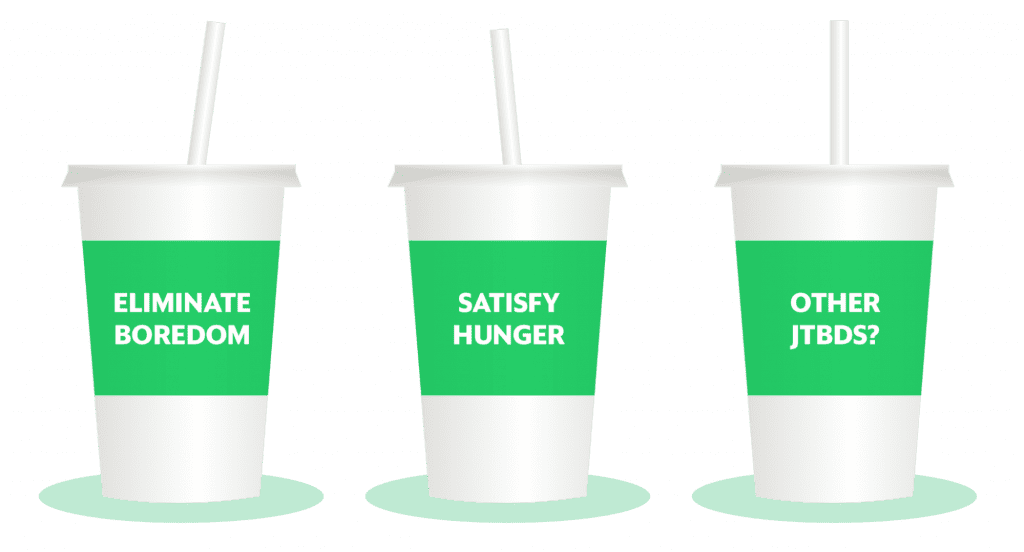
One of Christensen’s most famous JTBD case studies examined why Americans buy milkshakes at drive-thru windows in the morning. Through detailed interviews and observation, his team discovered that people “hire” milkshakes because they need something they can consume easily in the car, that keeps them occupied during a long commute, and isn’t messy or gone too quickly.
Milkshake JTBD Example:
Focusing solely on who the customer is via personas can actually make it harder to deeply understand the business problem and offer the right solution. Most persona profiling ends up stereotyping “who” the customer is, rather than focusing on what they’re actually trying to accomplish. By contrast, JTBD centers on the problem the user is trying to solve, leading to more actionable solutions.
The JTBD framework is a results-driven innovation process, designed to identify and solve customer pain points. It consists of clearly defined steps to evaluate customer needs and align company offerings accordingly.
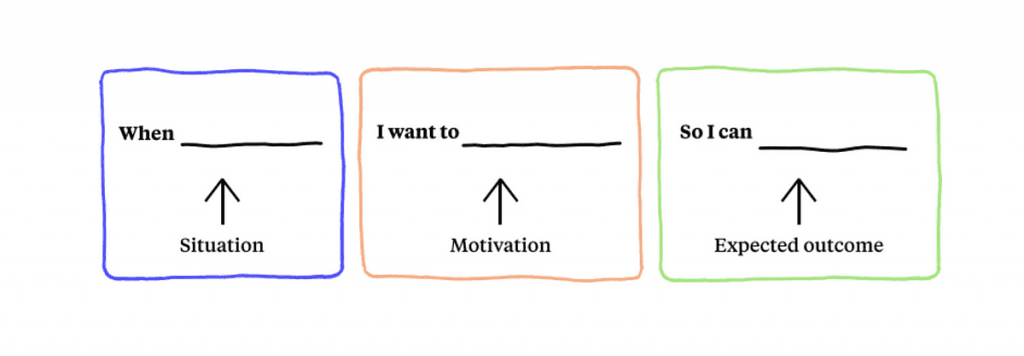
What Sets JTBD Apart? Traditional customer-centric operations tended to use the same old approaches. JTBD offers an alternative: a more direct and practical way to uncover customer motivation.
Why Are JTBD Principles Important? JTBD can be applied across a variety of fields: customer centricity, segmentation, marketing, competitive intelligence, innovation, and more.
How Can You Use JTBD Yourself? JTBD theory and practice are powerful tools for generating new ideas and improving your value proposition.
Business Logic of JTBD All your work is meaningless if it’s based only on assumptions or biased guesses about customers. That’s why investing in direct customer involvement is so critical.
JTBD, A Conclusion JTBD is still a young theory and methodology, but it focuses not on customer traits, but on the high-level jobs they’re trying to accomplish. This offers a new perspective on products, users, and competition. In practice, it combines well with familiar approaches like Design Thinking.
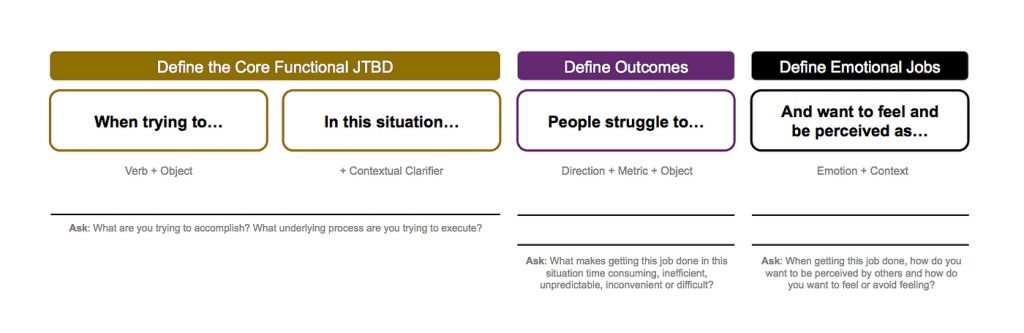
Connecting Personas and JTBD
Both frameworks aim to help us understand customers and deliver the best solutions. However, personas have lost effectiveness as they try to describe “who” the customer is in ever-greater detail, while JTBD has proven more useful for marketing by focusing on real needs and desired outcomes.
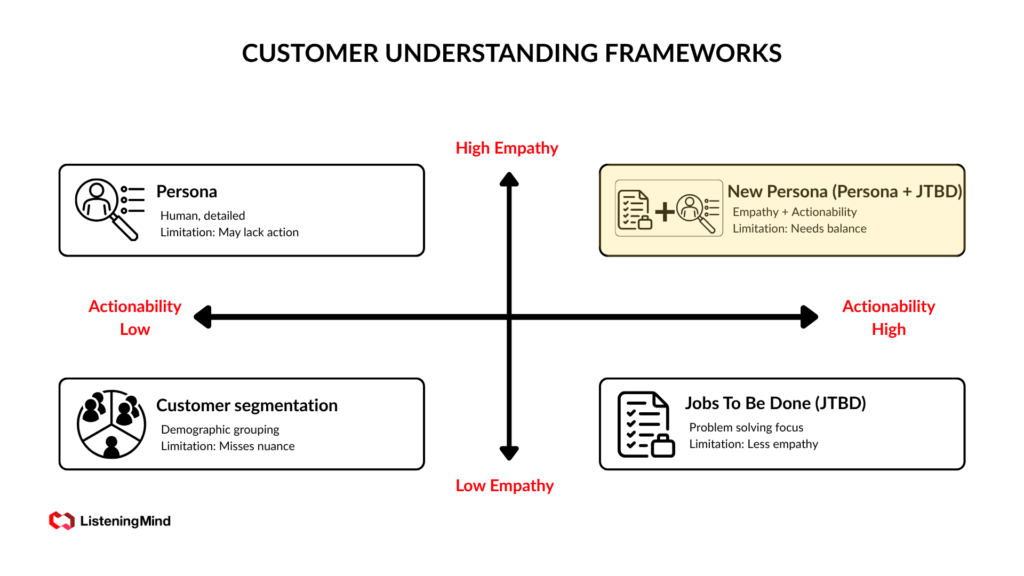
By wisely combining the strengths of JTBD and personas, you go beyond merely describing customer traits, and start to reflect their real “jobs” or goals. This new persona provides all relevant teams with a clear view not just of who uses your product or service, but also the challenges or goals they are ultimately trying to achieve. JTBD helps you map out all the possible ways a consumer might try to achieve their objective—compensating for the limits of classic persona frameworks.
This is where tools like ListeningMind can play a vital role. By analyzing customer search sequences and results pages, you can uncover more nuanced insights into their intent and needs. Such analysis greatly enhances the resolution of your JTBD. Understanding which search terms customers use, what information they seek, and what decisions they ultimately make enables you to create a new, integrated persona—combining JTBD and persona frameworks for a more effective marketing strategy.
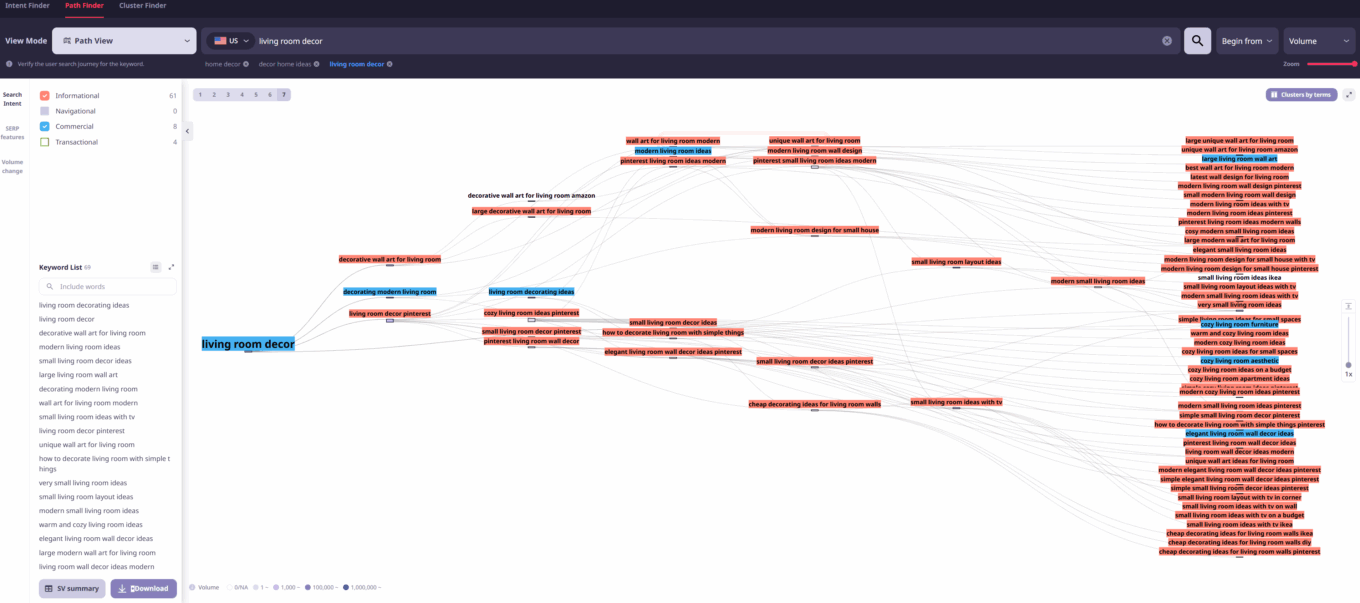
For example, using ListeningMind’s Path Finder, you might analyze search patterns related to “living room decor” and notice a clear behavioral transition. Users begin by looking for design inspiration and style ideas, then narrow their focus to specific products like wall art. This demonstrates a multi-stage JTBD progression — from exploring how to decorate to deciding what to buy.
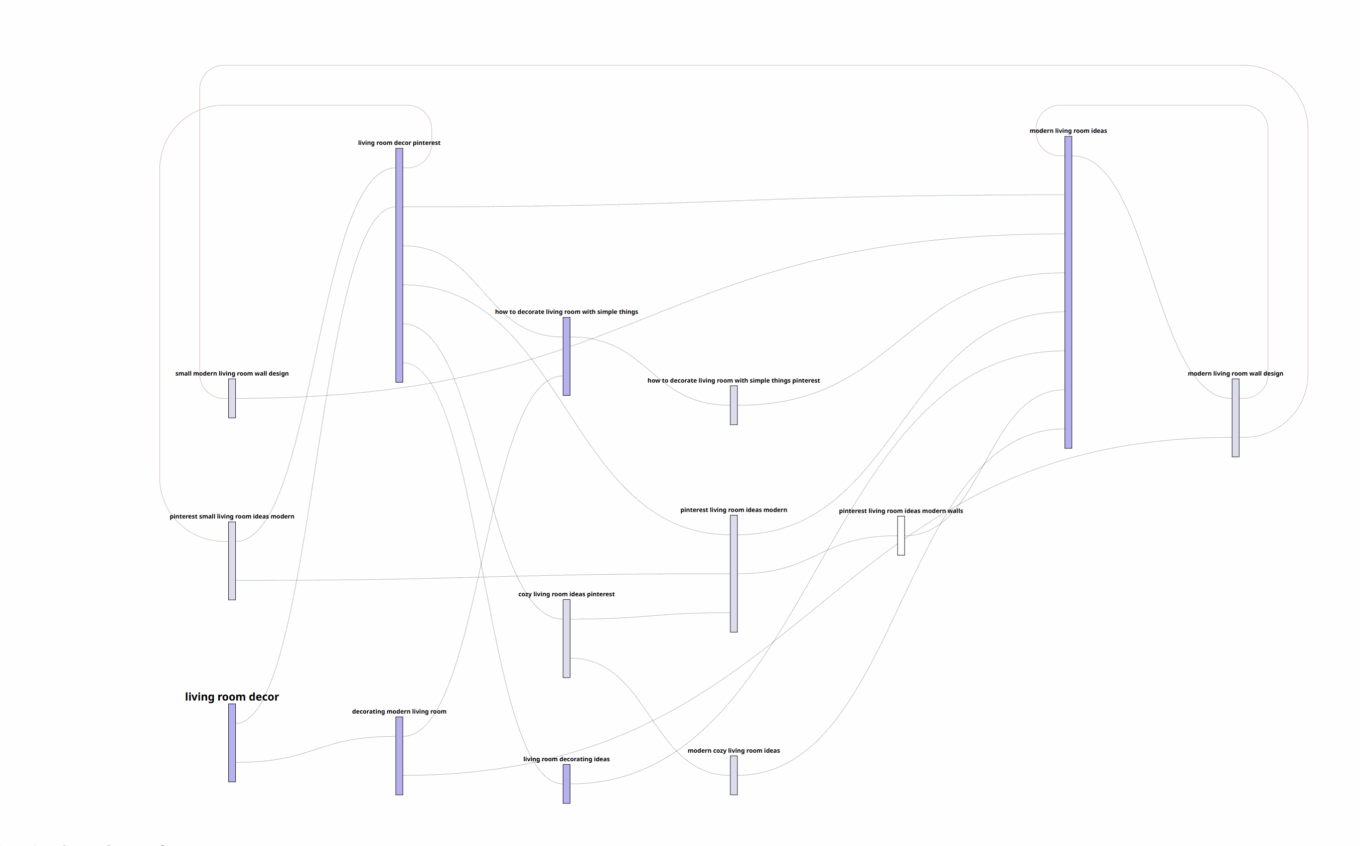
Building on this, ListeningMind’s Roadview provides a more detailed view of how intent evolves. For “living room decor,” it shows users moving from broad inspiration to actionable “how-to” searches, revealing the moment when curiosity turns into intent — the core transition in the JTBD journey.
Finally, using ListeningMind’s Cluster Finder, we can identify distinct behavioral communities behind these search patterns. For “wall art decor,” users group into clusters around style identity, practicality, and affordability, revealing the contextual personas that complete the JTBD picture.
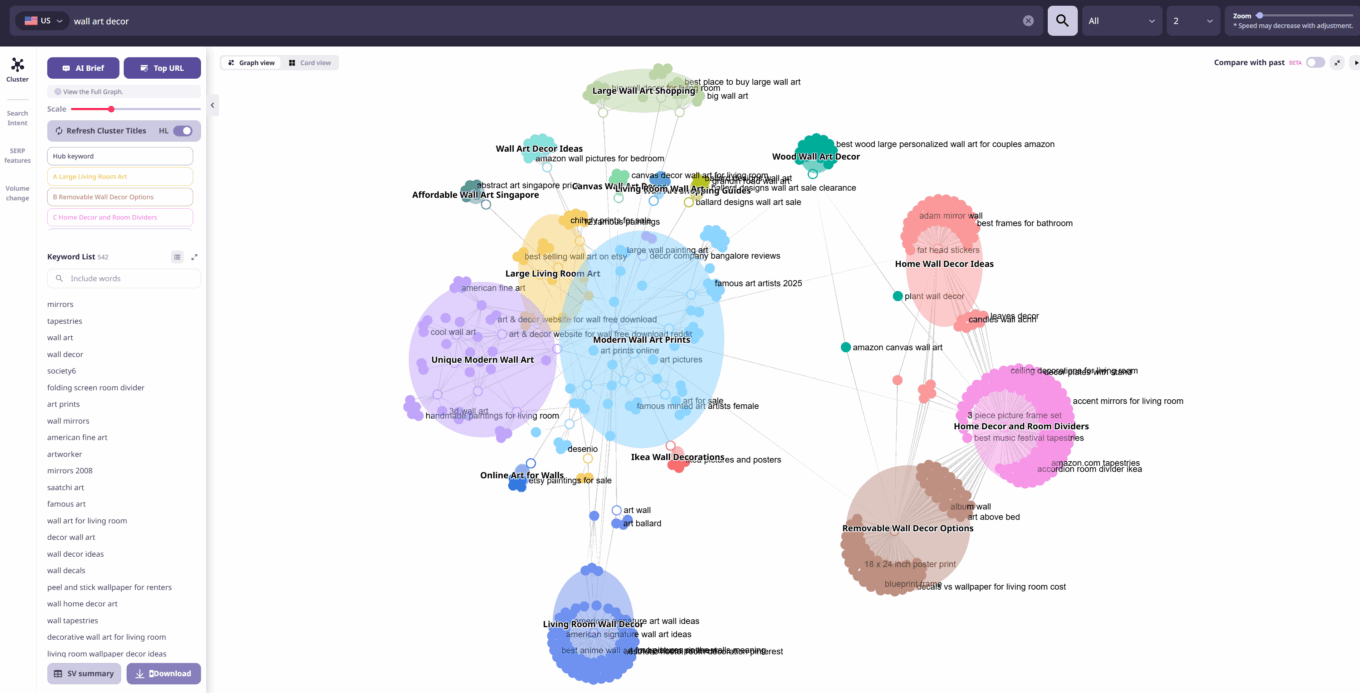
Together, these analyses demonstrate how ListeningMind’s tools can uncover the full consumer journey , from search motivation to contextual segmentation. Path Finder and Roadview reveal how users progress from broad inspiration to actionable intent, while Cluster Finder highlights the distinct motivations and personas that drive these behaviors. By connecting JTBD and persona frameworks, marketers can move beyond demographics to understand what truly shapes consumer decisions, the goals, constraints, and emotions behind every search.
Conclusion:
Both JTBD and personas offer unique advantages. Personas help you understand customer characteristics and behaviors in detail. JTBD, on the other hand, lets you deeply explore the real reasons customers use your product or service. By adopting an integrated approach, a “New Persona” that combines the two, you can more accurately understand and reflect your customers’ needs and actions. This is why I refer to an upgraded, JTBD-infused persona framework as the “New Persona.”
A unified customer understanding framework like the New Persona is becoming indispensable for developing and executing truly customer-centric business strategies. Integrated use of JTBD and personas will enable your company to quickly understand your customers, develop products ahead of the competition, and continually improve customer satisfaction.